Common Name: MINT FAMILY Habit: Annual to shrub [tree, vine], glabrous to hairy, generally aromatic. Stem: generally erect, generally 4-angled. Leaf: generally simple to deeply lobed, generally opposite, generally gland-dotted. Inflorescence: generally cymes, generally many in dense axillary clusters surrounding stem, generally separated by evident internodes or collectively crowded, spike- or panicle-like, occasionally head-like or raceme, subtended by leaves or bracts; flowers sessile or pedicelled. Flower: generally bisexual; calyx generally 5-lobed, radial to bilateral; corolla generally bilateral, 1--2-lipped, upper lip entire or 2-lobed, +- flat to hood-like, occasionally 0, lower lip generally 3-lobed; stamens generally 4, epipetalous, generally exserted, paired, pairs generally unequal, occasionally 2, staminodes 2 or 0; ovary superior, generally 4-lobed to base chambers 2, ovules 2 per chamber, style 1, generally arising from center at junction of lobes, stigmas generally 2. Fruit: generally 4 nutlets, generally ovoid to oblong, smooth. Genera In Family: +- 230 genera, 7200 species: worldwide. Many cultivated for herbs, oils (Lavandula, lavender; Mentha, mint; Rosmarinus, rosemary; Thymus, thyme), some cultivated as ornamental (in California Cedronella, Leonotis, Monarda, Phlomis). Note:Moluccella laevis L., shell flower, historical waif in California. Satureja calamintha (L.) Scheele subsp. ascendens (Jordan) Briq. reported as alien but not naturalized. Salazaria moved to Scutellaria; California Hyptis moved to Condea, California Satureja moved to Clinopodium. eFlora Treatment Author: Dieter H. Wilken & Margriet Wetherwax, family description, key to genera, except as noted Scientific Editor: Douglas H. Goldman, Bruce G. Baldwin.
Habit: Perennial herb to shrub, decumbent to erect, < 2 m, aromatic. Leaf: petioled; blade generally ovate-deltate, base rounded to tapered, margin entire to shallowly crenate-dentate, lower surface generally gland-dotted. Inflorescence: flowers 1--several in leaf axils. Flower: calyx 5-lobed, 2-lipped; corolla 5-lobed, white to lavender or salmon, 2-lipped, lower lip spreading, upper erect, 2-lobed; stamens 4, in 2 pairs, anther sacs spreading; style 2-lobed, exserted. Fruit: 1--2 mm; surface smooth to net-like. Etymology: (Latin: savory) Note:Clinopodium hortensis Kuntze cultivated as herb (summer savory). eFlora Treatment Author: Margriet Wetherwax & John M. Miller Reference: Cantino & Wagstaff 1998 Brittonia 50:63--70
Clinopodium douglasii (Benth.) Kuntze
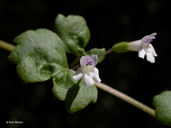
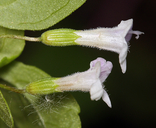
NATIVE Habit: Perennial herb, decumbent, forming mats < 1 m wide. Stem: +- woody, occasionally rooting; hairs sparse, minute, recurved. Leaf: 10--35 mm, 5--25 mm wide, ovate to ovate-triangular, shallowly crenate-dentate; hairs sparse, minute. Inflorescence: flowers 1(3) per leaf axil; pedicel 5--20 mm. Flower: calyx 4--5 mm, tubular, purple in age, lobes +- 0.5 mm; corolla 3--8 mm, white to lavender. Fruit: +- 1 mm, shiny brown, smooth. Ecology: Shady places, chaparral, woodland; Elevation: < 900 m. Bioregional Distribution: NW, n SNH, CW, SW; Distribution Outside California: to British Columbia, Idaho. Flowering Time: Apr--Sep Synonyms: Satureja douglasii (Benth.) Briq. Jepson eFlora Author: Margriet Wetherwax & John M. Miller Reference: Cantino & Wagstaff 1998 Brittonia 50:63--70 Index of California Plant Names (ICPN; linked via the Jepson Online Interchange) Previous taxon: Clinopodium chandleri Next taxon: Clinopodium mimuloides
Botanical illustration including Clinopodium douglasii
Citation for this treatment: Margriet Wetherwax & John M. Miller 2012, Clinopodium douglasii, in Jepson Flora Project (eds.) Jepson eFlora, https://ucjeps.berkeley.edu/eflora/eflora_display.php?tid=80483, accessed on April 26, 2024.
Citation for the whole project: Jepson Flora Project (eds.) 2024, Jepson eFlora, https://ucjeps.berkeley.edu/eflora/, accessed on April 26, 2024.
MAP CONTROLS 1. You can change the display of the base map layer control box in the upper right-hand corner.
2. County and Jepson Region polygons can be turned off and on using the check boxes.
(Note: any qualifiers in the taxon distribution description, such as 'northern', 'southern', 'adjacent' etc., are not reflected in the map above, and in some cases indication of a taxon in a subdivision is based on a single collection or author-verified occurence).
Data provided by the participants of the
Consortium of California Herbaria.
MAP LEGEND View all CCH records All markers link to CCH specimen records. The original determination is shown in the popup window.
Blue markers indicate specimens that map to one of the expected Jepson geographic subdivisions (see left map). Purple markers indicate specimens collected from a garden, greenhouse, or other non-wild location.
Yellow markers indicate records that may provide evidence for eFlora range revision or may have georeferencing or identification issues.
READ ABOUT YELLOW FLAGS
CCH collections by month
Duplicates counted once; synonyms included.
Species do not include records of infraspecific taxa, if there are more than 1 infraspecific taxon in CA.
Blue line denotes eFlora flowering time (fruiting time in some monocot genera).