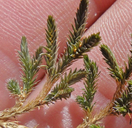
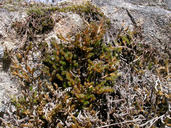
Common Name: SPIKE-MOSS FAMILY Stem: wiry, generally rooting adventitiously [or not] from downward-growing leafless shoot-like structures (rhizophores), branching variable, generally not fragile when dry. Leaf: many, simple, overlapped, appressed, small, +- scale-like, 1-veined, generally grooved abaxially [or not] nearly to tip, generally +- of 2 kinds ("under-leaves" under main stem, "over-leaves" over it). Cone: paired or 1, terminal, generally 4-sided, fertile leaves not like sterile, generally strongly keeled. Sporangia: 1 per leaf axil, 2 kinds, male (generally more distal in cones, spores many, small), female (spores (1)4, large, generally orange-yellow). Genera In Family: 1 genus, +- 700 species: worldwide, generally tropics, warm temperate. Note: Despite recent progress in understanding relationships (Zhou et al. 2016 Cladistics 32:360--389; Weststrand & Korall 2016 Amer J Bot 103:2136--2159), future taxonomic changes in the family are likely. eFlora Treatment Author: Paul Wilson & Thomas J. Rosatti Scientific Editor: Alan R. Smith, Thomas J. Rosatti, Bruce G. Baldwin.
Etymology: (Latin: small Selago, ancient name for some Lycopodium) Note: Some cultivated as groundcover, curiosity: Selaginella kraussiana; Selaginella lepidophylla (Hook. & Grev.) Spring, resurrection plant. Hand lens, generally at +- 20×, required for leaves (shape, margin, awn at tip), cones. Unabridged Note: All native California taxa are in the Rupestrae clade (Weststrand & Korall 2016 Amer J Bot 103:2160--2169), also treated as section Homoeophyllae (Zhou et al. 2015 Taxon 64:1117--1140) or, formerly, the nomenclaturally ambiguous subgenus Tetragonostachys (Jermy 1986 Fern Gazette 13:117--118). Selaginella shared a common ancestor with Isoetes, +- 380 million years ago (Larsén & Rydin 2016 Int J Pl Sci 177:157--174).
Selaginella wallacei Hieron.
NATIVE Habit: Plant mat-forming in sun, to elongate-creeping with sterile shoot internodes often > 7 mm in shade; green aging tan then gray. Leaf: of main stems 1.4--2.5 mm, 0.3--0.7 mm wide, lanceolate, generally not decurrent, color unlike brown of stem, base glabrous, tips of leaves of sterile stems thickened around end of abaxial groove; awn 0.2--0.5(0.9) mm, rigid, +- toothed. Cone: often paired, 10--45(90) mm. Ecology: Rocky outcrops, open to shady, dry to moist sites, chaparral to mixed-evergreen forest; Elevation: < 1820 m. Bioregional Distribution: NW, CaRF, n SNF (Butte Co.), n SNH, n SnFrB (Marin Co.); Distribution Outside California: to British Columbia, Montana. Note: In shady conditions, can have elongate branches and resemble rock-dwelling forms of S. oregana; both species often have particularly long cones. Jepson eFlora Author: Paul Wilson & Thomas J. Rosatti Index of California Plant Names (ICPN; linked via the Jepson Online Interchange) Previous taxon: Selaginella scopulorum Next taxon: Selaginella watsonii
Botanical illustration including Selaginella wallacei
Citation for this treatment: Paul Wilson & Thomas J. Rosatti 2012, Selaginella wallacei, in Jepson Flora Project (eds.) Jepson eFlora, https://ucjeps.berkeley.edu/eflora/eflora_display.php?tid=44093, accessed on April 26, 2024.
Citation for the whole project: Jepson Flora Project (eds.) 2024, Jepson eFlora, https://ucjeps.berkeley.edu/eflora/, accessed on April 26, 2024.
Geographic subdivisions for Selaginella wallacei:
NW, CaRF, n SNF (Butte Co.), n SNH, n SnFrB (Marin Co.)
MAP CONTROLS 1. You can change the display of the base map layer control box in the upper right-hand corner.
2. County and Jepson Region polygons can be turned off and on using the check boxes.
(Note: any qualifiers in the taxon distribution description, such as 'northern', 'southern', 'adjacent' etc., are not reflected in the map above, and in some cases indication of a taxon in a subdivision is based on a single collection or author-verified occurence).
Data provided by the participants of the
Consortium of California Herbaria.
MAP LEGEND View all CCH records All markers link to CCH specimen records. The original determination is shown in the popup window.
Blue markers indicate specimens that map to one of the expected Jepson geographic subdivisions (see left map). Purple markers indicate specimens collected from a garden, greenhouse, or other non-wild location.
Yellow markers indicate records that may provide evidence for eFlora range revision or may have georeferencing or identification issues.
READ ABOUT YELLOW FLAGS
CCH collections by month
Duplicates counted once; synonyms included.
Species do not include records of infraspecific taxa, if there are more than 1 infraspecific taxon in CA.
Blue line denotes eFlora flowering time (fruiting time in some monocot genera).