Common Name: LEGUME FAMILY Habit: Annual to tree. Leaf: generally alternate, generally compound, generally stipuled, generally entire, pinnately veined Inflorescence: generally raceme, spike, umbel or head; or flowers 1--few in axils. Flower: generally bisexual, generally bilateral; hypanthium 0 or flat to tubular; sepals generally 5, generally fused; petals generally 5, free, fused, or lower 2 +- united into keel (see 3, Key to Groups, for banner, wings); stamens 10 or many (or [1], 5, 6, 7, 9), free or fused or 10 with 9 filaments at least partly fused, 1 (uppermost) free; pistil 1, ovary superior, generally 1-chambered, ovules 1--many, style, stigma 1. Fruit: legume, including a stalk-like base (above receptacle) or not. Seed: 1--many, often +- reniform, generally hard, smooth. Genera In Family: +- 730 genera, 19400 species: worldwide; with grasses, requisite in agriculture, most natural ecosystems. Many cultivated, most importantly Arachis, peanut; Glycine, soybean; Phaseolus, beans; Medicago, alfalfa; Trifolium, clovers; many orns. Note: Unless stated otherwise, fruit length including stalk-like base, number of 2° leaflets is per 1° leaflet. Upper suture of fruit adaxial, lower abaxial. Anthyllis vulneraria L. evidently a waif, a contaminant of legume seed from Europe. Laburnum anagyroides Medik., collected on Mount St. Helena in 1987, may be naturalized. Ceratonia siliqua L., carob tree (Group 2), differs from Gleditsia triacanthos L. in having evergreen (vs deciduous) leaves that are 1-pinnate (vs 1-pinnate on spurs on old stems, 2-pinnate on new stems) with 2--5(8) (vs 7--17) 1° leaflets, commonly cultivated, now naturalized in southern California. Aeschynomene rudis Benth. , Halimodendron halodendron (Pall.) Voss (possibly extirpated), Lens culinaris Medik. are agricultural weeds. Caragana arborescens Lam. only cult. Ononis alopecuroides L. , Sphaerophysa salsula (Pall.) DC. all evidently extirpated. Cercidium moved to Parkinsonia; Chamaecytisus to Cytisus; Psoralidium lanceolatum to Ladeania. eFlora Treatment Author: Martin F. Wojciechowski, except as noted Scientific Editor: Martin F. Wojciechowski, Thomas J. Rosatti.
Common Name: LOTUS Habit: Perennial herb, unarmed. Leaf: odd-1-pinnate; stipules scarious or leaflet-like, fragile or not, early-deciduous; leaflets 3--15, often +- opposite. Inflorescence: several-flowered umbel or 1--2-flowered, axillary, generally peduncled, often bracted. Flower: corolla yellow, white, or pink, fading darker; 9 filaments fused, 1 free. Fruit: dehiscent, exserted from calyx, linear to oblong, +- beaked. Seed: few--several. Etymology: (D. Hosack, New York physician, botanist, mineralogist, 1769--1835) Note: Pollen apertures 3. Intermediates may be hybrids. eFlora Treatment Author: Luc Brouillet Reference: Brouillet 2008 J Bot Res Inst Texas 2:387--394 Unabridged Reference: Isely 1981 Mem New York Bot Gard 25:128--206
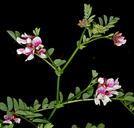
Habit: Generally spreading soft-hairy, glandular or not. Stem: generally erect, 1.5--5(10) dm. Leaf: stipules often wide, leaflet-like, persistent, in age reduced, scarious or not; leaflets 9--15, 5--20 mm, oblong to ovate. Inflorescence: 4--9-flowered; peduncle bract well below umbel, (1)3(7)-parted, small. Flower: calyx 5--6.5 mm, lobes < tube; corolla 10--12 mm, pink to red-purple, claw exserted from calyx tube. Fruit: 2--2.5 cm, 3--4 mm wide, widely oblong, +- hairy to +- glabrous. Seed: many. Note: Varieties geographically distinct.
Hosackia stipularis Benth. var. ottleyi (Isely) Brouillet
Citation for this treatment: Luc Brouillet 2012, Hosackia stipularis var. ottleyi, in Jepson Flora Project (eds.) Jepson eFlora, https://ucjeps.berkeley.edu/eflora/eflora_display.php?tid=91762, accessed on April 18, 2024.
Citation for the whole project: Jepson Flora Project (eds.) 2024, Jepson eFlora, https://ucjeps.berkeley.edu/eflora/, accessed on April 18, 2024.
MAP CONTROLS 1. You can change the display of the base map layer control box in the upper right-hand corner.
2. County and Jepson Region polygons can be turned off and on using the check boxes.
(Note: any qualifiers in the taxon distribution description, such as 'northern', 'southern', 'adjacent' etc., are not reflected in the map above, and in some cases indication of a taxon in a subdivision is based on a single collection or author-verified occurence).
Data provided by the participants of the
Consortium of California Herbaria.
MAP LEGEND View all CCH records All markers link to CCH specimen records. The original determination is shown in the popup window.
Blue markers indicate specimens that map to one of the expected Jepson geographic subdivisions (see left map). Purple markers indicate specimens collected from a garden, greenhouse, or other non-wild location.
Yellow markers indicate records that may provide evidence for eFlora range revision or may have georeferencing or identification issues.
READ ABOUT YELLOW FLAGS
CCH collections by month
Duplicates counted once; synonyms included.
Species do not include records of infraspecific taxa, if there are more than 1 infraspecific taxon in CA.
Blue line denotes eFlora flowering time (fruiting time in some monocot genera).