Common Name: MORNING-GLORY FAMILY Habit: Annual, perennial herb, subshrub, generally twining or trailing. Leaf: 0 or alternate. Inflorescence: cyme or flowers 1 in axils; bracts subtending flowers 0 or 2. Flower: bisexual, radial; sepals (4)5, +- free, overlapping, persistent, often unequal; corolla generally showy, generally bell-shaped, +- shallowly 5-lobed, generally pleated and twisted in bud; stamens 5, epipetalous; pistil 1, ovary superior, chambers generally 2, each generally 2-ovuled, styles 1--2. Fruit: generally capsule. Seed: 1--4(6). Genera In Family: 55--60 genera, 1600--1700 species: warm temperate to tropics; some cultivated for food or as ornamental (Ipomoea). Note: Monophyletic only if Cuscutaceae included, as treated here. Ipomoea cairica (L.) Sweet, Ipomoea hederacea Jacq. [Ipomoea nil L., misappl.], Ipomoea indica (Burm.) Merr. (including Ipomoea mutabilis Ker Gawl.), Ipomoea purpurea (L.) Roth, Ipomoea triloba L., all included in TJM (1993), not naturalized. eFlora Treatment Author: Robert E. Preston, except as noted Scientific Editor: Thomas J. Rosatti.
Common Name: DODDER Habit: Vine, annual (perennial herb if on perennial host), not in contact with ground, attached to, holoparasitic on host by many small, specialized roots (haustoria) along stem, generally glabrous. Stem: thread-like, +- green, yellow, orange, or +- red. Leaf: 0 or scale-like, alternate, +- 2 mm. Inflorescence: generally cyme, head- to panicle-like (flowers 1), subtended by 0--3 bracts. Flower: bisexual, radial, parts generally in 4s or 5s; calyx generally divided 2/5--3/5, persistent, generally +- cream-white; corolla generally +- white, persistent (withered in fruit) or not, tube cup-shaped to cylindric, bulged or horizontally ridged below lobes or generally not, generally with scales subtending stamens, lobes alternate stamens, erect to reflexed; ovary superior, chambers 2, each 2-ovuled, styles 2, generally free, persistent, stigmas 2, generally spheric, persistent. Fruit: capsule, generally indehiscent to irregularly dehiscent (or circumscissile near base), spheric to ovoid, depressed or not, thickened and/or raised around generally inconspicuous opening between styles or not. Seed: 1--4; coat papillate when hydrated, honeycombed when dry, (rarely neither, with cells +- rectangular, in +- jigsaw-puzzle-like arrangement); embryo generally slender, 1--3-coiled. Etymology: (Aramaic, Hebrew; from the verb K-S-Y (Kaph, Shin, Yodh), to cover, from habit) Note: By persistent, withered corolla, fruit may be "capped" (corolla on top of fruit), "surrounded" (fruit at least in part visible, corolla +- loosely around fruit), or "enclosed" (fruit not visible, corolla +- tightly around fruit). Cuscuta pentagona Engelm. excluded. eFlora Treatment Author: Mihai Costea & Saša Stefanović Reference: Costea & Stefanovic 2009 Syst Bot 34:570--579 Unabridged Reference: Costea et al. 2005 Brittonia 57:264--272; Costea et al. 2006 Sida 22:151--175, 177--195, 197--207, 209--225; Costea & Stefanovic 2009. Cuscuta jepsonii (Convolvulaceae), an invasive weed or an extinct endemic? Amer J Bot 96:1744--1750; Costea et al. 2009. Untangling the systematics of salt marsh dodders: Cuscuta pacifica a new segregate species from Cuscuta salina (Convolvulaceae). Syst Bot 34:787--795; Costea & Stefanovic. 2009. Molecular phylogeny of Cuscuta californica complex (Convolvulaceae) and a new species from New Mexico and Trans-Pecos. Syst Bot 34:570--579; Costea & Tardif 2006 Canad J Pl Sci 86:293--316
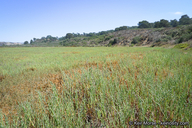
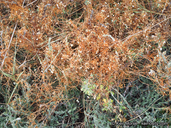
Common Name: GOLDENTHREAD Inflorescence: umbel- to +- head-like, flowers 2--17; pedicels 0.5--2 mm. Flower: 3.5--6 mm, membranous, papillate or not, parts in 5s; calyx generally = corolla tube, bell- to cup-shaped, generally divided 1/3, not veined, not shiny, lobes ovate-triangular, bases +- overlapped, margins entire, tip acute to acuminate; corolla tube 1.5--2.6 mm, bell-shaped, scales 1/2--2/3 corolla tube, oblong, rounded, short-fringed, lobes spreading to erect, generally = tube, widely ovate, margins entire, tip acute to acuminate, straight; filaments 0.3--0.6 mm, anthers included, 0.35--0.5 mm, widely elliptic to +- round; styles 0.4--1 mm, generally < ovary. Fruit: 2--3.6 mm, 1.4--2.1 mm wide, elliptic-ovoid, +- thickened, +- raised around opening between styles, not translucent, surrounded or capped by corolla. Seed: 1--2, 1.45--1.95 mm, 1.25--1.43 mm wide, +- spheric to widely elliptic.
Citation for this treatment: Mihai Costea & Saša Stefanović 2012, Cuscuta pacifica var. pacifica, in Jepson Flora Project (eds.) Jepson eFlora, https://ucjeps.berkeley.edu/eflora/eflora_display.php?tid=89286, accessed on April 25, 2024.
Citation for the whole project: Jepson Flora Project (eds.) 2024, Jepson eFlora, https://ucjeps.berkeley.edu/eflora/, accessed on April 25, 2024.
MAP CONTROLS 1. You can change the display of the base map layer control box in the upper right-hand corner.
2. County and Jepson Region polygons can be turned off and on using the check boxes.
(Note: any qualifiers in the taxon distribution description, such as 'northern', 'southern', 'adjacent' etc., are not reflected in the map above, and in some cases indication of a taxon in a subdivision is based on a single collection or author-verified occurence).
Data provided by the participants of the
Consortium of California Herbaria.
MAP LEGEND View all CCH records All markers link to CCH specimen records. The original determination is shown in the popup window.
Blue markers indicate specimens that map to one of the expected Jepson geographic subdivisions (see left map). Purple markers indicate specimens collected from a garden, greenhouse, or other non-wild location.
Yellow markers indicate records that may provide evidence for eFlora range revision or may have georeferencing or identification issues.
READ ABOUT YELLOW FLAGS
CCH collections by month
Duplicates counted once; synonyms included.
Species do not include records of infraspecific taxa, if there are more than 1 infraspecific taxon in CA.
Blue line denotes eFlora flowering time (fruiting time in some monocot genera).