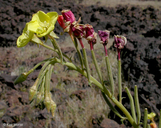
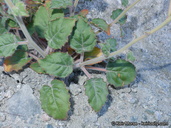
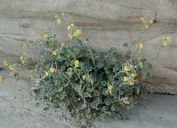
Common Name: EVENING-PRIMROSE FAMILY Habit: Annual to perennial herb (to tree). Leaf: cauline or basal, alternate, opposite, or whorled, generally simple and toothed (to pinnately compound); stipules 0 or generally deciduous. Inflorescence: spike, raceme, panicle, or flowers 1 in axils; bracted. Flower: generally bisexual, generally radial, often opening at either dawn or dusk; hypanthium generally prolonged beyond ovary (measured from ovary tip to sepal base); sepals 4(2--7); petals 4(2--7, rarely 0), often fading darker; stamens 2 × or = sepals in number, anthers 2-chambered, opening lengthwise, pollen interconnected by threads; ovary inferior, chambers generally as many as sepals (sometimes becoming 1), placentas axile or parietal, ovules 1--many per chamber, style 1, stigma 4-lobed (or lobes as many as sepals), club-shaped, spheric, or hemispheric. Fruit: capsule, loculicidal (sometimes berry or indehiscent and nut-like). Seed: sometimes winged or hair-tufted. Genera In Family: 22 genera, +- 657 species: worldwide, especially western North America; many cultivated (Clarkia, Epilobium, Fuchsia, Oenothera). Note:Gaura moved to Oenothera. Fuchsia magellanica Lam. naturalized in northern California. eFlora Treatment Author: Warren L. Wagner & Peter C. Hoch, family description, key to genera, treatment of genera by Warren L. Wagner, except as noted Scientific Editor: Robert W. Patterson, Bruce G. Baldwin.
Habit: Annual, occasionally perennial herb, from taproot. Leaf: basal and cauline, alternate, lanceolate to ovate, pinnately lobed with large terminal lobe (simple), margin dentate to entire, abaxial face and/or margin with +- conspicuous brown oil cells, long-petioled. Inflorescence: erect or nodding raceme. Flower: generally opening at dawn (occasionally at dusk); sepals 4, reflexed; petals 4, yellow or white (often fading orange-red) or lavender, generally fading red, if yellow generally strongly ultraviolet reflective, often with 1+ red spots near base, occasionally non-reflective near base or throughout; stamens (4)8, longer opposite sepals, anthers attached at middle, filaments long-ciliate or glabrous, pollen grains 3-angled at 20×; stigma entire and spheric or rarely conic-peltate, generally > anthers and cross-pollinated or +- = anthers and self-pollinated. Fruit: straight to curved, not twisted or coiled, valves with obvious midrib, pedicelled. Seed: in 2 rows per chamber, lenticular to narrowly ovoid, with +- pronounced membranous margin when immature. Etymology: (Greek: juice) Note: Incl in Camissonia in TJM (1993). eFlora Treatment Author: Warren L. Wagner Reference: Wagner et al. 2007 Syst Bot Monogr 83:1--240 Unabridged Reference: Raven 1969 Contr US Natl Herb 37:161--396
Citation for this treatment: Warren L. Wagner 2012, Chylismia cardiophylla subsp. cardiophylla, in Jepson Flora Project (eds.) Jepson eFlora, https://ucjeps.berkeley.edu/eflora/eflora_display.php?tid=89214, accessed on April 24, 2024.
Citation for the whole project: Jepson Flora Project (eds.) 2024, Jepson eFlora, https://ucjeps.berkeley.edu/eflora/, accessed on April 24, 2024.
MAP CONTROLS 1. You can change the display of the base map layer control box in the upper right-hand corner.
2. County and Jepson Region polygons can be turned off and on using the check boxes.
(Note: any qualifiers in the taxon distribution description, such as 'northern', 'southern', 'adjacent' etc., are not reflected in the map above, and in some cases indication of a taxon in a subdivision is based on a single collection or author-verified occurence).
Data provided by the participants of the
Consortium of California Herbaria.
MAP LEGEND View all CCH records All markers link to CCH specimen records. The original determination is shown in the popup window.
Blue markers indicate specimens that map to one of the expected Jepson geographic subdivisions (see left map). Purple markers indicate specimens collected from a garden, greenhouse, or other non-wild location.
Yellow markers indicate records that may provide evidence for eFlora range revision or may have georeferencing or identification issues.
READ ABOUT YELLOW FLAGS
CCH collections by month
Duplicates counted once; synonyms included.
Species do not include records of infraspecific taxa, if there are more than 1 infraspecific taxon in CA.
Blue line denotes eFlora flowering time (fruiting time in some monocot genera).