Common Name: GOOSEFOOT FAMILY Habit: Annual to shrub; hairs simple, stellate, or glandular; plants in several genera scaly, mealy, or powdery from collapsed glands; monoecious, dioecious, with bisexual flowers, or with both bisexual and unisexual flowers. Stem: occasionally fleshy. Leaf: blade simple, generally alternate, occasionally fleshy or reduced to scales, veins pinnate; stipules 0. Inflorescence: raceme, spike, catkin-like, spheric head, axillary clusters of flowers, or flowers 1; bracts 0--5, herbaceous, generally persistent or strongly modified in fruit, wings, tubercles or spines present or 0. Flower: bisexual or unisexual, small, generally green; calyx parts (1)3--5, or 0 in pistillate flowers, free or fused basally (or +- throughout), leaf-like in texture, membranous, or fleshy, deciduous or not, often strongly modified in fruit; corolla 0; stamens 1--5, opposite sepals, filaments free, equal; anthers 4-chambered; ovary superior (1/2-inferior), chamber 1; ovule 1; styles, stigmas 1--4 (or stigmas sessile). Fruit: achene or utricle, generally falling with persistent calyx or bracts. Seed: 1, small, lenticular to spheric; seed coat smooth to finely dotted, warty, net-like, or prickly, margin occasionally winged. Genera In Family: 100 genera, 1500 species: worldwide, especially deserts, saline or alkaline soils; some cultivated for food (Beta vulgaris subsp. vulgaris, beet, Swiss chard; Spinacia oleracea L., spinach; Chenopodium quinoa Willd., quinoa); and some worldwide, naturalized ruderal or noxious agricultural weeds. Note:Nitrophila treated in Amaranthaceae, Sarcobatus treated in Sarcobataceae. Key to genera revised by Elizabeth H. Zacharias to incorporate Extriplex and Stutzia, 2 genera segregated from Atriplex. Native spp. of Kochia now treated in Neokochia. Chenopodiaceae often treated now within a more broadly circumscribed Amaranthaceae (Morales-Briones et al. 2021). eFlora Treatment Author: Mihai Costea, family description, key to genera, revised by Thomas J. Rosatti & Elizabeth H. Zacharias, except as noted Scientific Editor: Bruce G. Baldwin, David J. Keil, Thomas J. Rosatti, Margriet Wetherwax.
Common Name: SALTBUSH, ORACH Habit: Generally monoecious annual, to generally dioecious shrub, generally scaly. Leaf: generally alternate, distal +- reduced; blade entire to variously dentate; anatomy Kranz or non-Kranz (see note). Inflorescence: axillary or terminal. Staminate Inflorescence: spheric cluster to spike-like or panicle; bracts 0. Pistillate Inflorescence: cluster to spike- or panicle-like, occasionally 1; bracts 2 per fruit, enlarged in age, free to variously fused, generally compressed, generally sessile, falling with fruit (or not). Staminate Flower: calyx lobes 3--5; stamens 3--5. Pistillate Flower: calyx generally +- 0; stigmas 2. Seed: generally erect. Etymology: (Latin: name derived from Greek) Note: Generally in alkaline or saline soils; some weedy; some accumulate selenium. Bract descriptions refer to 2 bracts surrounding flower, enlarging in fruit. Australian Atriplex crassipes J.M. Black possibly in SCo. In this revised taxonomy, Atriplex californica, Atriplex joaquinana moved to Extriplex, Atriplex covillei to Stutzia, both new genera [Zacharias & Baldwin 2010 Syst Bot 35(4):839--857]. Kranz anatomy (observable at 10 ×, sometimes only after scraping off scaly, mealy, or powdery layer) characterized by veins that are darker green than rest of leaf, due to higher concentrations of chloroplasts in bundle-sheath cells surrounding veins. eFlora Treatment Author: Elizabeth H. Zacharias and David Keil Reference: Welsh 2003 FNANM 4:322--381
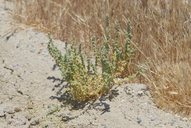
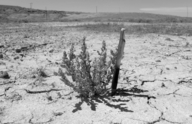
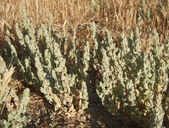
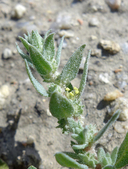
Habit: Annual 1--3 dm; herbage gray-green. Stem: 1--few from base; branches decumbent to erect, stiff, generally gray-scaly, in age glabrous, straw-colored. Leaf: blade 8--20 mm, elliptic to ovate, base tapered to +- obtuse; distal leaves gray-scaly; Kranz. Inflorescence: staminate and pistillate flowers in mixed axillary clusters; bracts in fruit fused proximally, variable among varieties, widely deltate to semicircular, 2--6 mm, widely obtuse to truncate at base, with sides smooth or obscurely to prominently tubercled, middle tooth of distal margin generally not > other teeth. Staminate Flower: Sepals (4)5. Seed: 1--1.5 mm, dark brown.
Atriplex coronata S. Watson var. vallicola (Hoover) S.L. Welsh
Citation for this treatment: Elizabeth H. Zacharias and David Keil 2023, Atriplex coronata var. vallicola, in Jepson Flora Project (eds.) Jepson eFlora, Revision 12, https://ucjeps.berkeley.edu/eflora/eflora_display.php?tid=88896, accessed on April 25, 2024.
Citation for the whole project: Jepson Flora Project (eds.) 2024, Jepson eFlora, https://ucjeps.berkeley.edu/eflora/, accessed on April 25, 2024.
MAP CONTROLS 1. You can change the display of the base map layer control box in the upper right-hand corner.
2. County and Jepson Region polygons can be turned off and on using the check boxes.
(Note: any qualifiers in the taxon distribution description, such as 'northern', 'southern', 'adjacent' etc., are not reflected in the map above, and in some cases indication of a taxon in a subdivision is based on a single collection or author-verified occurence).
Data provided by the participants of the
Consortium of California Herbaria.
MAP LEGEND View all CCH records All markers link to CCH specimen records. The original determination is shown in the popup window.
Blue markers indicate specimens that map to one of the expected Jepson geographic subdivisions (see left map). Purple markers indicate specimens collected from a garden, greenhouse, or other non-wild location.
Yellow markers indicate records that may provide evidence for eFlora range revision or may have georeferencing or identification issues.
READ ABOUT YELLOW FLAGS
CCH collections by month
Duplicates counted once; synonyms included.
Species do not include records of infraspecific taxa, if there are more than 1 infraspecific taxon in CA.
Blue line denotes eFlora flowering time (fruiting time in some monocot genera).