Common Name: OAK FAMILY Habit: Shrub, tree, evergreen or not; monoecious. Leaf: simple, alternate, petioled; margin entire to lobed; stipules small, generally deciduous. Staminate Inflorescence: catkin or stiff spike, many-flowered. Pistillate Inflorescence: 1--few-flowered, generally above staminate inflorescence; involucre bracts many, generally overlapping, flat or cylindric. Staminate Flower: calyx generally 4--6-lobed, minute; petals 0; stamens 4--12+. Pistillate Flower: calyx generally 6-lobed, minute; petals 0; ovary inferior, style branches generally 3. Fruit: 1 nut subtended, partly enclosed by scaly, cup-like involucre or 1--3 nuts subtended, enclosed by spiny, bur-like involucre; mature years 1--2. Seed: generally 1. Genera In Family: 7 genera, +- 900 species: generally northern hemisphere. Note: Wood of Quercus critical for pre-20th century ship-building, charcoal for metallurgy; some now supply wood (Fagus, Quercus), cork (Quercus suber), food (Castanea, chestnut). Lithocarpus densiflorus moved to Notholithocarpus. eFlora Treatment Author: John M. Tucker, except as noted Scientific Editor: Thomas J. Rosatti, Bruce G. Baldwin.
Common Name: OAK Habit: Evergreen or not. Leaf: stipules small, generally early-deciduous. Staminate Inflorescence: catkins, 1--several, pendent, slender, proximal on twig. Pistillate Inflorescence: in distal leaf axils, short-stalked; flower generally 1. Staminate Flower: stamens 4--10. Pistillate Flower: calyx minute, generally 6-lobed; ovary enclosed by involucre. Fruit: nut 1, partly enclosed by cup-like involucre (cup) with appressed scales (nut and cup = acorn), remnants of perianth and style persistent as small point at tip; scales tubercled to not; mature in years 1 (on younger stems) or 2 (on older stems). Chromosomes: 2n=24. Etymology: (Latin: ancient name for oak) Note: Many named hybrids; those (3) treated here form widespread populations; most others occur as single individuals, and some but not all of these are mentioned here, under the first parent treated (alphabetically). Reproduction of many species declining due to habitat degradation or loss as well as disease. Quercus robur added, as waif. eFlora Treatment Author: Thomas J. Rosatti & John M. Tucker Reference: Manos et al. 1999 Molec Phylogen Evol 12:333--349 Unabridged Reference: Cottam, W. P., J. M. Tucker, & F. S. Santamour. 1982. Oak hybridization at the University of Utah. State Arboretum of Utah Publication No. 1. Salt Lake City; Hardin, J. W. 1975. Hybridization and introgression in Quercus alba. Journal of the Arnold Arboretum 56: 336--363; Manos, P. S., Doyle, J. J., & Nixon, K. C. 1999. Phylogeny, biogeography, and processes of molecular differentiation of Quercus subgenus Quercus (Fagaceae). Molec Phylogen Evol 12: 333--349.
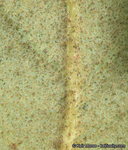
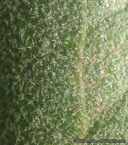
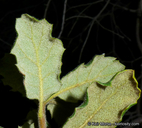
Common Name: LEATHER OAK Habit: Shrub to small tree 1--5+ m, evergreen; twigs tomentose, glabrous in age or not. Leaf: 1.5--3 cm; petiole < 5 mm; blade oblong to elliptic, adaxially convex, puberulent, dull green, abaxially short-hairy, pale green, tip spiny or abruptly pointed, margin wavy, often rolled under, toothed, teeth spine-tipped or abruptly pointed. Fruit: cup 12--18 mm wide, 4--6 mm deep, bowl-shaped, scales tubercled; nut 15--25 mm, ovoid to cylindric, distally obtuse to rounded, shell glabrous inside; mature in year 1. Note: Hybridizes with Quercus berberidifolia, Quercus garryana (Quercus ×subconvexa J.M. Tucker).
Quercus durata Jeps. var. gabrielensis Nixon & C.H. Mull.
Citation for this treatment: Thomas J. Rosatti & John M. Tucker 2014, Quercus durata var. gabrielensis, in Jepson Flora Project (eds.) Jepson eFlora, Revision 2, https://ucjeps.berkeley.edu/eflora/eflora_display.php?tid=76904, accessed on April 18, 2024.
Citation for the whole project: Jepson Flora Project (eds.) 2024, Jepson eFlora, https://ucjeps.berkeley.edu/eflora/, accessed on April 18, 2024.
MAP CONTROLS 1. You can change the display of the base map layer control box in the upper right-hand corner.
2. County and Jepson Region polygons can be turned off and on using the check boxes.
(Note: any qualifiers in the taxon distribution description, such as 'northern', 'southern', 'adjacent' etc., are not reflected in the map above, and in some cases indication of a taxon in a subdivision is based on a single collection or author-verified occurence).
Data provided by the participants of the
Consortium of California Herbaria.
MAP LEGEND View all CCH records All markers link to CCH specimen records. The original determination is shown in the popup window.
Blue markers indicate specimens that map to one of the expected Jepson geographic subdivisions (see left map). Purple markers indicate specimens collected from a garden, greenhouse, or other non-wild location.
Yellow markers indicate records that may provide evidence for eFlora range revision or may have georeferencing or identification issues.
READ ABOUT YELLOW FLAGS
CCH collections by month
Duplicates counted once; synonyms included.
Species do not include records of infraspecific taxa, if there are more than 1 infraspecific taxon in CA.
Blue line denotes eFlora flowering time (fruiting time in some monocot genera).