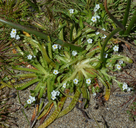
Common Name: BORAGE FAMILY Habit: Annual, perennial herb, or shrub, often bristly or sharp-hairy. Stem: prostrate-decumbent to erect. Leaf: basal and/or cauline, simple, generally alternate, sometimes opposite, especially at base. Inflorescence: cymes, arranged singly or in groups of 2--5, generally coiled in flower, generally elongating in fruit. Flower: bisexual, generally radial; sepals 5, free or fused at least at base; corolla 5-lobed, salverform, funnel-shaped, rotate, or bell-shaped, appendages (often called "fornices") 0 or 5 at top of tube, when present often differentially pigmented, alternate stamens; stamens epipetalous; ovary superior, 4-lobed, style 1, entire or minutely 2-lobed (2-branched). Fruit: nutlets 1--4, when > 1, all similar (often called "homomorphic") or 1 or 2 dissimilar in size and/or shape from the others (often called "heteromorphic"), free (fused), smooth to roughened, prickly or bristly or not. Genera In Family: +- 90 genera, +- 1600--1700 species: mostly temperate, especially western North America, Mediterranean; some cultivated (Borago, Echium, Myosotis, Symphytum). Toxicity: Many genera may be TOXIC from pyrrolizidine alkaloids or accumulated nitrates. Note: Sometimes still treated in broader sense of TJM2 (e.g., APG IV 2016 Bot J Linn Soc 181:1--20), but recent evidence (Luebert et al. 2016) supports segregation, for our flora, of the families Ehretiaceae, Heliotropiaceae, Hydrophyllaceae, Lennoaceae, and Namaceae. eFlora Treatment Author: Michael G. Simpson, C. Matt Guilliams, Kristen Hasenstab-Lehman & Ronald B. Kelley Scientific Editor: Bruce G. Baldwin, C. Matt Guilliams, Kristen Hasenstab-Lehman, David J. Keil, Ronald B. Kelley, Robert W. Patterson, Thomas J. Rosatti & Michael G. Simpson
Common Name: POPCORNFLOWER Habit: Annual (perennial herb), generally strigose to spreading-hairy; fibrous- to taprooted, staining red dye present or not. Stem: branched at base or above, < 5 dm. Leaf: cauline or basal and cauline, 0.5--10 cm, generally smaller tipward, linear to oblanceolate. Inflorescence: raceme- or spike-like cymes, coiled in bud, generally elongate in fruit; bracts 0--many. Flower: calyx lobes fused below middle, 2--10 mm in fruit; corolla rotate to funnel-shaped or cylindric, white or white with yellow area, tube generally +- yellow inside, limb 1--12 mm diam, appendages prominent to minute, white to yellow. Fruit: nutlets generally 4, +- ovate (triangular to +- lanceolate), rarely on narrow stalk or short peg, variously roughened, abaxially generally with central ridge, lateral ridges, cross-ribs, generally tubercled, occasionally prickly or bristly; adaxially keeled above attachment scar, scar on side generally near middle to base, sometimes on bottom or oblique (on angle between side and bottom), generally raised. Etymology: (Greek: sideways pit, from position of nutlet attachment scar) Note: Nutlet characters in key generally best for 3 nutlets farthest from stem; yellow on corolla changes to white after pollination. Other taxa in TJM (2012) moved to Amsinckiopsis and Sonnea. Unabridged Note: Fully mature nutlets needed for identification; in many species nutlet closest to stem often more firmly attached, larger, differently textured, and with completely different attachment scar than other 3; nutlet characters used in key focus on 3 more loosely attached nutlets. Intergradation common in some species groups; reticulate speciation in genus; sect. Allocarya often treated as separate genus in older works; many species need study. Corolla size can diminish markedly during flower period. Yellow corolla appendages and, if present, contrasting yellow corolla centers, change to white after successful pollination. eFlora Treatment Author: Ronald B. Kelley & C. Matt Guilliams Unabridged Reference: Horn 2000 Ph.D. Dissertation Univ Munich; Johnston 1932 Contr Arnold Arboretum 3:1--102; Guilliams 2015 Ph.D. Dissertation Univ CA Berkeley.
Common Name: TRACY'S POPCORNFLOWER Habit: Annual, +- strigose. Stem: decumbent or sprawling to erect, 1--4 dm. Leaf: cauline, lower 3--8 cm. Inflorescence: bracts below middle. Flower: calyx 2--4 mm, appressed- to spreading-hairy; corolla limb 1.5--3.5 mm diam, appendages yellow. Fruit: nutlet dull, brown to gray; abaxial ridge rounded, lateral ridges +- 0; adaxial ridge in trough; scar oblique, narrow-elliptic to triangular, concave, sunken. Note: Varieties intergrade.
Plagiobothrys reticulatus (Piper) I.M. Johnst. var. rossianorum I.M. Johnst.
NATIVE Stem: +- decumbent or sprawling, occasionally ascending. Fruit: nutlet 1.1--1.9 mm, oblong-ovate, +- flat; abaxial cross-ribs +- few, scattered, irregular, interspace tubercles generally dense or large; adaxial ridge in narrow groove; scar bordered by generally narrow, +- obscure trough. Ecology: Moist places in coastal grassland, beach deposits, mud flats; Elevation: < 800 m. Bioregional Distribution: NCo, CCo, SnFrB, SCoRO. Flowering Time: Apr--Jun Synonyms: Plagiobothrys scouleri (Hook. & Arn.) I.M. Johnst. var. penicillatus (Greene) Cronquist, in part Unabridged Note: Highly variable, related to Plagiobothrys reticulatus var. reticulatus, but suggestive of hybridization involving Plagiobothrys bracteatus, Plagiobothrys diffusus; study needed. Jepson eFlora Author: Ronald B. Kelley & C. Matt Guilliams Index of California Plant Names (ICPN; linked via the Jepson Online Interchange) Previous taxon: Plagiobothrys reticulatus var. reticulatus Next taxon: Plagiobothrys salsus
Citation for this treatment: Ronald B. Kelley & C. Matt Guilliams 2021, Plagiobothrys reticulatus var. rossianorum, in Jepson Flora Project (eds.) Jepson eFlora, Revision 9, https://ucjeps.berkeley.edu/eflora/eflora_display.php?tid=63901, accessed on April 25, 2024.
Citation for the whole project: Jepson Flora Project (eds.) 2024, Jepson eFlora, https://ucjeps.berkeley.edu/eflora/, accessed on April 25, 2024.
MAP CONTROLS 1. You can change the display of the base map layer control box in the upper right-hand corner.
2. County and Jepson Region polygons can be turned off and on using the check boxes.
(Note: any qualifiers in the taxon distribution description, such as 'northern', 'southern', 'adjacent' etc., are not reflected in the map above, and in some cases indication of a taxon in a subdivision is based on a single collection or author-verified occurence).
Data provided by the participants of the
Consortium of California Herbaria.
MAP LEGEND View all CCH records All markers link to CCH specimen records. The original determination is shown in the popup window.
Blue markers indicate specimens that map to one of the expected Jepson geographic subdivisions (see left map). Purple markers indicate specimens collected from a garden, greenhouse, or other non-wild location.
Yellow markers indicate records that may provide evidence for eFlora range revision or may have georeferencing or identification issues.
READ ABOUT YELLOW FLAGS
CCH collections by month
Duplicates counted once; synonyms included.
Species do not include records of infraspecific taxa, if there are more than 1 infraspecific taxon in CA.
Blue line denotes eFlora flowering time (fruiting time in some monocot genera).