Common Name: BROOMRAPE FAMILY Habit: Annual, perennial herb, shrub; often glandular; root-parasites, roots modified into absorptive structures. Stem: generally round in ×-section. Leaf: generally simple, generally alternate, reduced to +- fleshy scales in non-green plants lacking chlorophyll; stipules generally 0. Inflorescence: spike to panicle, generally bracted, or flowers 1--2 in axils. Flower: bisexual; calyx lobes 0--5; corolla generally strongly bilateral, generally 2-lipped (upper lip generally 2-lobed, lower lip generally 3-lobed), abaxial lobes outside other lobes in bud; stamens epipetalous, 4 in 2 pairs (sometimes 1 pair sterile), additional staminode 0(1), anther sacs unequal; ovary superior, chambers 1--2, placentas 2--4, parietal, style 1, stigma lobes 0 or 2. Fruit: capsule, generally +- ovoid, loculicidal, valves 2--4. Seed: many, small, angled; surface smooth or netted. Genera In Family: +- 100 genera, 2060 species: worldwide, especially northern temperate and Africa. Note: High yield losses in many crops caused by Orobanche and Phelipanche species in Africa, Mediterranean, Middle East, and eastern Europe. Taxa of Orobanche in TJM2 treated here in Aphyllon and Phelipanche. eFlora Treatment Author: Margriet Wetherwax, except as noted Scientific Editor: Robert W. Patterson, Bruce G. Baldwin.
Common Name: LOUSEWORT Habit: Perennial herb, +- green. Stem: decumbent to erect, generally 1--several from generally short caudex. Leaf: alternate, generally +- basal, generally < inflorescence, toothed or generally > 7-lobed, generally reduced distally on stem; petiole generally < blade. Inflorescence: raceme, spike-like; bracts (at least proximal) generally +- like distal leaves; pedicels 1--6 mm. Flower: calyx lobes (2,4)5, distal-most generally shortest (all generally < tube), lateral fused in pairs; corolla white or yellow or pink to red or purple, upper lip hood- or beak-like, curved or not, lower lip 3-lobed, narrow to fan-shaped, central lobe generally smallest; fertile stamens 4, generally glabrous, anthers generally included, sacs 2 per stamen, equal; stigma head-like, generally exserted. Fruit: generally +- ovate or lanceolate in outline, asymmetric, opening mostly on upper side. Seed: smooth or netted. Etymology: (Latin: lice, from belief that ingestion by stock promoted lice infestation) eFlora Treatment Author: Linda Ann Vorobik & David J. Keil Reference: Ree 2005 Int J Pl Sci 166:595--613
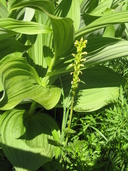
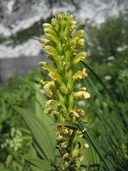
Pedicularis bracteosa Benth. var. flavida (Pennell) Cronquist
NATIVE Stem: 30--110 cm, sparsely hairy distally. Leaf: +- ovate; segments singly to doubly toothed; basal leaves 8--25 cm, 5--21-segmented, petiole +- = blade, generally 0 at flower; cauline leaves 3--15 cm, proximal 13--25-segmented, distal dentate. Inflorescence: 4--17 cm, > leaves, glabrous; proximal bracts > flowers. Flower: calyx 7--13 mm, lobes minutely ciliate; corolla 15--24 mm, +- club-like, +- yellow, upper lip 8--10 mm, deeply hooded, lower lip 4--6 mm; anthers 1.5--3 mm, base acute to obtuse. Fruit: 9--10 mm. Seed: 2.5--3.5 mm, surface netted. Ecology: Moist upper montane conifer forest; Elevation: 1200--2400 m. Bioregional Distribution: KR; Distribution Outside California: Oregon. Flowering Time: Jul--Aug Unabridged Synonyms: Pedicularis flavida Pennell Jepson eFlora Author: Linda Ann Vorobik & David J. Keil Reference: Ree 2005 Int J Pl Sci 166:595--613 Index of California Plant Names (ICPN; linked via the Jepson Online Interchange) Listed on CNPS Rare Plant Inventory Previous taxon: Pedicularis aurantiaca Next taxon: Pedicularis centranthera
Botanical illustration including Pedicularis bracteosa var. flavida
Citation for this treatment: Linda Ann Vorobik & David J. Keil 2023, Pedicularis bracteosa var. flavida, in Jepson Flora Project (eds.) Jepson eFlora, Revision 12, https://ucjeps.berkeley.edu/eflora/eflora_display.php?tid=63102, accessed on April 17, 2024.
Citation for the whole project: Jepson Flora Project (eds.) 2024, Jepson eFlora, https://ucjeps.berkeley.edu/eflora/, accessed on April 17, 2024.
MAP CONTROLS 1. You can change the display of the base map layer control box in the upper right-hand corner.
2. County and Jepson Region polygons can be turned off and on using the check boxes.
(Note: any qualifiers in the taxon distribution description, such as 'northern', 'southern', 'adjacent' etc., are not reflected in the map above, and in some cases indication of a taxon in a subdivision is based on a single collection or author-verified occurence).
Data provided by the participants of the
Consortium of California Herbaria.
MAP LEGEND View all CCH records All markers link to CCH specimen records. The original determination is shown in the popup window.
Blue markers indicate specimens that map to one of the expected Jepson geographic subdivisions (see left map). Purple markers indicate specimens collected from a garden, greenhouse, or other non-wild location.
Yellow markers indicate records that may provide evidence for eFlora range revision or may have georeferencing or identification issues.
READ ABOUT YELLOW FLAGS
CCH collections by month
Duplicates counted once; synonyms included.
Species do not include records of infraspecific taxa, if there are more than 1 infraspecific taxon in CA.
Blue line denotes eFlora flowering time (fruiting time in some monocot genera).