Common Name: HELIOTROPE FAMILY Habit: Annual or perennial herb [shrub, tree, woody vine], generally hairy, often bristly or strigose and/or glandular. Stem: prostrate to erect, branched. Leaf: simple, alternate, generally entire; stipules 0. Inflorescence: 1-many cymes, generally coiled, or flowers 1. Flower: generally bisexual, generally radial; calyx lobes 5, generally free to base; corolla lobes 5, fused, generally rotate or bell-shaped, appendages 0; stamens 5, epipetalous; ovary superior, subtended by disk-like nectary, chambers generally 4, style terminal, stigmatic head conical with basal ring-shaped stigma and sterile tip. Fruit: dry or fleshy, generally 4-seeded, sometimes separating into 1--4 nutlets. Genera In Family: 4 genera, +- 450 species; worldwide distribution, especially in tropics and subtropics. Note: Included in Boraginaceae in TJM2 and some other treatments (Angiosperm Phylogeny Group IV 2016 Bot Linn Soc 181:1--20) but treated as separate family by Boraginales Working Group (Luebert et al. 2016). eFlora Treatment Author: Michael G. Simpson
Common Name: HELIOTROPE Habit: Annual, perennial herb [shrub], glabrous to bristly or strigose. Stem: prostrate to erect, branched. Leaf: generally cauline, petioled to sessile, generally entire. Inflorescence: flower 1 in axils or many in terminal coiled spike-like cymes. Flower: corolla rotate to bell-shaped, white to purple; stamens attached on upper tube, included, anthers +- sessile; style 0 or not lobed, stigma 1, linear to disk-like. Fruit: nutlets 2 or 4, erect, generally ovoid to spheric, smooth, roughened, or hairy, scar generally lateral. Etymology: (Greek: sun turning, from some species flowering at summer solstice) eFlora Treatment Author: Ronald B. Kelley & Dieter H. Wilken Unabridged Reference: Ewan 1942 Bull So Calif Acad Sci 41: 51--57
Heliotropium curassavicum L. var. oculatum (A. Heller) I.M. Johnst. ex Tidestr.
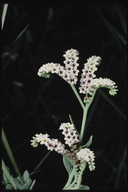
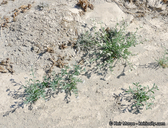
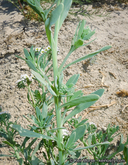
NATIVE Habit: Perennial herb, fleshy, occasionally from rhizome-like root. Stem: prostrate to +- ascending, 1--6 dm, glabrous. Leaf: 1--6 cm, generally oblanceolate, short-petioled to subsessile, acute to obtuse, glabrous. Inflorescence: spike-like cymes 2--4. Flower: calyx lobes oblong to narrow-ovate, glabrous; corolla 3--5 mm, 3--5(7) mm diam, salverform to bell-shaped, white, throat generally blue-purple, upper tube +- yellow. Fruit: nutlets 4, smooth. Chromosomes: 2n=26, 28. Ecology: Moist to dry, saline to alkaline soils, generally near water; Elevation: < 2250 m. Bioregional Distribution: CA (exc KR, NCoRH, c SNH); Distribution Outside California: southern Nevada, southwestern Utah, to western Texas, northern Mexico. Flowering Time: Feb--Oct Synonyms: Heliotropium oculatum A. Heller; Heliotropium spathulatum subsp. oculatum (A. Heller) Ewan Unabridged Note: Part of worldwide, highly polymorphic sp. complex with many ecological and/or geographical variants. Jepson eFlora Author: Ronald B. Kelley & Dieter H. Wilken Index of California Plant Names (ICPN; linked via the Jepson Online Interchange) Previous taxon: Heliotropium convolvulaceum var. californicum Next taxon: Heliotropium europaeum
Botanical illustration including Heliotropium curassavicum var. oculatum
Citation for this treatment: Ronald B. Kelley & Dieter H. Wilken 2012, Heliotropium curassavicum var. oculatum, in Jepson Flora Project (eds.) Jepson eFlora, https://ucjeps.berkeley.edu/eflora/eflora_display.php?tid=59914, accessed on April 16, 2024.
Citation for the whole project: Jepson Flora Project (eds.) 2024, Jepson eFlora, https://ucjeps.berkeley.edu/eflora/, accessed on April 16, 2024.
MAP CONTROLS 1. You can change the display of the base map layer control box in the upper right-hand corner.
2. County and Jepson Region polygons can be turned off and on using the check boxes.
(Note: any qualifiers in the taxon distribution description, such as 'northern', 'southern', 'adjacent' etc., are not reflected in the map above, and in some cases indication of a taxon in a subdivision is based on a single collection or author-verified occurence).
Data provided by the participants of the
Consortium of California Herbaria.
MAP LEGEND View all CCH records All markers link to CCH specimen records. The original determination is shown in the popup window.
Blue markers indicate specimens that map to one of the expected Jepson geographic subdivisions (see left map). Purple markers indicate specimens collected from a garden, greenhouse, or other non-wild location.
Yellow markers indicate records that may provide evidence for eFlora range revision or may have georeferencing or identification issues.
READ ABOUT YELLOW FLAGS
CCH collections by month
Duplicates counted once; synonyms included.
Species do not include records of infraspecific taxa, if there are more than 1 infraspecific taxon in CA.
Blue line denotes eFlora flowering time (fruiting time in some monocot genera).