Common Name: BROOMRAPE FAMILY Habit: Annual, perennial herb, shrub; often glandular; root-parasites, roots modified into absorptive structures. Stem: generally round in ×-section. Leaf: generally simple, generally alternate, reduced to +- fleshy scales in non-green plants lacking chlorophyll; stipules generally 0. Inflorescence: spike to panicle, generally bracted, or flowers 1--2 in axils. Flower: bisexual; calyx lobes 0--5; corolla generally strongly bilateral, generally 2-lipped (upper lip generally 2-lobed, lower lip generally 3-lobed), abaxial lobes outside other lobes in bud; stamens epipetalous, 4 in 2 pairs (sometimes 1 pair sterile), additional staminode 0(1), anther sacs unequal; ovary superior, chambers 1--2, placentas 2--4, parietal, style 1, stigma lobes 0 or 2. Fruit: capsule, generally +- ovoid, loculicidal, valves 2--4. Seed: many, small, angled; surface smooth or netted. Genera In Family: +- 100 genera, 2060 species: worldwide, especially northern temperate and Africa. Note: High yield losses in many crops caused by Orobanche and Phelipanche species in Africa, Mediterranean, Middle East, and eastern Europe. Taxa of Orobanche in TJM2 treated here in Aphyllon and Phelipanche. eFlora Treatment Author: Margriet Wetherwax, except as noted Scientific Editor: Robert W. Patterson, Bruce G. Baldwin.
Habit: Annual, green to yellow-brown or +- purple; generally ascending-branched. Leaf: alternate or +- basal, sessile, +- linear, distal finely divided. Inflorescence: spike and/or flowers solitary in axils; bracts generally leaf-like. Flower: calyx +- equally 4-lobed; corolla tube generally slender, upper lip folded lengthwise, tip of upper 2 corolla lobes open, opening directed forward, forming a beak, lower lip deeply 3-pouched, 3-toothed, throat abruptly generally indented forming a fold proximal to lower lip; stamens 4, anther sac 1 per stamen, generally included; stigma generally slightly enlarged, entire to slightly 2-lobed. Seed: 20--80, 0.8--1.2 mm, ovoid, attached at base, dark brown; coat netted, generally tight-fitting. Chromosomes: 2n=22. Etymology: (Greek: 3 bladders, from lower lip pouches) Note: Hybrids common. Related to Castilleja, Orthocarpus; isolated reproductively. eFlora Treatment Author: Margriet Wetherwax, T I. Chuang & Lawrence R. Heckard Reference: Chuang & Heckard 1991 Syst Bot 16:644--666 Unabridged Reference: Hong 1996 Novon 6:372--374
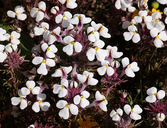
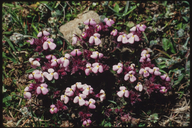
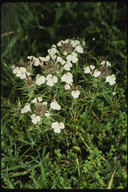
Common Name: BUTTER-AND-EGGS, JOHNNY-TUCK Habit: Plant generally 10--35 cm, +- purple, generally puberulent, glandular- and nonglandular-hairy. Leaf: 10--50 mm, 3--7-lobed. Inflorescence: 2--15 cm, dense distally; bracts 5--18 mm, 3--5-lobed. Flower: calyx 8--13 mm, divided 1/4--1/2; corolla 10--25 mm, yellow, or white fading rose-pink, beak dark purple, tube densely puberulent, lower lip +- = beak, pouches 3--4 mm deep. Fruit: 5--8 mm, oblong. Seed: 30--50, dark brown.
Triphysaria eriantha (Benth.) T.I. Chuang & Heckard subsp. rosea (A. Gray) T.I. Chuang & Heckard
Citation for this treatment: Margriet Wetherwax, T I. Chuang & Lawrence R. Heckard 2012, Triphysaria eriantha subsp. rosea, in Jepson Flora Project (eds.) Jepson eFlora, https://ucjeps.berkeley.edu/eflora/eflora_display.php?tid=53280, accessed on April 24, 2024.
Citation for the whole project: Jepson Flora Project (eds.) 2024, Jepson eFlora, https://ucjeps.berkeley.edu/eflora/, accessed on April 24, 2024.
MAP CONTROLS 1. You can change the display of the base map layer control box in the upper right-hand corner.
2. County and Jepson Region polygons can be turned off and on using the check boxes.
(Note: any qualifiers in the taxon distribution description, such as 'northern', 'southern', 'adjacent' etc., are not reflected in the map above, and in some cases indication of a taxon in a subdivision is based on a single collection or author-verified occurence).
Data provided by the participants of the
Consortium of California Herbaria.
MAP LEGEND View all CCH records All markers link to CCH specimen records. The original determination is shown in the popup window.
Blue markers indicate specimens that map to one of the expected Jepson geographic subdivisions (see left map). Purple markers indicate specimens collected from a garden, greenhouse, or other non-wild location.
Yellow markers indicate records that may provide evidence for eFlora range revision or may have georeferencing or identification issues.
READ ABOUT YELLOW FLAGS
CCH collections by month
Duplicates counted once; synonyms included.
Species do not include records of infraspecific taxa, if there are more than 1 infraspecific taxon in CA.
Blue line denotes eFlora flowering time (fruiting time in some monocot genera).