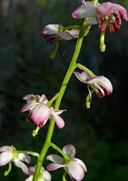
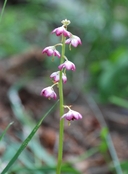
Common Name: HEATH FAMILY Habit: Perennial herb, shrub, tree. Stem: bark often peeling distinctively. Leaf: simple or 0, generally cauline, alternate, opposite (whorled), evergreen or deciduous, often leathery, petioled or not; stipules 0. Inflorescence: raceme, panicle, cyme, or flowers 1, terminal or axillary, generally bracted; pedicel often with 2 bractlets. Flower: generally bisexual, generally radial, bell-shaped, cylindric, or urn-shaped; sepals generally (0)4--5, generally free; petals generally (0)4--5, free or fused; stamens (2--5)8--10, free, filaments rarely appendaged, anthers dehiscing by pores or slits, awns 0 or 2(4), seemingly abaxial, reduced or elongate, generally curved; nectary generally present at ovary base, generally disk-like; ovary superior or inferior, chambers generally 1--5, placentas axile or parietal, ovules 1--many per chamber, style 1, stigma head- to funnel-like or lobed. Fruit: capsule, drupe, berry. Seed: generally many, winged or not. Genera In Family: +- 100 genera, 3000 species: generally worldwide except deserts; some cultivated, especially Arbutus, Arctostaphylos, Rhododendron, Vaccinium. Note: Monophyletic only if Empetraceae included, as treated here. Ledum included in Rhododendron. Non-green plants obtain nutrition from green plants through fungal intermediates. eFlora Treatment Author: Gary D. Wallace, except as noted Scientific Editor: Gary D. Wallace, Thomas J. Rosatti, Bruce G. Baldwin.
Common Name: WINTERGREEN Habit: Perennial subshrub, evergreen, rhizomed. Leaf: +- basal, reniform, ovate, +- round, elliptic, or obovate, +- entire to crenate or dentate, generally petioled (if vestigial, lanceolate to deltate, +- not green, sessile). Inflorescence: raceme, +- erect, not 1-sided, elongate; scape smooth, glabrous, bracts generally 1--several, deltate or lanceolate; flower bract 1 per flower, < to >> pedicel. Flower: radial, +- closed or subradial or bilateral, +- open, parts in 5s, free; petals without tubercles, upper 2 generally forming hood over upturned stamens; stamens 10, filaments generally widened at base, smooth, glabrous, anther generally with tube-like constrictions subtending pores; nectary 0; ovary superior, style +- included and straight or generally exserted and downcurved, stigma peltate, with 5 spreading lobes above a prominent, reflexed collar or generally not peltate, generally with 5 +- erect lobes projecting beyond a delicate, reflexed collar. Fruit: capsule, pendent; valves opening base to tip, margins fibrous. Seed: +- 1000. Etymology: (Latin: little pear, +- from leaf shape) Note:Pyrola chlorantha not in CA. Unabridged Note: In Jepson eFlora Revision 2, Pyrola aphylla, Pyrola crypta, Pyrola dentata added, as native. eFlora Treatment Author: Diana D. Jolles Reference: Jolles & Wolfe 2012 Syst Bot 37:468--477; Jolles & Wilson 2014 Taxon 63(4):789--800
Citation for this treatment: Diana D. Jolles 2017, Pyrola asarifolia subsp. asarifolia, in Jepson Flora Project (eds.) Jepson eFlora, Revision 5, https://ucjeps.berkeley.edu/eflora/eflora_display.php?tid=52590, accessed on April 24, 2024.
Citation for the whole project: Jepson Flora Project (eds.) 2024, Jepson eFlora, https://ucjeps.berkeley.edu/eflora/, accessed on April 24, 2024.
MAP CONTROLS 1. You can change the display of the base map layer control box in the upper right-hand corner.
2. County and Jepson Region polygons can be turned off and on using the check boxes.
(Note: any qualifiers in the taxon distribution description, such as 'northern', 'southern', 'adjacent' etc., are not reflected in the map above, and in some cases indication of a taxon in a subdivision is based on a single collection or author-verified occurence).
Data provided by the participants of the
Consortium of California Herbaria.
MAP LEGEND View all CCH records All markers link to CCH specimen records. The original determination is shown in the popup window.
Blue markers indicate specimens that map to one of the expected Jepson geographic subdivisions (see left map). Purple markers indicate specimens collected from a garden, greenhouse, or other non-wild location.
Yellow markers indicate records that may provide evidence for eFlora range revision or may have georeferencing or identification issues.
READ ABOUT YELLOW FLAGS
CCH collections by month
Duplicates counted once; synonyms included.
Species do not include records of infraspecific taxa, if there are more than 1 infraspecific taxon in CA.
Blue line denotes eFlora flowering time (fruiting time in some monocot genera).