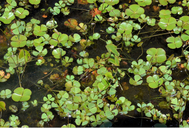
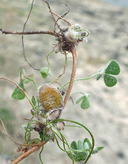
Common Name: MARSILEA FAMILY Habit: Plant generally aquatic or in perennially wet areas, generally rooted in mud; rhizome creeping, slender, branched. Leaf: floating, emergent, or out of water, +- alike; blade 1-palmate or 0, << stipe; veins not or repeatedly forked, free or netted. Sporangia: in stalked, spheric or +- flat-ovoid, hard cases of 1 kind, attached near stipe base. Spores: large megaspores (female) and small microspores (male), in separate sporangia. Genera In Family: 3 genera, +- 70 species: especially temperate. eFlora Treatment Author: Andy Murdock, Alan R. Smith & Thomas Lemieux Scientific Editor: Alan R. Smith, Bruce G. Baldwin.
Common Name: WATER-CLOVER Leaf: blades floating and emergent; stipe of floating leaves weak. Sporangium Case: fused to stalk 0.8--1.7 mm, +- flat-ovoid; hairs long, dense, deciduous or not; distal tooth present or 0, tip of stalk often appearing tooth-like. Etymology: (L.F. Marsigli, Italian botanist, 1656--1730) Note:Marsilea mutica Mett. (native to Australia, New Caledonia), Marsilea drummondii A. Braun (native to Australia) cultivated in United States in aquatic gardens, occasional escape in urban areas, may persist in California; weed of concern in southeastern US [Knepper et al. 2002 Amer Fern J 92:243--244]. Reference: Johnson 1986 Syst Bot Monogr 11:1--87
Marsilea vestita Hook. & Grev. subsp. vestita
NATIVE Leaf: hairy; stipe of floating leaves 6--35 cm, others 3--8 cm; leaflet sides generally unequally concave causing leaflet asymmetry, distal margin convex, +- entire. Sporangium Case: 3--8 mm, 3--7 mm wide; stalk unbranched. Ecology: Creek beds, flood basins, vernal pools; Elevation: < 2200 m. Bioregional Distribution: KR, NCoRI, CaR, n&s SNF, SNH, GV, CW (exc SCoRI), SCo, WTR, SnBr, PR, MP, DSon; Distribution Outside California: to western and central Canada, Mexico; also Peru. Jepson eFlora Author: Andy Murdock, Alan R. Smith & Thomas Lemieux Reference: Johnson 1986 Syst Bot Monogr 11:1--87 Index of California Plant Names (ICPN; linked via the Jepson Online Interchange) Previous taxon: Marsilea oligospora Next taxon: Pilularia
Botanical illustration including Marsilea vestita subsp. vestita
Citation for this treatment: Andy Murdock, Alan R. Smith & Thomas Lemieux 2012, Marsilea vestita subsp. vestita, in Jepson Flora Project (eds.) Jepson eFlora, https://ucjeps.berkeley.edu/eflora/eflora_display.php?tid=51529, accessed on April 16, 2024.
Citation for the whole project: Jepson Flora Project (eds.) 2024, Jepson eFlora, https://ucjeps.berkeley.edu/eflora/, accessed on April 16, 2024.
MAP CONTROLS 1. You can change the display of the base map layer control box in the upper right-hand corner.
2. County and Jepson Region polygons can be turned off and on using the check boxes.
(Note: any qualifiers in the taxon distribution description, such as 'northern', 'southern', 'adjacent' etc., are not reflected in the map above, and in some cases indication of a taxon in a subdivision is based on a single collection or author-verified occurence).
Data provided by the participants of the
Consortium of California Herbaria.
MAP LEGEND View all CCH records All markers link to CCH specimen records. The original determination is shown in the popup window.
Blue markers indicate specimens that map to one of the expected Jepson geographic subdivisions (see left map). Purple markers indicate specimens collected from a garden, greenhouse, or other non-wild location.
Yellow markers indicate records that may provide evidence for eFlora range revision or may have georeferencing or identification issues.
READ ABOUT YELLOW FLAGS
CCH collections by month
Duplicates counted once; synonyms included.
Species do not include records of infraspecific taxa, if there are more than 1 infraspecific taxon in CA.
Blue line denotes eFlora flowering time (fruiting time in some monocot genera).