Common Name: VIOLET FAMILY Habit: Annual, perennial herb, [small shrub, tree, vine], from caudices, taproots, rhizomes, or stolons; hairs 0 or simple. Stem: 0 or prostrate to erect. Leaf: basal, cauline, or both, alternate, [opposite], simple to compound, petioled; stipules generally small; blade linear to round, entire to toothed or lobed. Inflorescence: flowers 1 [raceme], axillary or scapose; peduncle bractlets 2, generally alternate. Flower: bisexual, bilateral [radial]; sepals 5, free, basal lobes present [0], generally not prominent; petals 5, free, lowest often largest, base +- elongated into a spur; stamens 5, alternate petals, filaments short, wide, with large in-pointing hairs, lowest 2 anthers with basal nectaries extending into petal spur; ovary superior, chamber 1, placentas parietal, 3, ovules [1] generally many, style 1, often enlarged distally, stigma often oblique or hooked, hairy or not. Fruit: capsule [berry], 3-valved, loculicidal, explosively dehiscent or not. Seed: generally with outgrowth, attractive to ants. Genera In Family: 23 genera, 830 species: worldwide, generally temperate, tropics (especially higher elevations). Note: Lengths of lowest petal including spur. eFlora Treatment Author: R. John Little Scientific Editor: Thomas J. Rosatti.
Common Name: VIOLET Leaf: generally deciduous. Flower: sepals +- equal, entire; petals unequal, lowest generally largest, with spur generally < 3 [20] mm, lateral 2 equal, generally spreading, upper 2 equal, erect or reflexed, overlapped or not, lateral 2 generally, others sometimes with beard of variously shaped hairs basally; cleistogamous flowers generally present, petals 0. Fruit: ovoid to oblong, hairy or not. Seed: 8--75. Etymology: (Latin: classical name) Note: Important orns including Viola odorata, Viola tricolor L. (Johnny-jump-up, wild pansy), Viola ×wittrockiana Gams (garden pansy). Unabridged Reference: Baker, M.S. 1949a. Studies in western violets. IV. Leafl. West. Bot. 5: 141--147; Baker, M.S. 1949b. Studies in western violets. VI; Madroño 10: 110--128; Baker, M.S. 1957. Brittonia 9: 217--230; Ballard, H.E. 1992. Systematics of Viola Section Viola in North Am north of Mexico. M.S. thesis, Central Michigan University, Mt. Pleasant, Michigan; Ballard, H.E. 1994. Violets of Michigan. Michigan Botanist 33: 131--199; Davidse, G. 1976. A study of some Intermountain violets (Viola Sect. Chamaemelanium). Madroño 23: 274--283; Fabijan et al. 1987. The taxonomy of the Viola nuttallii complex. Can. J. Bot. 65: 2562--2580; Gil-ad, N.L. 1995. Systematics and evolution of Viola L. subsection Boreali-Americanae (W. Becker) Brizicky. Ph.D. dissertation, Univ of Michigan, Ann Arbor, Michigan; Gil-ad, N.L. 1997. Systematics of Viola subsection Boreali-Americanae. Boissiera 53: 1--130; Gil-ad, N.L. 1998. The micromorphologies of seed coats and petal trichomes of the taxa of Viola subsect. Boreali-Americanae (Violaceae) and their utility in discerning orthospecies from hybrids. Brittonia 50: 91--121; Hitchcock, C.L. 1961. Vasc. Pl. Pacific NorthW. Vol. 3; McKinney, L.E. 1992. A taxonomic revision of the acaulescent blue violets (Viola) of North Am. Sida Botanical Miscellany, 7: 1--59; McKinney, L.E. and N. Russell. 2002. Violaceae of the Southeastern United States. Castanea 4: 369--379; Russell, N.H. 1965. Violets (Viola) of the central and eastern United States: an introductory survey. Sida 1: 1--113
Viola beckwithii Torr. & A. Gray
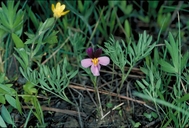
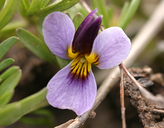
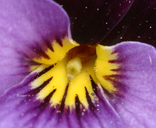
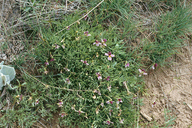
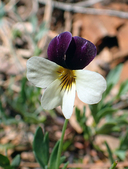
NATIVE Habit: Perennial herb 2--22 cm, glabrous to puberulent. Stem: decumbent to erect, generally several, up to 1/2 subterranean, clustered on deep caudex. Leaf: ternate-compound; basal 2--6 per caudex, generally puberulent (glabrous), petiole 2--10.5 cm, blade 2.4--5 cm, 3.5--4.5 cm wide, ovate to deltate, +- fleshy, leaflets dissected into several 1--7 mm wide, narrow oblong, elliptic, lanceolate, or oblanceolate segments, tip obtuse to acute; cauline petiole 2--5.7 cm, blade 1--2.7 cm, 1.5--3 cm wide, +- like basal. Inflorescence: axillary; peduncle 2--15.7 cm. Flower: sepals lanceolate, not ciliate; upper 2 petals dark red-violet, often overlapped, lower 3 lilac to +- white, veined dark violet, yellow to orange basally, lateral 2 bearded with cylindric hairs, lowest 10--22 mm; cleistogamous flowers 0. Fruit: 7--12 mm, oblong-ovoid, glabrous. Seed: 3--4 mm, brown. Ecology: Vernally moist places among shrubs or beneath pines; Elevation: 900--2700 m. Bioregional Distribution: KR, CaRH, n SNH, MP; Distribution Outside California: to Oregon, Idaho, Utah. Flowering Time: Mar--May Note: 3 lower petals white in some populations (V.B. Baird 1942). Synonyms: Viola beckwithii subsp. glabrata M.S. Baker Jepson eFlora Author: R. John Little Index of California Plant Names (ICPN; linked via the Jepson Online Interchange) Previous taxon: Viola bakeri Next taxon: Viola cuneata
Citation for this treatment: R. John Little 2012, Viola beckwithii, in Jepson Flora Project (eds.) Jepson eFlora, https://ucjeps.berkeley.edu/eflora/eflora_display.php?tid=48163, accessed on April 24, 2024.
Citation for the whole project: Jepson Flora Project (eds.) 2024, Jepson eFlora, https://ucjeps.berkeley.edu/eflora/, accessed on April 24, 2024.
Geographic subdivisions for Viola beckwithii:
KR, CaRH, n SNH, MP
MAP CONTROLS 1. You can change the display of the base map layer control box in the upper right-hand corner.
2. County and Jepson Region polygons can be turned off and on using the check boxes.
(Note: any qualifiers in the taxon distribution description, such as 'northern', 'southern', 'adjacent' etc., are not reflected in the map above, and in some cases indication of a taxon in a subdivision is based on a single collection or author-verified occurence).
Data provided by the participants of the
Consortium of California Herbaria.
MAP LEGEND View all CCH records All markers link to CCH specimen records. The original determination is shown in the popup window.
Blue markers indicate specimens that map to one of the expected Jepson geographic subdivisions (see left map). Purple markers indicate specimens collected from a garden, greenhouse, or other non-wild location.
Yellow markers indicate records that may provide evidence for eFlora range revision or may have georeferencing or identification issues.
READ ABOUT YELLOW FLAGS
CCH collections by month
Duplicates counted once; synonyms included.
Species do not include records of infraspecific taxa, if there are more than 1 infraspecific taxon in CA.
Blue line denotes eFlora flowering time (fruiting time in some monocot genera).