Common Name: VERVAIN FAMILY Habit: Annual to shrub [tree], generally hairy. Leaf: cauline, opposite, generally toothed; stipules 0. Inflorescence: raceme, spike, or head, generally elongated in fruit; bract generally 1 per flower. Flower: bisexual; calyx generally 4--5-toothed; corolla 4--5-lobed, radial to bilateral, salverform to 2-lipped; stamens 4--5 (if 4, generally in unequal pairs), epipetalous; ovary superior, 2- or 4-lobed, generally 2- chambered, style 1, often with 2 unequal lobes, only 1 stigmatic, lateral. Fruit: 2 or 4 nutlets, drupe-like, or capsule. Genera In Family: +- 31 genera, +- 920 species: especially American tropics. Some cultivated (Lantana, Verbena, Vitex); some weedy worldwide (Lantana); some used for wood (Tectona, teak). Avicennia included in Acanthaceae. eFlora Treatment Author: Dieter H. Wilken Scientific Editor: Bruce G. Baldwin.
Common Name: VERVAIN Habit: Annual to perennial herb [shrub]. Stem: often 4-angled; hairs generally short, stiff. Leaf: reduced distally on stem; blade entire to pinnately lobed. Inflorescence: spike, often in panicle-like clusters, generally terminal, generally elongated in fruit. Flower: calyx 5-ribbed, 5-toothed, hairs generally strigose or appressed; corolla 4--5-lobed, generally +- radial, sometimes bilateral and 2-lipped; stamens 4; ovary 4-chambered, ovules 4, style 1, lobes 2, 1 tooth-like, 1 with +- spheric stigma. Fruit: nutlets 4, generally oblong. Etymology: (Latin: ancient name) Note:Verbena gooddingii, Verbena pulchella often placed in Glandularia (sister to Verbena in strictest sense). Reference: Munir 2002 J Adelaide Bot Gard 18:21--103; Yeo 1990 Kew Bull 45:101--120; Yuan & Olmstead 2008 Molec Phylogen Evol 48:23--33
Verbena lasiostachys Link
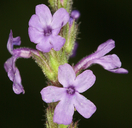
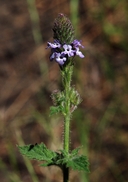
NATIVE Habit: Perennial herb 35--80 cm. Stem: 1--5+, ascending to erect; hairs short, spreading. Leaf: 4--10 cm, +- ovate, coarsely toothed, deeply 1--2-lobed near base, soft-hairy to scabrous; petiole < 2 cm, occasionally narrowly winged. Inflorescence: spikes 1--3 per stem, in fruit 7--25 cm, generally open proximally (fruits not overlapping); flower bract 3--4.5 mm. Flower: calyx 2.5--4 mm; corolla 2.5--5 mm, blue to purple. Fruit: 1--2 mm. Note: Varieties need study. Jepson eFlora Author: Dieter H. Wilken Reference: Munir 2002 J Adelaide Bot Gard 18:21--103; Yeo 1990 Kew Bull 45:101--120; Yuan & Olmstead 2008 Molec Phylogen Evol 48:23--33 Index of California Plant Names (ICPN; linked via the Jepson Online Interchange) Previous taxon: Verbena hastata Next taxon: Verbena lasiostachys var. lasiostachys
Botanical illustration including Verbena lasiostachys
Citation for this treatment: Dieter H. Wilken 2012, Verbena lasiostachys, in Jepson Flora Project (eds.) Jepson eFlora, https://ucjeps.berkeley.edu/eflora/eflora_display.php?tid=47907, accessed on April 23, 2024.
Citation for the whole project: Jepson Flora Project (eds.) 2024, Jepson eFlora, https://ucjeps.berkeley.edu/eflora/, accessed on April 23, 2024.
MAP CONTROLS 1. You can change the display of the base map layer control box in the upper right-hand corner.
2. County and Jepson Region polygons can be turned off and on using the check boxes.
(Note: any qualifiers in the taxon distribution description, such as 'northern', 'southern', 'adjacent' etc., are not reflected in the map above, and in some cases indication of a taxon in a subdivision is based on a single collection or author-verified occurence).
Data provided by the participants of the
Consortium of California Herbaria.
MAP LEGEND View all CCH records All markers link to CCH specimen records. The original determination is shown in the popup window.
Blue markers indicate specimens that map to one of the expected Jepson geographic subdivisions (see left map). Purple markers indicate specimens collected from a garden, greenhouse, or other non-wild location.
Yellow markers indicate records that may provide evidence for eFlora range revision or may have georeferencing or identification issues.
READ ABOUT YELLOW FLAGS
CCH collections by month
Duplicates counted once; synonyms included.
Species do not include records of infraspecific taxa, if there are more than 1 infraspecific taxon in CA.
Blue line denotes eFlora flowering time (fruiting time in some monocot genera).