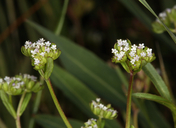
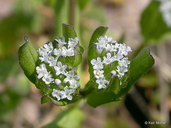
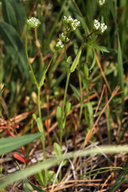
Common Name: VALERIAN FAMILY Habit: Annual, perennial herb, occasionally strongly scented, odor generally unpleasant. Leaf: simple to pinnately lobed or compound; petioles generally sheathing; basal +- whorled; cauline opposite, petioled to sessile. Inflorescence: cyme, panicle, or head-like, generally +- dense. Flower: generally bisexual; calyx fused to ovary tip, limb 0 or lobes generally 5--15, coiled inward, plumose in age, pappus-like, spreading in fruit; corolla radial to 2-lipped, lobes generally 5, throat generally > lobes, > tube, base generally spurred or swollen, tube slender, long or short; stamens generally 1--3, fused to petals; ovary inferior, chamber generally 1, or occasionally 3 but 2 empty or vestigial. Fruit: achene, smooth, ribbed, or winged. Genera In Family: +- 17 genera, 300 species: generally temperate, worldwide except Australia. Some species cultivated (Centranthus), some medicinal (Valeriana). eFlora Treatment Author: Abigail J. Moore & Lauramay T. Dempster, except as noted Scientific Editor: Douglas H. Goldman, Bruce G. Baldwin.
Citation for this treatment: Abigail J. Moore 2012, Valerianella locusta, in Jepson Flora Project (eds.) Jepson eFlora, https://ucjeps.berkeley.edu/eflora/eflora_display.php?tid=47754, accessed on April 17, 2024.
Citation for the whole project: Jepson Flora Project (eds.) 2024, Jepson eFlora, https://ucjeps.berkeley.edu/eflora/, accessed on April 17, 2024.
Geographic subdivisions for Valerianella locusta:
KR, NCoRO, CaRH, n SN, n ScV, CCo, SnFrB
MAP CONTROLS 1. You can change the display of the base map layer control box in the upper right-hand corner.
2. County and Jepson Region polygons can be turned off and on using the check boxes.
(Note: any qualifiers in the taxon distribution description, such as 'northern', 'southern', 'adjacent' etc., are not reflected in the map above, and in some cases indication of a taxon in a subdivision is based on a single collection or author-verified occurence).
Data provided by the participants of the
Consortium of California Herbaria.
MAP LEGEND View all CCH records All markers link to CCH specimen records. The original determination is shown in the popup window.
Blue markers indicate specimens that map to one of the expected Jepson geographic subdivisions (see left map). Purple markers indicate specimens collected from a garden, greenhouse, or other non-wild location.
Yellow markers indicate records that may provide evidence for eFlora range revision or may have georeferencing or identification issues.
READ ABOUT YELLOW FLAGS
CCH collections by month
Duplicates counted once; synonyms included.
Species do not include records of infraspecific taxa, if there are more than 1 infraspecific taxon in CA.
Blue line denotes eFlora flowering time (fruiting time in some monocot genera).