![]() |
|||||
| University of California, Berkeley | |||||
| Directory News Site Map Home | |||||
| Jepson eFlora: Taxon page
Key to families | Table of families and genera |
|
|
Indexes to all accepted names and synonyms: | A | B | C | D | E | F | G | H | I | J | K | L | M | N | O | P | Q | R | S | T | U | V | W | X | Y | Z | |
|
Tree.
Leaf: simple, alternate, 2-ranked; veins pinnate; stipules deciduous.
Flower: radial; sepals 4–9, free to fused; corolla 0; stamens 4–9, opposite sepals; ovary superior, chamber 1, ovule 1, style branches 2.
Fruit: 2-winged nutlet.
7 genera, ± 60 species: temperate to tropics; some cultivated for ornamental (Ulmus, Zelkova), used for wood (especially Ulmus). [Sytsma et al. 2002 Ann Missouri Bot Gard 89:1531–1546] Celtis moved to Cannabaceae. —Scientific Editor: Bruce G. Baldwin.
Unabridged references: [Elias 1970 J Arnold Arbor 51:18–40]
Deciduous.Key to Ulmus
Leaf: serrate (or doubly so), base generally oblique, 2° veins straight, parallel, extending to margin, each ending in a tooth; axils of 2° veins generally with prominent tufts of hairs.
Inflorescence: umbels or short racemes in leaf axils on old wood; flowers sessile or pedicels 7–17 mm.
Flower: bisexual; calyx generally bell-shaped, lobes 4–9; stamens 4–9, exserted; ovary strongly compressed; style divided to base, branches spreading.
± 40 species: n temperate. Widely cultivated as street trees; flowers, fruit needed for identification.
To 35 m; bark split into ridges that mostly curve together at their ends.
Stem: corky outgrowths on branches 0; winter buds red-brown, conical or narrowly ovoid, ± pubescent.
Leaf: 8.6–12.5 cm, 4.2–7 cm wide, elliptical or occasionally oblong, acuminate, generally slenderly so, margins strongly double- serrate, abaxial surface sparsely long-hairy on blade and veins, hairs tufted in vein axils.
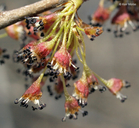
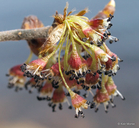
Inflorescence: flower, fruit before leaves in spring; pedicel 7–17 mm, slender.
Fruit: 0.9–1.3 cm, 0.6–0.8 cm wide, elliptical or oblong, tan, margins densely ciliate, surfaces glabrous.
Seeding along disturbed streambanks, or spreading by root suckers near old plantings; 60–700 m. Sacramento Valley, South Coast;
Previous taxon: Ulmus
Next taxon: Ulmus minor
Citation for the whole project: Jepson Flora Project (eds.) [year] Jepson eFlora, http://ucjeps.berkeley.edu/IJM.html [accessed on month, day, year]
Citation for an individual treatment: [Author of taxon treatment] [year]. [Taxon name] in Jepson Flora Project (eds.) Jepson eFlora, [URL for treatment]. Accessed on [month, day, year].
Copyright © 2012 Regents of the University of California
We encourage links to these pages, but the content may not be downloaded for reposting, repackaging, redistributing, or sale in any form, without written permission from The Jepson Herbarium.
| Bioregions in which taxon occurs | Red area (if present) is the part of the bioregion lying between the upper and lower elevation limits of the taxon; markers link to CCH specimen records. If the markers are obscured, reload the page [or change window size and reload]. Yellow markers indicate records that may have georeferencing or identification issues. |
|
|
|
|
Chart based on elevation range in Manual and elevations and coordinates of CCH records. Data provided by the participants of the Consortium of California Herbaria. Note: About half of the CCH records include both elevation and coordinates. | Map made in collaboration with Scott Loarie. Data provided by the participants of the Consortium of California Herbaria.
View all CCH records
CCH collections by month |