Common Name: ARROW-GRASS FAMILY Habit: Annual, perennial herb, rhizomed or dense-tufted, terrestrial or aquatic. Leaf: generally +- basal, alternate, +- flat to narrow-cylindric; sheath open, generally liguled. Inflorescence: spike or generally +- scapose raceme; bracts 0. Flower: generally bisexual; perianth parts generally 6 in 2 whorls (0, 1) [3, 4], free, scale-like, +- green or tinged +- red-purple; stamens 0, 1, 3, or 6, filaments short, +- fused to perianth; pistil 1, carpels 1, 6 [3, 4], +- fused, separating in fruit [or not], each with 1 chamber and 1 ovule or 3 carpels fertile, 3 sterile, placentas basal, stigmas generally +- sessile. Fruit: achene or generally mericarps. Genera In Family: 3 genera, 30 species: temperate, circumboreal, Australia, southern Africa, South America. Note:Lilaea included in Triglochin. eFlora Treatment Author: David J. Keil Scientific Editor: Thomas J. Rosatti.
Common Name: ARROW-GRASS Habit: Plant +- glabrous. Leaf: basal, +- tufted; sheath membranous; ligule tip entire to 2-lobed [0]. Flower: perianth parts generally adaxially concave; anthers +- sessile; stigma papillate or +- plumose. Fruit: achene or generally 3, 6 mericarps. Seed: 1, linear, +- flat or angled. Etymology: (Greek: 3 points, from fruits of some) Toxicity: TOXIC when fresh, from cyanogenic compounds.
Triglochin palustris L.
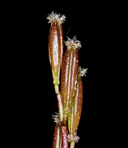
NATIVE Habit: Perennial herb 1--3(5.5) dm, tufted; rhizomes ascending, +- stout. Leaf: 5--30 cm, 0.5--2 mm wide, +- elliptic in ×-section; ligule 0.5--1.5 mm, tip generally deep-2-lobed. Inflorescence: aerial raceme, generally 1--2 per pl, generally > leaves; pedicels generally 4--6 mm in fruit, erect. Flower: perianth parts generally 6, 1.5--2 mm; stamens 6; fertile carpels 3. Fruit: mericarps 3, 5--7(9) mm, distally clinging to fruit axis, abaxially weak-ridged. Chromosomes: 2n=24. Ecology: Wet meadows, wet flats, stream and lake margins; Elevation: 2100--3450 m. Bioregional Distribution: c&s SNH; Distribution Outside California: circumboreal, South America, New Zealand. Flowering Time: Jul--Aug Jepson eFlora Author: David J. Keil Index of California Plant Names (ICPN; linked via the Jepson Online Interchange) Listed on CNPS Rare Plant Inventory Previous taxon: Triglochin maritima Next taxon: Triglochin scilloides
Botanical illustration including Triglochin palustris
Citation for this treatment: David J. Keil 2012, Triglochin palustris, in Jepson Flora Project (eds.) Jepson eFlora, https://ucjeps.berkeley.edu/eflora/eflora_display.php?tid=47200, accessed on April 19, 2024.
Citation for the whole project: Jepson Flora Project (eds.) 2024, Jepson eFlora, https://ucjeps.berkeley.edu/eflora/, accessed on April 19, 2024.
MAP CONTROLS 1. You can change the display of the base map layer control box in the upper right-hand corner.
2. County and Jepson Region polygons can be turned off and on using the check boxes.
(Note: any qualifiers in the taxon distribution description, such as 'northern', 'southern', 'adjacent' etc., are not reflected in the map above, and in some cases indication of a taxon in a subdivision is based on a single collection or author-verified occurence).
Data provided by the participants of the
Consortium of California Herbaria.
MAP LEGEND View all CCH records All markers link to CCH specimen records. The original determination is shown in the popup window.
Blue markers indicate specimens that map to one of the expected Jepson geographic subdivisions (see left map). Purple markers indicate specimens collected from a garden, greenhouse, or other non-wild location.
Yellow markers indicate records that may provide evidence for eFlora range revision or may have georeferencing or identification issues.
READ ABOUT YELLOW FLAGS
CCH collections by month
Duplicates counted once; synonyms included.
Species do not include records of infraspecific taxa, if there are more than 1 infraspecific taxon in CA.
Blue line denotes eFlora flowering time (fruiting time in some monocot genera).