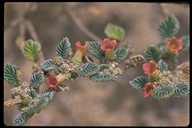
Common Name: EHRETIA FAMILY Habit: Perennial herb to shrub [tree], hairy to glabrous. Leaf: simple, alternate, entire to crenate [dissected], petiolate; stipules 0. Inflorescence: axillary [terminal] cymes or flowers 1, sometimes congested. Flower: bisexual [unisexual, plants dioecious], generally radial; calyx lobes 5, fused or free to base; corolla lobes 5, fused, generally rotate or bell-shaped to urn-shaped; stamens 5, epipetalous, generally exserted; ovary superior, generally subtended by disk-like nectary, chambers 1--4, style terminal, 2-branched, stigma club-shaped or head-shaped. Fruit: generally separating into two 2-seeded drupe-like units, four 1-seeded drupe-like units, or four nutlets. Genera In Family: 7 genera, +- 150 species; worldwide distribution, especially in tropics and subtropics. Note: Included in Boraginaceae in TJM2 and some other treatments (Angiosperm Phylogeny Group IV 2016 Bot J Linn Soc 181:1--20) but treated as separate family by Boraginales Working Group (Luebert et al. 2016). Lennoaceae nested within Ehretiaceae in some molecular phylogenetic analyses. eFlora Treatment Author: Michael G. Simpson
Habit: Annual to subshrub, variously hairy, glandular or not; +- taprooted, rhizome generally 0. Stem: prostrate. Leaf: cauline, generally clustered, evergreen, petioled, margin rolled under, entire or +- crenate. Inflorescence: +- axillary; flowers 1 or clustered, sessile. Flower: radial to +- bilateral; calyx lobes 5, not enlarged in fruit; corolla generally +- funnel-shaped, tube yellow in youth, appendages 0; style 2-lobed, stigmas 2. Fruit: nutlets 1--4, not separate to base, 4-grooved to deep-4-lobed, +- tubercled or not. Etymology: (Native South American name for flower) Unabridged Note: Separated from Coldenia of eastern hemisphere prior to TJM (1993). eFlora Treatment Author: Ronald B. Kelley Unabridged Reference: Richardson 1977 Rhodora 79:467--572
Tiquilia plicata (Torr.) A.T. Richardson
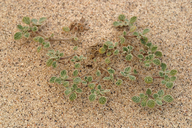
NATIVE Habit: Perennial herb, not woody, matted; rhizomed. Stem: branches opposite, +- glandular. Leaf: clustered, white-canescent; blade 3--12 mm, obovate to wide-ovate, margin entire, lateral veins 4--7 pairs, deeply sunken. Inflorescence: flowers clustered in leaf axils; bracts 0. Flower: calyx 2--3 mm, lobes +- free, hairs within long; corolla 4--6 mm, 2--3 mm diam, blue to lavender; style > calyx, branched 1/2--4/5. Fruit: deeply 4-lobed; nutlets ovoid, smooth, shiny. Chromosomes: n=8. Ecology: Dunes, sandy gravel flats; Elevation: < 1100 m. Bioregional Distribution: D; Distribution Outside California: western Arizona, southern Nevada, northern Mexico. Flowering Time: Mar--Jul Synonyms: Coldenia plicata (Torr.) Coville Jepson eFlora Author: Ronald B. Kelley Index of California Plant Names (ICPN; linked via the Jepson Online Interchange) Previous taxon: Tiquilia palmeri Next taxon: Elaeagnaceae
Citation for this treatment: Ronald B. Kelley 2021, Tiquilia plicata, in Jepson Flora Project (eds.) Jepson eFlora, Revision 9, https://ucjeps.berkeley.edu/eflora/eflora_display.php?tid=46670, accessed on April 24, 2024.
Citation for the whole project: Jepson Flora Project (eds.) 2024, Jepson eFlora, https://ucjeps.berkeley.edu/eflora/, accessed on April 24, 2024.
MAP CONTROLS 1. You can change the display of the base map layer control box in the upper right-hand corner.
2. County and Jepson Region polygons can be turned off and on using the check boxes.
(Note: any qualifiers in the taxon distribution description, such as 'northern', 'southern', 'adjacent' etc., are not reflected in the map above, and in some cases indication of a taxon in a subdivision is based on a single collection or author-verified occurence).
Data provided by the participants of the
Consortium of California Herbaria.
MAP LEGEND View all CCH records All markers link to CCH specimen records. The original determination is shown in the popup window.
Blue markers indicate specimens that map to one of the expected Jepson geographic subdivisions (see left map). Purple markers indicate specimens collected from a garden, greenhouse, or other non-wild location.
Yellow markers indicate records that may provide evidence for eFlora range revision or may have georeferencing or identification issues.
READ ABOUT YELLOW FLAGS
CCH collections by month
Duplicates counted once; synonyms included.
Species do not include records of infraspecific taxa, if there are more than 1 infraspecific taxon in CA.
Blue line denotes eFlora flowering time (fruiting time in some monocot genera).