Common Name: CARROT FAMILY Habit: Annual to perennial herb [shrub, tree], generally from taproot. Stem: generally +- scapose, generally ribbed, hollow. Leaf: basal and generally cauline, generally alternate; stipules generally 0; petiole base generally sheathing stem; blade generally much dissected, occasionally compound. Inflorescence: umbel or head, simple or compound, generally peduncled; bracts present in involucres or 0; bractlets generally present in "involucels". Flower: many, small, generally bisexual (or some staminate), generally radial (or outer bilateral); calyx 0 or lobes 5, small; petals 5, free, generally ovate or spoon-shaped, generally incurved at tips, generally +- ephemeral; stamens 5; pistil 1, ovary inferior, 2-chambered, generally with a +- conic, persistent projection or platform at tip subtending 2 free styles. Fruit: 2 dry, 1-seeded halves (= mericarps), separating from each other but generally +- persistent to central axis; ribs on halves 5, 2 marginal, 3 to back; oil tubes 1--several per interval between ribs. Genera In Family: 300 genera, 3000 species: +- worldwide, especially temperate; many cultivated for food or spice (e.g., Carum, caraway; Daucus; Petroselinum); Bupleurum lancifolium Hornem. is historical garden weed; some toxic (e.g., Conium). Note: Mature fruit generally critical in identification, shape given in outline. Hydrocotyle moved to Araliaceae, Orogenia moved to Lomatium, Sphenosciadium moved to Angelica. Petroselinum crispum (Mill.) A.W. Hill is a waif. eFlora Treatment Author: Lincoln Constance & Margriet Wetherwax, except as noted Scientific Editor: Douglas H. Goldman, Bruce G. Baldwin.
Habit: Perennial herb, taprooted or roots tuberous; glabrous to hairy. Stem: 0 or short. Leaf: blade oblong to obovate, 1--2-pinnate or -ternate, leaflets wide, margins entire to pinnately lobed. Inflorescence: umbels compound, terminal; peduncle generally > leaf; bracts generally 0; involucel 1-sided; bractlets inconspicuous to leaf-like; rays, pedicels few to many, ascending to reflexed, generally few fertile. Flower: calyx lobes occasionally 0; petals wide, yellow, tips narrowed; styles slender; ovary tip projection inconspicuous. Fruit: oblong to round, +- compressed side-to-side, glabrous; ribs prominent to thread-like, +- equal, unwinged; oil tubes several per rib-interval; fruit axis generally divided +- to base. Seed: face generally grooved or concave. Etymology: (I.F. Tausch, Czech botanist, 1793--1848) eFlora Treatment Author: Lincoln Constance & Margriet Wetherwax
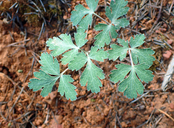
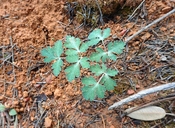
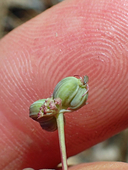
NATIVE Habit: Plant 2--4 dm, glabrous. Stem: 0 or generally < leaves. Leaf: petiole 2--12 cm; blade 6--12 cm, ovate to round, 2-ternate or ternate-pinnate, leaflets 10--17 mm, ovate to round, coarsely serrate or lobed. Inflorescence: peduncle 2--4 dm; bractlets several, 1--7 mm, lanceolate; rays 5--12, 1--6 cm, unequal; pedicel 1--3 mm. Flower: calyx lobes minute; corolla yellow; styles slender. Fruit: 2--3 mm, +- round; ribs thread-like; oil tubes 2--3 per rib-interval; fruit axis divided to base or nearly so. Chromosomes: 2n=22. Ecology: Gravelly, generally serpentine flats in conifer forest; Elevation: 80--1700 m. Bioregional Distribution: KR, NCoRO; Distribution Outside California: southern Oregon. Flowering Time: Apr--Jun Jepson eFlora Author: Lincoln Constance & Margriet Wetherwax Index of California Plant Names (ICPN; linked via the Jepson Online Interchange) Listed on CNPS Rare Plant Inventory Previous taxon: Tauschia arguta Next taxon: Tauschia hartwegii
Citation for this treatment: Lincoln Constance & Margriet Wetherwax 2012, Tauschia glauca, in Jepson Flora Project (eds.) Jepson eFlora, https://ucjeps.berkeley.edu/eflora/eflora_display.php?tid=46096, accessed on April 20, 2024.
Citation for the whole project: Jepson Flora Project (eds.) 2024, Jepson eFlora, https://ucjeps.berkeley.edu/eflora/, accessed on April 20, 2024.
MAP CONTROLS 1. You can change the display of the base map layer control box in the upper right-hand corner.
2. County and Jepson Region polygons can be turned off and on using the check boxes.
(Note: any qualifiers in the taxon distribution description, such as 'northern', 'southern', 'adjacent' etc., are not reflected in the map above, and in some cases indication of a taxon in a subdivision is based on a single collection or author-verified occurence).
Data provided by the participants of the
Consortium of California Herbaria.
MAP LEGEND View all CCH records All markers link to CCH specimen records. The original determination is shown in the popup window.
Blue markers indicate specimens that map to one of the expected Jepson geographic subdivisions (see left map). Purple markers indicate specimens collected from a garden, greenhouse, or other non-wild location.
Yellow markers indicate records that may provide evidence for eFlora range revision or may have georeferencing or identification issues.
READ ABOUT YELLOW FLAGS
CCH collections by month
Duplicates counted once; synonyms included.
Species do not include records of infraspecific taxa, if there are more than 1 infraspecific taxon in CA.
Blue line denotes eFlora flowering time (fruiting time in some monocot genera).