Common Name: GOOSEFOOT FAMILY Habit: Annual to shrub; hairs simple, stellate, or glandular; plants in several genera scaly, mealy, or powdery from collapsed glands; monoecious, dioecious, with bisexual flowers, or with both bisexual and unisexual flowers. Stem: occasionally fleshy. Leaf: blade simple, generally alternate, occasionally fleshy or reduced to scales, veins pinnate; stipules 0. Inflorescence: raceme, spike, catkin-like, spheric head, axillary clusters of flowers, or flowers 1; bracts 0--5, herbaceous, generally persistent or strongly modified in fruit, wings, tubercles or spines present or 0. Flower: bisexual or unisexual, small, generally green; calyx parts (1)3--5, or 0 in pistillate flowers, free or fused basally (or +- throughout), leaf-like in texture, membranous, or fleshy, deciduous or not, often strongly modified in fruit; corolla 0; stamens 1--5, opposite sepals, filaments free, equal; anthers 4-chambered; ovary superior (1/2-inferior), chamber 1; ovule 1; styles, stigmas 1--4 (or stigmas sessile). Fruit: achene or utricle, generally falling with persistent calyx or bracts. Seed: 1, small, lenticular to spheric; seed coat smooth to finely dotted, warty, net-like, or prickly, margin occasionally winged. Genera In Family: 100 genera, 1500 species: worldwide, especially deserts, saline or alkaline soils; some cultivated for food (Beta vulgaris subsp. vulgaris, beet, Swiss chard; Spinacia oleracea L., spinach; Chenopodium quinoa Willd., quinoa); and some worldwide, naturalized ruderal or noxious agricultural weeds. Note:Nitrophila treated in Amaranthaceae, Sarcobatus treated in Sarcobataceae. Key to genera revised by Elizabeth H. Zacharias to incorporate Extriplex and Stutzia, 2 genera segregated from Atriplex. Native spp. of Kochia now treated in Neokochia. Chenopodiaceae often treated now within a more broadly circumscribed Amaranthaceae (Morales-Briones et al. 2021). eFlora Treatment Author: Mihai Costea, family description, key to genera, revised by Thomas J. Rosatti & Elizabeth H. Zacharias, except as noted Scientific Editor: Bruce G. Baldwin, David J. Keil, Thomas J. Rosatti, Margriet Wetherwax.
Common Name: SEABLITE, SEEPWEED Habit: Annual to shrub, glabrous to hairy. Leaf: generally alternate; blade entire, cylindric to adaxially flattened or completely flattened, fleshy, generally glaucous, tip acute [obtuse to round]. Inflorescence: cyme; clusters sessile, generally in panicles of spikes; bracts leaf-like to reduced; bractlets subtending flowers 1--3, minute, membranous; flowers 1--12 per cluster. Flower: generally bisexual; calyx radial, bilateral, or asymmetric, lobes 5, generally fleshy, rounded, hooded, keeled, horned, or wing-margined; ovary +- lenticular, rounded, conic or pear-shaped, neck occasionally narrowed, stigmas 2--4(5). Fruit: enclosed in calyx. Seed: horizontal or vertical, lenticular or flat, of 2 kinds in some species. Etymology: (Ancient Arabic name) eFlora Treatment Author: H. Jochen Schenk & Wayne R. Ferren, Jr. Reference: Ferren & Schenk 2003 FNANM 4:390--398
Suaeda calceoliformis (Hook.) Moq.
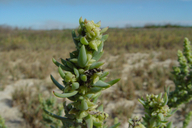
NATIVE Habit: Annual < 8 dm, glabrous, glaucous. Stem: prostrate to erect, 1--several; branches generally decumbent to ascending, green to dark red, generally striped. Leaf: generally tightly ascending, < 40 mm, linear, sessile; adaxial surface flat, green to +- red. Inflorescence: generally dense, branched; flowers 3--7 per cluster; bracts subtending branches = leaves; bracts subtending flowers < leaves, generally widest proximal to middle, fresh bracts membranous-margined at base. Flower: bilateral, 1--4 mm including horns; mature calyx lobes horned, +- keeled, wing-margined; ovary rounded to lenticular, stigmas generally 2, glabrous. Seed: horizontal; lenticular seeds 0.8--1.7 mm, shiny, generally black; flat seeds 1--1.5 mm, dull, brown. Chromosomes: 2n=36,54. Ecology: Saline or alkaline, wetland soils, generally dried; Elevation: < 2200 m. Bioregional Distribution: CA; Distribution Outside California: to Alaska, eastern Canada, Texas, Mexico. Flowering Time: Jul--Oct Unabridged Synonyms: Suaeda depressa (Pursh) S. Watson var. depressa, misappl.; Suaeda depressa var. erecta S. Watson Jepson eFlora Author: H. Jochen Schenk & Wayne R. Ferren, Jr. Reference: Ferren & Schenk 2003 FNANM 4:390--398 Index of California Plant Names (ICPN; linked via the Jepson Online Interchange) Previous taxon: Suaeda Next taxon: Suaeda californica
Botanical illustration including Suaeda calceoliformis
Citation for this treatment: H. Jochen Schenk & Wayne R. Ferren, Jr. 2012, Suaeda calceoliformis, in Jepson Flora Project (eds.) Jepson eFlora, https://ucjeps.berkeley.edu/eflora/eflora_display.php?tid=45831, accessed on April 25, 2024.
Citation for the whole project: Jepson Flora Project (eds.) 2024, Jepson eFlora, https://ucjeps.berkeley.edu/eflora/, accessed on April 25, 2024.
MAP CONTROLS 1. You can change the display of the base map layer control box in the upper right-hand corner.
2. County and Jepson Region polygons can be turned off and on using the check boxes.
(Note: any qualifiers in the taxon distribution description, such as 'northern', 'southern', 'adjacent' etc., are not reflected in the map above, and in some cases indication of a taxon in a subdivision is based on a single collection or author-verified occurence).
Data provided by the participants of the
Consortium of California Herbaria.
MAP LEGEND View all CCH records All markers link to CCH specimen records. The original determination is shown in the popup window.
Blue markers indicate specimens that map to one of the expected Jepson geographic subdivisions (see left map). Purple markers indicate specimens collected from a garden, greenhouse, or other non-wild location.
Yellow markers indicate records that may provide evidence for eFlora range revision or may have georeferencing or identification issues.
READ ABOUT YELLOW FLAGS
CCH collections by month
Duplicates counted once; synonyms included.
Species do not include records of infraspecific taxa, if there are more than 1 infraspecific taxon in CA.
Blue line denotes eFlora flowering time (fruiting time in some monocot genera).