Common Name: THEOPHRASTA FAMILY Habit: Perennial herb [shrub, tree], [generally glandular-hairy]. Leaf: simple, alternate but generally clustered at stem tips, petioled, stipules 0, margins entire [spiny-toothed]. Inflorescence: generally terminal, [rarely flowers 1 in axils]. Flower: bisexual [unisexual, plants dioecious], radial, parts generally in 5s, generally with glandular dots, lines, or pits; sepals free or united at base; corolla united at base, lobes spreading; stamens epipetalous, opposite corolla lobes, anthers forming cone as flower opens, then spreading; staminodes 5, alternate stamens, epipetalous, scale-, petal-, or stamen-like; ovary partly inferior, 1-chambered, placenta free-central or basal, style 1, stigma head-like. Fruit: capsule [generally dry berry or drupe]. Seed: 1--many, generally yellow to orange-red. Genera In Family: 7--9 genera, +- 100 species: generally tropical America. Note: Incl in Primulaceae in TJM (1993). Unabridged Note: Incl in Primulaceae in TJM (1993). The partially inferior ovary as well as aspects of staminode anatomy are unusual for Primulaceae. Recent research (Källersjö et al. 2000 Amer J Bot 87:1325--1341) has shown that Samolus is a sister-taxon to Theophrastaceae, providing evidence for its removal from Primulaceae. eFlora Treatment Author: Anita F. Cholewa Scientific Editor: Thomas J. Rosatti.
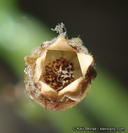
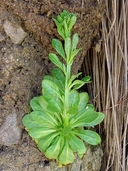
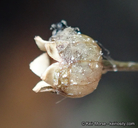
Habit: Erect, glabrous. Leaf: cauline or basal and cauline, alternate. Inflorescence: raceme, terminal and axillary. Flower: corolla > calyx, white. Fruit: spheric, valves 5, opposite calyx lobes. Etymology: (Celtic: from curative properties)
Samolus parviflorus Raf.
NATIVE Stem: 1.5--4 dm. Leaf: 2--5 cm; blade lance-oblong to obovate, generally tapered to winged petiole, tip obtuse to rounded. Inflorescence: pedicels ascending to spreading, 1--2 cm, with 1 bractlet +- near middle. Flower: calyx 1--2 mm, lobes triangular; corolla +- 1.5 mm across. Fruit: +- 2.5 mm wide. Chromosomes: 2n=26. Ecology: Moist sites; Elevation: generally < 1300 m. Bioregional Distribution: GV, CW, SCo, n ChI, WTR, SnBr, PR; Distribution Outside California: to British Columbia, eastern North America, South America. Flowering Time: Spring--summer Note:Samolus ebracteatus Kunth (leaves crowded near stem bases; bractlets, staminodes 0), from Baja California and Clark Co., Nevada, expected in extreme southeastern California. Synonyms: Samolus floribundus Kunth; Samolus valerandi L. subsp. parviflorus (Raf.) Hultén Jepson eFlora Author: Anita F. Cholewa Index of California Plant Names (ICPN; linked via the Jepson Online Interchange) Previous taxon: Samolus Next taxon: Thymelaeaceae
Botanical illustration including Samolus parviflorus
Citation for this treatment: Anita F. Cholewa 2012, Samolus parviflorus, in Jepson Flora Project (eds.) Jepson eFlora, https://ucjeps.berkeley.edu/eflora/eflora_display.php?tid=43144, accessed on April 23, 2024.
Citation for the whole project: Jepson Flora Project (eds.) 2024, Jepson eFlora, https://ucjeps.berkeley.edu/eflora/, accessed on April 23, 2024.
Geographic subdivisions for Samolus parviflorus:
GV, CW, SCo, n ChI, WTR, SnBr, PR
MAP CONTROLS 1. You can change the display of the base map layer control box in the upper right-hand corner.
2. County and Jepson Region polygons can be turned off and on using the check boxes.
(Note: any qualifiers in the taxon distribution description, such as 'northern', 'southern', 'adjacent' etc., are not reflected in the map above, and in some cases indication of a taxon in a subdivision is based on a single collection or author-verified occurence).
Data provided by the participants of the
Consortium of California Herbaria.
MAP LEGEND View all CCH records All markers link to CCH specimen records. The original determination is shown in the popup window.
Blue markers indicate specimens that map to one of the expected Jepson geographic subdivisions (see left map). Purple markers indicate specimens collected from a garden, greenhouse, or other non-wild location.
Yellow markers indicate records that may provide evidence for eFlora range revision or may have georeferencing or identification issues.
READ ABOUT YELLOW FLAGS
CCH collections by month
Duplicates counted once; synonyms included.
Species do not include records of infraspecific taxa, if there are more than 1 infraspecific taxon in CA.
Blue line denotes eFlora flowering time (fruiting time in some monocot genera).