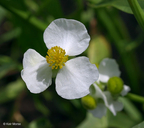
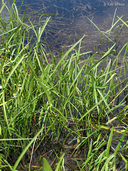
Common Name: WATER-PLANTAIN FAMILY Habit: Annual, perennial herb from caudices, corms, stolons, rhizomes, or tubers, aquatic (+- emergent or on mud); roots fibrous, septate or not; monoecious, dioecious, or flowers bisexual. Stem: caudex short. Leaf: basal, simple, palmately veined, floating or not; submersed generally linear to ovate; emergent linear to sagittate. Inflorescence: generally scapose, umbel-, raceme-, or panicle-like; flowers, branches whorled. Flower: radial; sepals 3, generally green, generally persistent; petals 3, generally > sepals, white or pink; stamens 6--many; pistils 6--many, free or +- fused at base. Fruit: achene, generally compressed, beaked. Genera In Family: +- 12 genera, 75--100 species: especially tropics, subtropics. eFlora Treatment Author: Charles E. Turner, Robert R. Haynes & C. Barre Hellquist Scientific Editor: Thomas J. Rosatti.
Common Name: ARROWHEAD Habit: Annual, perennial herb; roots septate; generally monoecious; scape generally straight at inflorescence. Leaf: petiole cylindric to 3-angled; submersed blades tapered to base; floating or emergent blades generally sagittate (linear to ovate). Inflorescence: lowest node generally with 3 pistillate flowers, those above generally staminate. Flower: sepals 3--10 mm, reflexed to appressed in fruit; petals generally entire. Staminate Flower: stamens 7--30. Pistillate Flower: receptacle convex; pistils many, spiralled on convex receptacle. Fruit: body generally 2--3.5 mm, strongly compressed, abaxially winged or ridged; beak generally lateral, spreading to erect. Etymology: (Latin: arrow, from leaf shape) Note: Some species weedy; tubers of some eaten by humans, wildlife; Sagittaria brevirostra Mack. & Bush reportedly persisting at Stafford Lake and Chileno Laguna, Marin Co. Unabridged Reference: Bogin 1955 Mem New York Bot Gard 9:179--233
Sagittaria latifolia Willd.
NATIVE Habit: Perennial herb; tubers oblong, +- white or +- blue. Leaf: petioles of emergent leaves ascending to erect, blades 1.5--30 cm, sagittate, basal lobes +- = terminal. Staminate Flower: filaments glabrous. Pistillate Flower: pedicel ascending in fruit; sepals reflexed in fruit. Fruit: beak spreading, 1--2 mm. Chromosomes: 2n=22. Ecology: Ponds, slow streams; Elevation: < 1500 m. Bioregional Distribution: CA-FP, GB; Distribution Outside California: to southern Canada, eastern United States, northern South America. Flowering Time: Jul--Aug Jepson eFlora Author: Charles E. Turner, Robert R. Haynes & C. Barre Hellquist Index of California Plant Names (ICPN; linked via the Jepson Online Interchange) Previous taxon: Sagittaria cuneata Next taxon: Sagittaria longiloba
Botanical illustration including Sagittaria latifolia
Citation for this treatment: Charles E. Turner, Robert R. Haynes & C. Barre Hellquist 2012, Sagittaria latifolia, in Jepson Flora Project (eds.) Jepson eFlora, https://ucjeps.berkeley.edu/eflora/eflora_display.php?tid=42617, accessed on April 19, 2024.
Citation for the whole project: Jepson Flora Project (eds.) 2024, Jepson eFlora, https://ucjeps.berkeley.edu/eflora/, accessed on April 19, 2024.
MAP CONTROLS 1. You can change the display of the base map layer control box in the upper right-hand corner.
2. County and Jepson Region polygons can be turned off and on using the check boxes.
(Note: any qualifiers in the taxon distribution description, such as 'northern', 'southern', 'adjacent' etc., are not reflected in the map above, and in some cases indication of a taxon in a subdivision is based on a single collection or author-verified occurence).
Data provided by the participants of the
Consortium of California Herbaria.
MAP LEGEND View all CCH records All markers link to CCH specimen records. The original determination is shown in the popup window.
Blue markers indicate specimens that map to one of the expected Jepson geographic subdivisions (see left map). Purple markers indicate specimens collected from a garden, greenhouse, or other non-wild location.
Yellow markers indicate records that may provide evidence for eFlora range revision or may have georeferencing or identification issues.
READ ABOUT YELLOW FLAGS
CCH collections by month
Duplicates counted once; synonyms included.
Species do not include records of infraspecific taxa, if there are more than 1 infraspecific taxon in CA.
Blue line denotes eFlora flowering time (fruiting time in some monocot genera).