Common Name: BUCKTHORN FAMILY Habit: [Perennial herb] shrub, tree, generally erect, often thorny. Leaf: simple, generally alternate, often clustered on short-shoots; stipules generally present, occasionally modified into spines; generally petioled; blade pinnate-veined or 1--5-ribbed from base. Inflorescence: cyme, panicle, umbel, or flowers 1 or clustered in axils or on short-shoots. Flower: generally bisexual, radial; hypanthium subtending, surrounding, or partly fused to ovary; sepals 4--5; petals 0, 4--5, generally clawed; stamens 0, 4--5, alternate sepals, attached to hypanthium top, each generally fitting into a petal concavity; disk (0 or) between stamens, ovary, thin to fleshy, entire or lobed, free from ovary, adherent or fused to hypanthium; ovary superior or +- inferior, chambers [1]2--4, 1--2-ovuled, style 1, stigma entire or 2--3-lobed. Fruit: capsule, drupe. Genera In Family: 50--52 genera, 950 species: especially tropics, subtropics some cultivated (Ceanothus; Frangula; Rhamnus; Ziziphus). eFlora Treatment Author: John O. Sawyer, Jr., except as noted Scientific Editor: Steve Boyd, Thomas J. Rosatti.
Common Name: BUCKTHORN Habit: Shrub, small tree, < 10 m. Stem: branches alternate, stiff or flexible; twigs generally not thorn-tipped; winter bud scales present, generally +- 3 mm. Leaf: scattered along branches or clustered on short-shoots, deciduous or evergreen; stipules generally deciduous; petioles generally glabrous; blade veins prominent or not. Inflorescence: flowers 1 or in cyme-like clusters in axils. Flower: unisexual (bisexual), generally on separate pls, generally < 3 mm; hypanthium bell-shaped to cup-like, 2--3 mm wide; sepals 4--5, thin, spreading, not keeled adaxially; petals 0 or 4--5; disk thin, adhering to hypanthium; ovary appearing superior or partly inferior, chambers 2--4, each 1-ovuled, style 1, stigma 2--4-lobed. Fruit: drupe, 2--3[4]-stoned. Etymology: (Greek: name for plants of this genus) Note: W.H. Brewer collected Rhamnus cathartica L., considered invasive in parts of United States, in 1861, but it apparently never naturalized. Other taxa in TJM (1993) moved to Frangula. eFlora Treatment Author: John O. Sawyer, Jr. Reference: Bolmgren & Oxelman 2004 Taxon 53:383--390 Unabridged Reference: Wolf 1938 Rancho Santa Ana Bot Gard Monogr 1
Rhamnus pirifolia Greene
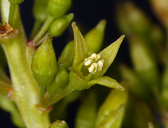
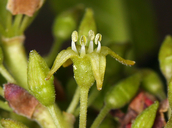
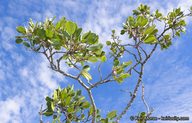
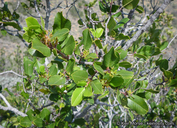
NATIVE Habit: Small tree, < 10 m. Stem: bark gray; branches ascending; twigs purple. Leaf: evergreen; petiole 5--10 mm; blade 20--50 mm, elliptic, thick, glabrous, abaxially concave, base rounded, tip acute to rounded, mucronate, margin entire to toothed, veins prominent. Inflorescence: 1--6-flowered, glabrous; pedicels 3--6 mm. Flower: generally unisexual; hypanthium +- 2 mm wide; sepals 4; petals 0. Fruit: 2-stoned, 6--8 mm, red. Ecology: Coastal-sage scrub, chaparral; Elevation: 10--520 m. Bioregional Distribution: ChI; Distribution Outside California: Mexico (Guadalupe Island). Flowering Time: Jan--Apr Synonyms: Rhamnus catalinae Davidson; Rhamnus crocea Nutt. var. insularis Sargent; Rhamnus crocea subsp. pirifolia (Greene) C.B. Wolf; Rhamnus crocea var. pirifolia (Greene) Little Jepson eFlora Author: John O. Sawyer, Jr. Reference: Bolmgren & Oxelman 2004 Taxon 53:383--390 Index of California Plant Names (ICPN; linked via the Jepson Online Interchange) Listed on CNPS Rare Plant Inventory Previous taxon: Rhamnus pilosa Next taxon: Ziziphus
Botanical illustration including Rhamnus pirifolia
Citation for this treatment: John O. Sawyer, Jr. 2012, Rhamnus pirifolia, in Jepson Flora Project (eds.) Jepson eFlora, https://ucjeps.berkeley.edu/eflora/eflora_display.php?tid=41075, accessed on April 19, 2024.
Citation for the whole project: Jepson Flora Project (eds.) 2024, Jepson eFlora, https://ucjeps.berkeley.edu/eflora/, accessed on April 19, 2024.
MAP CONTROLS 1. You can change the display of the base map layer control box in the upper right-hand corner.
2. County and Jepson Region polygons can be turned off and on using the check boxes.
(Note: any qualifiers in the taxon distribution description, such as 'northern', 'southern', 'adjacent' etc., are not reflected in the map above, and in some cases indication of a taxon in a subdivision is based on a single collection or author-verified occurence).
Data provided by the participants of the
Consortium of California Herbaria.
MAP LEGEND View all CCH records All markers link to CCH specimen records. The original determination is shown in the popup window.
Blue markers indicate specimens that map to one of the expected Jepson geographic subdivisions (see left map). Purple markers indicate specimens collected from a garden, greenhouse, or other non-wild location.
Yellow markers indicate records that may provide evidence for eFlora range revision or may have georeferencing or identification issues.
READ ABOUT YELLOW FLAGS
CCH collections by month
Duplicates counted once; synonyms included.
Species do not include records of infraspecific taxa, if there are more than 1 infraspecific taxon in CA.
Blue line denotes eFlora flowering time (fruiting time in some monocot genera).