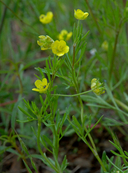
Common Name: BUTTERCUP FAMILY Habit: Annual, perennial herb, woody vine [shrub], occasionally aquatic. Leaf: generally basal and cauline, alternate or opposite, simple or compound; petioles at base generally flat, occasionally sheathing or stipule-like. Inflorescence: cyme, raceme, panicle, or flowers 1. Flower: generally bisexual, generally radial; sepals 3--6(20), free, early-deciduous or withering in fruit, generally green; petals 0--many, generally free; stamens generally 5--many, staminodes generally 0; pistils 1--many, ovary superior, chamber 1, style 0--1, generally +- persistent as beak, ovules 1--many. Fruit: achene, follicle, berry, +- utricle in Trautvetteria, in aggregate or not, 1--many-seeded. Genera In Family: +- 60 genera, 1700 species: worldwide, especially northern temperate, tropical mountains; many ornamental (Adonis, Aquilegia, Clematis, Consolida, Delphinium, Helleborus, Nigella). Toxicity: some highly TOXIC (Aconitum, Actaea, Delphinium, Ranunculus). Note: Taxa of Isopyrum in TJM (1993) moved to Enemion; Kumlienia moved to Ranunculus. eFlora Treatment Author: Margriet Wetherwax & Dieter H. Wilken, family description, key to genera Scientific Editor: Douglas H. Goldman, Bruce G. Baldwin.
Common Name: BUTTERCUP Habit: Annual to perennial herb, occasionally from stolons or caudices, terrestrial or aquatic; roots generally fibrous. Stem: prostrate to erect. Leaf: basal, cauline, or both, alternate, generally reduced upward; petiole base flat, stipule-like or not; basal, proximal cauline petioles generally long; blades simple to dissected or compound, entire to toothed. Inflorescence: cyme, axillary or terminal, 1--few-flowered. Flower: sepals 3--5(6), generally early-deciduous, generally green to yellow or purple; petals 0--17[(150)], shiny, generally yellow, occasionally white or purple, nectaries near base, pocket-like or with flap-like scale; anthers yellow; pistils generally many. Fruit: achene, compressed or not, +- spheric, disk-like (width 3--15 × depth), or lenticular (width 1--2 × depth), beaked. Etymology: (Latin: diminutive of Rana, frog, from wet habitats) eFlora Treatment Author: Alan T. Whittemore
Ranunculus arvensis L.
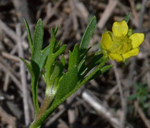
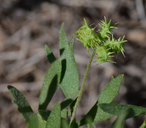
NATURALIZED Habit: Annual, biennial 10--40 cm, erect or ascending, not bulbous-based; roots basal, not tuberous. Leaf: basal, proximal cauline 1.8--5.2 cm, 1.6--4.2 cm wide, obovate to wedge-shaped, deeply lobed or dissected, leaflets oblanceolate, divided into entire or distally dentate, oblanceolate or linear segments or not, leaflet base narrowly acuminate, tip rounded, dentate or acuminate. Flower: receptacle sparsely bristly; sepals 5, spreading, 4--7 mm, 1--2 mm wide, early-deciduous; petals 5, 5--8 mm, 2--4 mm wide. Fruit: body 4--6.4 mm, 8--9 mm wide, disk-like, wall spiny; beak 1.6--3.8 mm, straight, lanceolate to awl-shaped. Ecology: Roadsides, fields, disturbed areas; Elevation: < 1000 m. Bioregional Distribution: KR, NCoRI, CaR, n SNF, ScV, MP; Distribution Outside California: to Washington, New York, South America, Australia; native to Eurasia. Flowering Time: Apr--May Jepson eFlora Author: Alan T. Whittemore Index of California Plant Names (ICPN; linked via the Jepson Online Interchange) Previous taxon: Ranunculus aquatilis var. diffusus Next taxon: Ranunculus bonariensis var. trisepalus
Botanical illustration including Ranunculus arvensis
Citation for this treatment: Alan T. Whittemore 2012, Ranunculus arvensis, in Jepson Flora Project (eds.) Jepson eFlora, https://ucjeps.berkeley.edu/eflora/eflora_display.php?tid=40860, accessed on April 24, 2024.
Citation for the whole project: Jepson Flora Project (eds.) 2024, Jepson eFlora, https://ucjeps.berkeley.edu/eflora/, accessed on April 24, 2024.
Geographic subdivisions for Ranunculus arvensis:
KR, NCoRI, CaR, n SNF, ScV, MP
MAP CONTROLS 1. You can change the display of the base map layer control box in the upper right-hand corner.
2. County and Jepson Region polygons can be turned off and on using the check boxes.
(Note: any qualifiers in the taxon distribution description, such as 'northern', 'southern', 'adjacent' etc., are not reflected in the map above, and in some cases indication of a taxon in a subdivision is based on a single collection or author-verified occurence).
Data provided by the participants of the
Consortium of California Herbaria.
MAP LEGEND View all CCH records All markers link to CCH specimen records. The original determination is shown in the popup window.
Blue markers indicate specimens that map to one of the expected Jepson geographic subdivisions (see left map). Purple markers indicate specimens collected from a garden, greenhouse, or other non-wild location.
Yellow markers indicate records that may provide evidence for eFlora range revision or may have georeferencing or identification issues.
READ ABOUT YELLOW FLAGS
CCH collections by month
Duplicates counted once; synonyms included.
Species do not include records of infraspecific taxa, if there are more than 1 infraspecific taxon in CA.
Blue line denotes eFlora flowering time (fruiting time in some monocot genera).