Common Name: LOOSESTRIFE FAMILY Habit: Annual, perennial herb, shrub, tree. Stem: 4-angled or cylindric. Leaf: simple, entire, generally opposite, 4-ranked (alternate, whorled). Inflorescence: flowers terminal or in axils of upper leaves or leaf-like bracts, 1 or in +- dense cymes or along short shoots, sessile or not, subtended by [0]2 bractlets. Flower: bisexual, generally radial; hypanthium bell-shaped to cylindric, membranous or leathery, persistent in fruit; sepals appearing as hypanthium lobes, 4--9, epicalyx lobes alternate sepals or 0; petals, stamens inserted on inner hypanthium; petals 4--6 or 0, alternate sepals, crinkled, deciduous; stamens generally = or 2 × sepals, included or exserted; ovary generally superior, chambers 2--6[many], style generally slender, stigma head-like. Fruit: dry capsule or leathery berry, dehiscent into 2--4 valves or irregularly. Seed: 3--many. Genera In Family: +- 28 genera, 600 species: temperate, tropics, generally in wet habitats. Some ornamental or cultivated for medicine, dyes. Note: "Epicalyx lobes" (lobes on calyx) formerly called "appendages," "hypanthium" in Lythraceae (and Onagraceae) including receptacle, sometimes called "flower cup" or "flower tube". Punicaceae (Punica) included here. eFlora Treatment Author: Shirley A. Graham Scientific Editor: Thomas J. Rosatti.
Common Name: POMEGRANATE Habit: Shrub, small tree, glabrous. Stem: branches generally many, from near base, often a thorn at tip. Leaf: simple, +- opposite, entire, deciduous. Inflorescence: flowers 1, terminal, 0--4 subterminal, clustered. Flower: bisexual, radial, hypanthium bell-shaped to cylindric, leathery; sepals 5--9, epicalyx lobes 0; petals 5--9, crumpled; stamens many, inserted at many levels in hypanthium; ovary inferior [partly superior], chambers generally 5 or more, irregular [or regular]. Fruit: berry, +- spheric, leathery, crowned by calyx, splitting irregularly. Seed: many, outer seed coat fleshy, juicy, inner hard. Etymology: (Latin: from early name malus Punicus, "apple of Carthage") Reference: [Lersten & Horner 2005 Amer J Bot 92:1935--1941]
Punica granatum L.
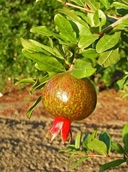
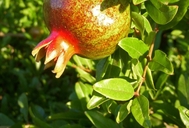
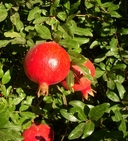
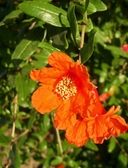
NATURALIZED Stem: < 5 m. Leaf: blade 1--9 cm, >> petiole, oblong- or lance-ovate, shiny adaxially. Flower: 2--3 cm; hypanthium, petals bright orange-red to pale yellow. Fruit: 5--12 cm, red-brown. Seed: red (+- white). Chromosomes: n=8,9. Ecology: Uncommon. Disturbed ground; Elevation: < 500 m. Bioregional Distribution: s SnJV, s CCo, SnGb, n SCo; Distribution Outside California: native southeastern Europe, Asia, to Himalayas. Flowering Time: Apr--Jul Note: Widely cultivated in warm areas for fruit (seeds edible, source of grenadine; juice popular antioxidant), ornamental (dwarf, doubled-flowered forms); often naturalized. Unabridged Note: Persistent calyx on fruit said to have inspired King Solomon's crown. Jepson eFlora Author: Shirley A. Graham Reference: [Lersten & Horner 2005 Amer J Bot 92:1935--1941] Index of California Plant Names (ICPN; linked via the Jepson Online Interchange) Previous taxon: Punica Next taxon: Rotala
Citation for this treatment: Shirley A. Graham 2012, Punica granatum, in Jepson Flora Project (eds.) Jepson eFlora, https://ucjeps.berkeley.edu/eflora/eflora_display.php?tid=40368, accessed on April 25, 2024.
Citation for the whole project: Jepson Flora Project (eds.) 2024, Jepson eFlora, https://ucjeps.berkeley.edu/eflora/, accessed on April 25, 2024.
Geographic subdivisions for Punica granatum:
s SnJV, s CCo, SnGb, n SCo
MAP CONTROLS 1. You can change the display of the base map layer control box in the upper right-hand corner.
2. County and Jepson Region polygons can be turned off and on using the check boxes.
(Note: any qualifiers in the taxon distribution description, such as 'northern', 'southern', 'adjacent' etc., are not reflected in the map above, and in some cases indication of a taxon in a subdivision is based on a single collection or author-verified occurence).
Data provided by the participants of the
Consortium of California Herbaria.
MAP LEGEND View all CCH records All markers link to CCH specimen records. The original determination is shown in the popup window.
Blue markers indicate specimens that map to one of the expected Jepson geographic subdivisions (see left map). Purple markers indicate specimens collected from a garden, greenhouse, or other non-wild location.
Yellow markers indicate records that may provide evidence for eFlora range revision or may have georeferencing or identification issues.
READ ABOUT YELLOW FLAGS
CCH collections by month
Duplicates counted once; synonyms included.
Species do not include records of infraspecific taxa, if there are more than 1 infraspecific taxon in CA.
Blue line denotes eFlora flowering time (fruiting time in some monocot genera).