Common Name: WOOD FERN FAMILY Habit: Perennial herb, in soil or rock crevices; rhizome generally short-creeping, suberect, or erect, scales large, generally tan to brown, generally uniformly colored. Leaf: generally tufted, 5--200+ cm, generally +- alike; stipe generally firm, base generally darker, with many vascular strands; blade 1--4-pinnate, often with scales, hair-like scales, hairs (except clear, needle-like hairs generally 0), or short-stalked glands on axes, between veins or not, veins free to netted; rachis, costa generally grooved adaxially. Sporangia: sori round, along veins; indusia peltate or round-reniform; spores elliptic, winged, ridged, or spiny, scar linear. Genera In Family: +- 40--45 genera, > 1600 species: worldwide, especially tropics, wooded areas. Note: Based on molecular sequence data, Athyrium, Cystopteris, Woodsia removed to Woodsiaceae to preserve a monophyletic Dryopteridaceae. Unabridged Note: Current data (as reported by Schuettpelz & Pryer and in papers cited therein) suggest that Wooodsiaceae is paraphyletic (with respect to Aspeniaceae, Blechnaceae, and Thelypteridaceae), yet are insufficient to resolve the questions of circumscription (too few taxa, not enough genes sampled). Alternative classifications that would preserve monophyly include recognition of several additional, small families (e.g., Cystopteridaceae, Athyriaceae, and others not in California, each comprising just a few genera) or lumping at least 4 currently recognized families, many of long-standing use and acceptance; a conservative and expedient course is taken for now (Smith et al. 2006), pending further work. eFlora Treatment Author: Alan R. Smith Scientific Editor: Thomas J. Rosatti.
Common Name: SWORD FERN Habit: Rhizome generally suberect to erect, often stout. Leaf: stipe stout, firm, generally densely scaly, ×-section with many round vascular strands in an arc; blade 1--3-[> 3--]pinnate, proximal pinnae reduced or not, thin to leathery, scaly, veins generally free, rarely +- jointed; pinna bases often wider acroscopically; teeth, generally including bristle-like tips, < 4 mm [or teeth 0]. Sporangia: sori round; indusium peltate [0 or reniform], sinus 0. Etymology: (Greek: many rows, from rows of sori on type sp.)
Polystichum scopulinum (D.C. Eaton) Maxon
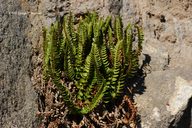
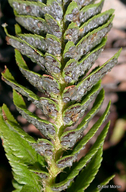
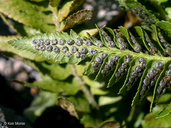
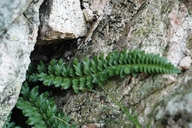
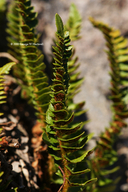
NATIVE Leaf: 10--50 cm; stipe 1/4--1/2 blade, base scales 1.5--2(3) mm wide, lanceolate to elliptic; blade narrow-lanceolate 1- to partly 2-pinnate; pinnae generally 1--3 cm, lance-oblong, proximal +- lanceolate, longest 1.5--3 cm. Sporangia: indusium entire. Chromosomes: 2n=164. Ecology: Serpentine to acidic soils, generally full sun, rock crevices, boulder bases; Elevation: 400--3200 m. Bioregional Distribution: KR, NCoRO, NCoRH, CaRH, SNH, SnGb, SnBr, SnJt, MP, DMtns (Surprise Canyon, Panamint Range); Distribution Outside California: to British Columbia, Rocky Mountains, Arizona. Note: Probably fertile hybrid between Polystichum imbricans, Polystichum lemmonii. DMtns distribution based on Rompert 229 (RSA), 1977, which differs from others in having pinna lobes 0 or shallow. Jepson eFlora Author: Alan R. Smith Index of California Plant Names (ICPN; linked via the Jepson Online Interchange) Previous taxon: Polystichum munitum Next taxon: Equisetaceae
Botanical illustration including Polystichum scopulinum
Citation for this treatment: Alan R. Smith 2012, Polystichum scopulinum, in Jepson Flora Project (eds.) Jepson eFlora, https://ucjeps.berkeley.edu/eflora/eflora_display.php?tid=39428, accessed on April 19, 2024.
Citation for the whole project: Jepson Flora Project (eds.) 2024, Jepson eFlora, https://ucjeps.berkeley.edu/eflora/, accessed on April 19, 2024.
MAP CONTROLS 1. You can change the display of the base map layer control box in the upper right-hand corner.
2. County and Jepson Region polygons can be turned off and on using the check boxes.
(Note: any qualifiers in the taxon distribution description, such as 'northern', 'southern', 'adjacent' etc., are not reflected in the map above, and in some cases indication of a taxon in a subdivision is based on a single collection or author-verified occurence).
Data provided by the participants of the
Consortium of California Herbaria.
MAP LEGEND View all CCH records All markers link to CCH specimen records. The original determination is shown in the popup window.
Blue markers indicate specimens that map to one of the expected Jepson geographic subdivisions (see left map). Purple markers indicate specimens collected from a garden, greenhouse, or other non-wild location.
Yellow markers indicate records that may provide evidence for eFlora range revision or may have georeferencing or identification issues.
READ ABOUT YELLOW FLAGS
CCH collections by month
Duplicates counted once; synonyms included.
Species do not include records of infraspecific taxa, if there are more than 1 infraspecific taxon in CA.
Blue line denotes eFlora flowering time (fruiting time in some monocot genera).