Common Name: BUCKWHEAT FAMILY Habit: Annual to shrub [tree]. Stem: nodes swollen or not. Leaf: simple, basal or cauline, generally alternate; ocreae present or 0, generally scarious, persistent or not. Inflorescence: flower clusters in axillary to terminal cyme-, panicle-, raceme-, spike-, umbel- or head-like arrangements, entire inflorescence or main inflorescence branches generally subtended by bracts ("inflorescence bracts"); peduncles present or 0; flower clusters in Eriogoneae-Eriogonoideae subtended by involucre of >= 1 free or +- fused, sometimes awn-tipped bracts ("involucre bracts") or, in Polygonoideae and rarely in Eriogonoideae, not (if bracts completely fused, involucre "tubular"); pedicels in Eriogoneae each often subtended by 2 free, transparent, linear bractlets or in Polygonoideae all subtended by 2+ fused, membranous, wide bractlets. Flower: generally bisexual, small, 1--200 per node; perianth parts 2--6, generally in 2 whorls, free or basally fused, generally petal-like, often +- concave adaxially, often darker at midvein, often turning +- red or +- brown in age; stamens [1]3 or 6--9 in 2 whorls; ovary superior, 1-chambered, ovule 1, styles 1--3. Fruit: achenes, included in or exserted from perianth, generally 3-angled, ovoid or elliptic, generally glabrous. Genera In Family: 48 genera, +- 1200 species: worldwide, especially northern temperate; some cultivated for food (Coccoloba, sea-grape; Fagopyrum, Rheum, Rumex) or ornamental (Antigonon, lovechain; Coccoloba; Muehlenbeckia; Persicaria; Polygonum), a few timbered (Coccoloba; Triplaris). Several (Emex; Fallopia; Persicaria; Polygonum; Rumex) are weeds. Note: Treatment of genera in Eriogonoideae based on monographic work of James L. Reveal. Involucre number throughout is number (1--many) per ultimate grouping, at tips of ultimate branches; flower number is per flower cluster or involucre, unless otherwise stated. Fagopyrum esculentum Moench not naturalized, considered an historical waif (or garden weed +- presently), therefore not treated. eFlora Treatment Author: Mihai Costea, except as noted Scientific Editor: Thomas J. Rosatti, Bruce G. Baldwin.
Common Name: SMARTWEED Habit: Annual, perennial herb, rhizomed or stoloned. Stem: prostrate to erect, ribbed or +- so or not, glabrous or hairy, generally with adventitious roots. Leaf: cauline, alternate, petioled or not; ocrea papery, rarely +- leaf-like, opaque, persistent or disintegrating, glabrous to variously hairy; blade lanceolate or ovate to hastate or sagittate, entire. Inflorescence: axillary, terminal, generally spike-like; flowers 1--14; peduncle present, pedicels present [or 0]. Flower: bisexual or functionally +- unisexual, base not stalk-like; perianth not or +- enlarging, bell-shaped (urn-shaped, rotate), glabrous, gland-dotted or not, green-white, white, pink, or red; perianth parts 4--5, fused 1/4--2/3, outer 2 > inner 2 or 3; stamens 5--8, filaments free, cylindric, thread-like, glabrous, outer fused to perianth tube or not, anthers elliptic to ovate, yellow, pink, or red; styles 2--3, erect to reflexed, free or fused, stigmas head-like. Fruit: included or exserted, brown or dark-brown to black, not winged, discoid, lens-shaped, or 3-angled. Seed: embryo curved. Etymology: (Latin: persica, peach, aria, pertaining to; from resemblance of leaves of some species to those of peach) eFlora Treatment Author: Mihai Costea
Persicaria punctata (Elliott) Small
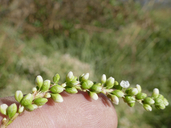
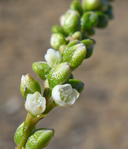
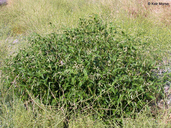
NATIVE Habit: Annual, perennial herb, generally rhizomed. Stem: ascending to erect, 15--100 cm, glabrous, gland-dotted. Leaf: ocrea (5)9--18 mm, cylindric, brown, margins truncate, ciliate, bristles 2--11 mm, surface glabrous or strigose, gland-dotted; petiole 0--1 cm; blade 5--10(15) cm, 0.6--2.4 cm wide, lanceolate to lance-ovate or sub-diamond-shaped, glabrous or scabrous on midveins, gland-dotted, adaxial dark blotch 0, base tapered or wedge-shaped, tip acute to acuminate. Inflorescence: axillary, terminal, generally erect, interrupted, 50--200 mm, 4--8 mm wide; peduncle 30--60 mm, glabrous, gland-dotted; bractlets generally not overlapped; pedicels ascending, 1--4 mm; flowers 2--6. Flower: perianth 3--3.5 mm, bell-shaped, +- enlarging, gland-dotted, generally +- green to white, lobes 5, margins generally white, veins prominent or not, not anchor-shaped, tips obtuse to rounded; stamens 6--8, included, anthers pink or red; styles 2--3, fused basally. Fruit: included or exserted, 2--3.2 mm, 1.5--2.2 mm wide, generally 3-angled (lens-shaped), brown-black, shiny, smooth. Chromosomes: 2n=44. Ecology: Shallow water, shores, marshes, floodplain forest; Elevation: < 1500 m. Bioregional Distribution: CA; Distribution Outside California: North America to South America. Flowering Time: Jun--Nov Note: Highly variable but named varieties not distinct. Confused with Persicaria hydropiper. Synonyms: Polygonum punctatum Elliott; Polygonum punctatum var. confertiflorum (Meisn.) Small; Polygonum punctatum var. ellipticum Fassett; Polygonum punctatum var. leptostachyum (Meisn.) Small; Polygonum punctatum var. parviflorum Fassett Jepson eFlora Author: Mihai Costea Index of California Plant Names (ICPN; linked via the Jepson Online Interchange) Previous taxon: Persicaria pensylvanica Next taxon: Persicaria wallichii
Botanical illustration including Persicaria punctata
Citation for this treatment: Mihai Costea 2012, Persicaria punctata, in Jepson Flora Project (eds.) Jepson eFlora, https://ucjeps.berkeley.edu/eflora/eflora_display.php?tid=37303, accessed on April 24, 2024.
Citation for the whole project: Jepson Flora Project (eds.) 2024, Jepson eFlora, https://ucjeps.berkeley.edu/eflora/, accessed on April 24, 2024.
MAP CONTROLS 1. You can change the display of the base map layer control box in the upper right-hand corner.
2. County and Jepson Region polygons can be turned off and on using the check boxes.
(Note: any qualifiers in the taxon distribution description, such as 'northern', 'southern', 'adjacent' etc., are not reflected in the map above, and in some cases indication of a taxon in a subdivision is based on a single collection or author-verified occurence).
Data provided by the participants of the
Consortium of California Herbaria.
MAP LEGEND View all CCH records All markers link to CCH specimen records. The original determination is shown in the popup window.
Blue markers indicate specimens that map to one of the expected Jepson geographic subdivisions (see left map). Purple markers indicate specimens collected from a garden, greenhouse, or other non-wild location.
Yellow markers indicate records that may provide evidence for eFlora range revision or may have georeferencing or identification issues.
READ ABOUT YELLOW FLAGS
CCH collections by month
Duplicates counted once; synonyms included.
Species do not include records of infraspecific taxa, if there are more than 1 infraspecific taxon in CA.
Blue line denotes eFlora flowering time (fruiting time in some monocot genera).