Common Name: BRAKE FAMILY Habit: Perennial herb, in soil or on or among rocks; rhizome creeping to erect, scaly. Leaf: generally all +- alike (or of 2 kinds, fertile, sterile), generally < 50 cm, often < 25 cm; stipe generally thin, wiry, often dark, ×-section with vascular strands generally 1--3, less often many in circle; blade generally pinnate or +- palmate-pinnate (see Adiantum), often >= 2-compound, abaxially often with glands, +- powdery exudate, hairs, or scales; segments round, oblong, fan-shaped, or other, veins generally free. Sporangia: in sori or not, marginal, submarginal, or along veins, covered by recurved, often modified segment margins (false indusia) or not; true indusia 0; spores spheric, sides flat or not, scar with 3 radiating branches. Genera In Family: +- 40 genera, 500 species: worldwide, especially dry areas. Note: CA members of Cheilanthes moved to the distantly related Myriopteris; Pellaea breweri to be moved as well, from a to-be-redefined Pellaea; traditional, often untenable limits of genera outside CA also being clarified using molecular phylogenetics. eFlora Treatment Author: Ruth E.B. Kirkpatrick, Alan R. Smith & Thomas Lemieux, except as noted Scientific Editor: Alan R. Smith, Thomas J. Rosatti.
Common Name: CLIFF-BRAKE Habit: Plant in soil or rock crevices; rhizome short- to long-creeping, scales overlapped, narrowly linear, light- to red- or medium-brown, often with dark mid-stripe. Leaf: erect, persistent, < 1 m; stipes +- cylindric, generally dark or red-brown to +- black, +- shiny, glabrous; blade 1--4-pinnate; segments generally stalked, generally free, linear to rounded, lobed or not, often folded lengthwise when dried; veins generally free. Sporangia: in +- continuous, submarginal bands, among a +- white to +- yellow exudate or not; segment margin generally recurved, generally modified; spores tan to light yellow. Etymology: (Greek: dusky, from blue-gray leaves) Note: Occasionally cultivated. Molecular data suggest Pellaea in the sense of Tryon (1957) is polyphyletic with monophyletic Astrolepis and Pellaea sect. Platyloma, as well as elements of Paragymnopteris and Paraceterach nested within (Kirkpatrick, 2007). eFlora Treatment Author: Ruth E.B. Kirkpatrick, Alan R. Smith, Thomas Lemieux & Edward Alverson Reference: Kirkpatrick 2007 Syst Bot 32:504--518 Unabridged Reference: Kirkpatrick, R.E.B. 2007. Investigating the monophyly of Pellaea (Pteridaceae) in the context of a phylogenetic analysis of cheilanthoid ferns. Syst Bot 32:504--518; Tryon 1957 Ann Missouri Bot Gard 44(2):125--193
Pellaea truncata Goodd.
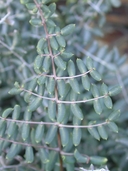
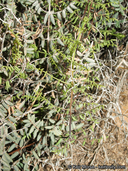
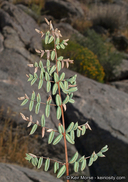
NATIVE Habit: Rhizome short-creeping, branched, to 8+ cm, 2--3 mm wide; scales +- brown, mid-stripe dark. Leaf: clustered, 15--30(36) cm, 4--11 cm wide, olive-green; stipe 1(2) mm wide, +- flat or adaxially grooved; blade 2-pinnate, narrowly triangular to oblong-triangular; pinnae generally not overlapped, +- spreading; segments 4--8 mm, 2--4 mm wide, linear to oblong, with mucro, margins wavy-crenate, often (especially sterile) +- white, fertile not appearing folded in half, recurved margins not meeting abaxially. Sporangia: 64-spored. Chromosomes: 2n=58. Ecology: Generally in crevices of or at bases of granite (in California) or igneous rock; Elevation: 1200--1900 m. Bioregional Distribution: e DMtns (Providence, New York mtns); Distribution Outside California: to Colorado, Texas, Baja California. Note: Hybrids with Pellaea mucronata var. mucronata uncommon. Jepson eFlora Author: Ruth E.B. Kirkpatrick, Alan R. Smith, Thomas Lemieux & Edward Alverson Reference: Kirkpatrick 2007 Syst Bot 32:504--518 Index of California Plant Names (ICPN; linked via the Jepson Online Interchange) Listed on CNPS Rare Plant Inventory Previous taxon: Pellaea mucronata var. mucronata Next taxon: Pentagramma
Citation for this treatment: Ruth E.B. Kirkpatrick, Alan R. Smith, Thomas Lemieux & Edward Alverson 2012, Pellaea truncata, in Jepson Flora Project (eds.) Jepson eFlora, https://ucjeps.berkeley.edu/eflora/eflora_display.php?tid=36795, accessed on April 17, 2024.
Citation for the whole project: Jepson Flora Project (eds.) 2024, Jepson eFlora, https://ucjeps.berkeley.edu/eflora/, accessed on April 17, 2024.
Geographic subdivisions for Pellaea truncata:
e DMtns (Providence, New York mtns)
MAP CONTROLS 1. You can change the display of the base map layer control box in the upper right-hand corner.
2. County and Jepson Region polygons can be turned off and on using the check boxes.
(Note: any qualifiers in the taxon distribution description, such as 'northern', 'southern', 'adjacent' etc., are not reflected in the map above, and in some cases indication of a taxon in a subdivision is based on a single collection or author-verified occurence).
Data provided by the participants of the
Consortium of California Herbaria.
MAP LEGEND View all CCH records All markers link to CCH specimen records. The original determination is shown in the popup window.
Blue markers indicate specimens that map to one of the expected Jepson geographic subdivisions (see left map). Purple markers indicate specimens collected from a garden, greenhouse, or other non-wild location.
Yellow markers indicate records that may provide evidence for eFlora range revision or may have georeferencing or identification issues.
READ ABOUT YELLOW FLAGS
CCH collections by month
Duplicates counted once; synonyms included.
Species do not include records of infraspecific taxa, if there are more than 1 infraspecific taxon in CA.
Blue line denotes eFlora flowering time (fruiting time in some monocot genera).