Common Name: CACTUS FAMILY Habit: Perennial herb, shrub, tree, generally fleshy. Stem: cylindric to spheric, or flat; surface smooth, tubercled, or ribbed (grooved); nodal areoles bearing flowers. Leaf: generally 0 or early-deciduous, flat to +- cylindric. Spines: areoles generally with central, radial spines, occasionally with glochids. Flower: generally 1 per areole, bisexual [unisexual], sessile, radial [bilateral]; perianth parts generally many [5], scale-like to petal-like; stamens many; ovary inferior [superior], style 1, stigma lobes generally several [many]. Fruit: dry to fleshy or juicy, indehiscent to variously dehiscent, spiny, scaly, or naked; tubercled or smooth. Seed: generally many, occasionally 0--few. Genera In Family: +- 125 genera, +- 1800 species: America (especially deserts), Africa; many cultivated, some edible. Note: Spines smaller, fewer (0) in shade forms; yellow spines blacken in age. Introduced species increasingly escape cultivation. Hybridization common in some genera. eFlora Treatment Author: Bruce D. Parfitt, except as noted Scientific Editor: Bruce D. Parfitt, Douglas H. Goldman, Bruce G. Baldwin, Thomas J. Rosatti.
Common Name: PRICKLY-PEAR Habit: Shrub, tree; roots fibrous [tuberous]. Stem: generally erect, < 6 [12] m; segments generally flat (+- cylindric), generally firmly attached; tubercles 0 to +- developed; ribs 0. Leaf: small, conic, fleshy, deciduous, present on young stems, ovaries. Spines: 0--many per areole, cylindric or flat, tip smooth or barbed, epidermis persistent; glochids generally many. Fruit: juicy, fleshy or dry; wall thick, bearing areoles; spiny or not. Seed: in a bony, +- white aril. Etymology: (Possibly from Papago name ("opun") for this food pl; or for a spiny plant of Opus, Greece) Note: Spines smaller, fewer in shade forms; yellow spines blacken in age. Spineless stems, ovaries, and fruit generally with glochids, these occasionally long, conspicuous; hybridization common. Taxa with cylindric to club-shaped stems moved to Cylindropuntia, Grusonia. eFlora Treatment Author: Marc Baker, Lucas C. Majure & Bruce D. Parfitt
Opuntia chlorotica Engelm. & J.M. Bigelow
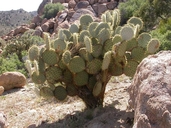
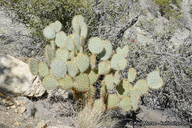
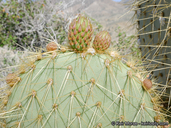
NATIVE Habit: +- tree-like. Stem: 1.5--2 m; branches ascending; segments 13--20 cm, generally round, glabrous. Spines: 3--8 in at least distal areoles, longest 2.5--5 cm, generally straight, flat, +- reflexed, translucent yellow. Flower: inner perianth 2--2.5 cm, yellow; filaments white; style white, stigma yellow-green. Fruit: +- 4 cm, juicy; exterior purple-red; middle layer white, seed-pulp pink; areoles 40--70. Seed: 3 mm. Chromosomes: 2n=22. Ecology: Pinyon/juniper woodland, desert scrub edge, chaparral; Elevation: 600--1300 m. Bioregional Distribution: e PR, DMoj (desert mountains and lower montane slopes, canyons); Distribution Outside California: to Nevada, New Mexico, northern Mexico. Flowering Time: May--Jun Note: If recognized taxonomically, stabilized hybrids with Opuntia phaeacantha in DMtns (New York Mountains, eastern San Bernardino Co.), southern Nevada, western Arizona assignable to Opuntia curvispina Griffiths (2n=44). Jepson eFlora Author: Marc Baker, Lucas C. Majure & Bruce D. Parfitt Index of California Plant Names (ICPN; linked via the Jepson Online Interchange) Previous taxon: Opuntia ×charlestonensis Next taxon: Opuntia curvispina
Citation for this treatment: Marc Baker, Lucas C. Majure & Bruce D. Parfitt 2019, Opuntia chlorotica, in Jepson Flora Project (eds.) Jepson eFlora, Revision 7, https://ucjeps.berkeley.edu/eflora/eflora_display.php?tid=35213, accessed on April 24, 2024.
Citation for the whole project: Jepson Flora Project (eds.) 2024, Jepson eFlora, https://ucjeps.berkeley.edu/eflora/, accessed on April 24, 2024.
Geographic subdivisions for Opuntia chlorotica:
e PR, DMoj (desert mountains and lower montane slopes, canyons)
MAP CONTROLS 1. You can change the display of the base map layer control box in the upper right-hand corner.
2. County and Jepson Region polygons can be turned off and on using the check boxes.
(Note: any qualifiers in the taxon distribution description, such as 'northern', 'southern', 'adjacent' etc., are not reflected in the map above, and in some cases indication of a taxon in a subdivision is based on a single collection or author-verified occurence).
Data provided by the participants of the
Consortium of California Herbaria.
MAP LEGEND View all CCH records All markers link to CCH specimen records. The original determination is shown in the popup window.
Blue markers indicate specimens that map to one of the expected Jepson geographic subdivisions (see left map). Purple markers indicate specimens collected from a garden, greenhouse, or other non-wild location.
Yellow markers indicate records that may provide evidence for eFlora range revision or may have georeferencing or identification issues.
READ ABOUT YELLOW FLAGS
CCH collections by month
Duplicates counted once; synonyms included.
Species do not include records of infraspecific taxa, if there are more than 1 infraspecific taxon in CA.
Blue line denotes eFlora flowering time (fruiting time in some monocot genera).