Common Name: MINT FAMILY Habit: Annual to shrub [tree, vine], glabrous to hairy, generally aromatic. Stem: generally erect, generally 4-angled. Leaf: generally simple to deeply lobed, generally opposite, generally gland-dotted. Inflorescence: generally cymes, generally many in dense axillary clusters surrounding stem, generally separated by evident internodes or collectively crowded, spike- or panicle-like, occasionally head-like or raceme, subtended by leaves or bracts; flowers sessile or pedicelled. Flower: generally bisexual; calyx generally 5-lobed, radial to bilateral; corolla generally bilateral, 1--2-lipped, upper lip entire or 2-lobed, +- flat to hood-like, occasionally 0, lower lip generally 3-lobed; stamens generally 4, epipetalous, generally exserted, paired, pairs generally unequal, occasionally 2, staminodes 2 or 0; ovary superior, generally 4-lobed to base chambers 2, ovules 2 per chamber, style 1, generally arising from center at junction of lobes, stigmas generally 2. Fruit: generally 4 nutlets, generally ovoid to oblong, smooth. Genera In Family: +- 230 genera, 7200 species: worldwide. Many cultivated for herbs, oils (Lavandula, lavender; Mentha, mint; Rosmarinus, rosemary; Thymus, thyme), some cultivated as ornamental (in California Cedronella, Leonotis, Monarda, Phlomis). Note:Moluccella laevis L., shell flower, historical waif in California. Satureja calamintha (L.) Scheele subsp. ascendens (Jordan) Briq. reported as alien but not naturalized. Salazaria moved to Scutellaria; California Hyptis moved to Condea, California Satureja moved to Clinopodium. eFlora Treatment Author: Dieter H. Wilken & Margriet Wetherwax, family description, key to genera, except as noted Scientific Editor: Douglas H. Goldman, Bruce G. Baldwin.
Habit: Annual to shrub, +- gland-dotted, scented. Leaf: entire to serrate, margin flat or wavy; petioles 0 or present, often grading into blade. Inflorescence: flowers in compact clusters of >= 1 per main stem, these occasionally arrayed in panicles (rarely spikes); flowers 3--100 per cluster; bracts generally erect in a cup-like involucre or reflexed, reduced in size inward, leaf-like to membranous in texture, green or straw-colored to rose or purple, linear to ovate, acuminate to acute or obtuse. Flower: calyx 5-lobed; 4--25 mm; corolla white to purple or yellow to red, weakly bilateral, upper lip erect, 2-lobed, lower lip recurved, 3-lobed; stamens 4; style unequally 2-lobed. Etymology: (Latin: small Monarda) Note: Complex; study needed; many taxa intergrade; flower cluster width and bract orientation given for pressed specimens. Leaf length including petiole, if present. M. Brunell authored Monardella follettii (in part), Monardella odoratissima (in part), Monardella palmeri, Monardella purpurea, Monardella sheltonii (in part), Monardella stebbinsii, Monardella villosa (in part). eFlora Treatment Author: Andrew C. Sanders, Mark A. Elvin & Mark S. Brunell Reference: Elvin & Sanders 2009 Novon 19:315--343; Epling 1925 Ann Missouri Bot Gard 12:1--106; Jepson 1943 Fl California 431--444 Unabridged Reference: Abrams 1951 Ill Fl Pac Sts V III:648--660
Monardella odoratissima Benth.
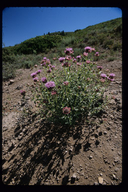
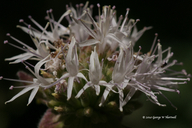
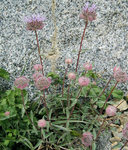
NATIVE Habit: Subshrub. Stem: 10--45 cm, ascending to erect, sparsely hairy (+- glabrous), rarely to occasionally with sparse, stalked, conical glands; distal stem diam 0.5--1.2 mm. Leaf: 15--50 mm, 5--18 mm wide, lanceolate to ovate, entire, sparsely to densely hairy, green to ash-gray, generally purple-tinged, glands on abaxial face in obvious pits. Inflorescence: flower clusters 1--several per main stem, 12--28(37) mm wide; generally subtended by unmodified leaves; bracts erect, in cup-like involucre, lanceolate to ovate, acute to obtuse, glabrous to woolly, ciliate, scarious, pale +- green or tinged purple to rose. Flower: calyx 6--11 mm, tube appressed-hairy, lobes densely spreading-stiff-hairy or woolly, hairs <= 1 mm; corolla 10--20 mm, white, lavender, or purple. Note: Ashy-gray, pale, chaffy-bracted, puberulent plants of northeastern Siskiyou Co. that have been identified as Monardella odoratissima subsp. odoratissima intergrade or are intermediate in morphology between subspecies glauca and pallida; if recognized taxonomically, plants in NCoRH with spreading, soft, wavy leaf hairs (and highly variable bract morphology) assignable to Monardella odoratissima subsp. pinetorum (Heller) Epling (study needed). Unabridged Synonyms: Monardella ovata Greene; Monardella odoratissima var. ovata (Greene) Jeps. Unabridged Note: Intergrades with Monardella purpurea (in KR, NCoR), Monardella linoides, Monardella eremicola, and possibly Monardella follettii. Type specimen of Monardella odoratissima subsp. odoratissima is from northern Washington; if recognized taxonomically, ashy-gray, pale, chaffy-bracted, puberulent plants of northeastern Siskiyou Co. assignable to subsp. odoratissima. The distribution of this variant is generally from Little Mount Hoffman (Siskiyou Co.) northeastern to Oregon; more study needed. Variation in California generally as follows: conical glands on stems widespread, but lacking in Wrn and northern SN (southwestern Plumas and northern Sierra cos.); leaf hairs most dense in NCoRH (Glenn and Tehama cos.) and central SN (Madera, Tulare, and northeastern El Dorado cos.); serrate leaves occur in the vicinity of Sonora Pass (Mono and Tuolumne cos.) and near Camel Peak (Plumas Co.), possibly reflecting intergradation with Monardella sheltonii. Leaf blade length-to-width ratio generally < 2 in NCoRH, southern CaR, and northern SN at < 2000 m elevation; leaf blade length-to-width ratio > 3.8 in central SN at > 2000 m elevation (leaf blade width generally negatively correlated with elevation); bract hairs generally least dense in central SN (Mono Co.), most dense in northern NCoRH and lower elevations of southern SN (Madera and Tulare cos.). Plants with only scarious bracts common in Wrn and eastern CaR of Siskiyou Co. Jepson eFlora Author: Andrew C. Sanders, Mark A. Elvin & Mark S. Brunell Reference: Elvin & Sanders 2009 Novon 19:315--343; Epling 1925 Ann Missouri Bot Gard 12:1--106; Jepson 1943 Fl California 431--444 Index of California Plant Names (ICPN; linked via the Jepson Online Interchange) Previous taxon: Monardella nana Next taxon: Monardella odoratissima subsp. glauca
Citation for this treatment: Andrew C. Sanders, Mark A. Elvin & Mark S. Brunell 2012, Monardella odoratissima, in Jepson Flora Project (eds.) Jepson eFlora, https://ucjeps.berkeley.edu/eflora/eflora_display.php?tid=33942, accessed on April 23, 2024.
Citation for the whole project: Jepson Flora Project (eds.) 2024, Jepson eFlora, https://ucjeps.berkeley.edu/eflora/, accessed on April 23, 2024.
MAP CONTROLS 1. You can change the display of the base map layer control box in the upper right-hand corner.
2. County and Jepson Region polygons can be turned off and on using the check boxes.
(Note: any qualifiers in the taxon distribution description, such as 'northern', 'southern', 'adjacent' etc., are not reflected in the map above, and in some cases indication of a taxon in a subdivision is based on a single collection or author-verified occurence).
Data provided by the participants of the
Consortium of California Herbaria.
MAP LEGEND View all CCH records All markers link to CCH specimen records. The original determination is shown in the popup window.
Blue markers indicate specimens that map to one of the expected Jepson geographic subdivisions (see left map). Purple markers indicate specimens collected from a garden, greenhouse, or other non-wild location.
Yellow markers indicate records that may provide evidence for eFlora range revision or may have georeferencing or identification issues.
READ ABOUT YELLOW FLAGS
CCH collections by month
Duplicates counted once; synonyms included.
Species do not include records of infraspecific taxa, if there are more than 1 infraspecific taxon in CA.
Blue line denotes eFlora flowering time (fruiting time in some monocot genera).