Common Name: CARPET-WEED FAMILY Habit: Annual [perennial herb, shrub], glabrous or hairy. Stem: prostrate to erect. Leaf: simple, generally basal and cauline, alternate, opposite, or whorled, entire, (fleshy), petioled [not]; stipules 0 or small, deciduous. Inflorescence: axillary or terminal cyme [umbel] or flowers 1; flowers pedicelled or not. Flower: generally bisexual, small, radial; sepals 4--5, free or fused, persistent; corolla 0 or small (= staminodes); stamens 2--25, free or fused basally, on hypanthium, alternate sepals, petal-like or not; nectary a ring; ovary superior, chambers [1]3--5[10], placentas generally axile, styles [0]1 or 3--5, generally free. Fruit: 3--5-valved capsule [achene]. Seed: 1 or more per chamber, reniform to lenticular, arilled or not. Genera In Family: 14 genera, 125 species: generally tropics, subtropics, especially Africa. eFlora Treatment Author: Michael A. Vincent & Wayne R. Ferren, Jr. Scientific Editor: Thomas J. Rosatti.
Common Name: CARPET-WEED Habit: Annual [perennial herb], glabrous. Stem: prostrate to erect, slender, branched from base. Leaf: generally whorled, linear to oblanceolate; stipules +- 0. Inflorescence: axillary, terminal, cyme, umbel [flowers 1]; pedicel 3--30 mm. Flower: sepals 5, free, margins +- scarious; petals 0; stamens 3--5, fused basally; styles 3--5, linear. Fruit: 3-valved, included in calyx. Seed: many, reniform, smooth, ridged, or finely net-sculptured; aril 0. Etymology: (Greek: soft or pliant) Note: Worldwide revision of genus needed.
Mollugo verticillata L.
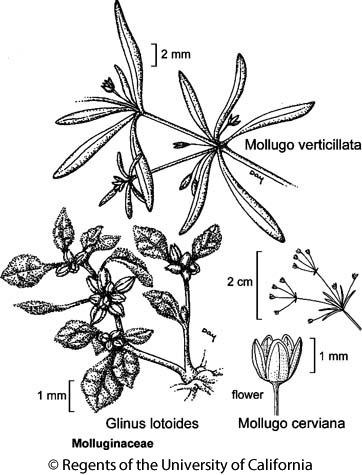
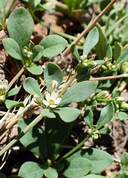
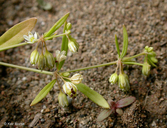
NATURALIZED Habit: Annual, mat-forming, < 50 cm diam, glabrous. Stem: forked unequally. Leaf: in whorls of 3--8, 5--40 mm. Inflorescence: flowers 2--6. Flower: sepals 1.5--2.5 mm, oblong-elliptic; stamens 3 mm; stigmas 3, +- sessile. Fruit: ovoid-ellipsoid. Seed: dark- or red-brown. Chromosomes: 2n=64. Ecology: Common. Moist, exposed, disturbed wetland margins, roadsides, fields; Elevation: < 1000 m. Bioregional Distribution: CA-FP, SNE; Distribution Outside California: North America; native to tropical America. Flowering Time: May--Nov Jepson eFlora Author: Michael A. Vincent & Wayne R. Ferren, Jr. Index of California Plant Names (ICPN; linked via the Jepson Online Interchange) Previous taxon: Mollugo cerviana Next taxon: Montiaceae
Botanical illustration including Mollugo verticillata
Citation for this treatment: Michael A. Vincent & Wayne R. Ferren, Jr. 2012, Mollugo verticillata, in Jepson Flora Project (eds.) Jepson eFlora, https://ucjeps.berkeley.edu/eflora/eflora_display.php?tid=33883, accessed on April 18, 2024.
Citation for the whole project: Jepson Flora Project (eds.) 2024, Jepson eFlora, https://ucjeps.berkeley.edu/eflora/, accessed on April 18, 2024.
MAP CONTROLS 1. You can change the display of the base map layer control box in the upper right-hand corner.
2. County and Jepson Region polygons can be turned off and on using the check boxes.
(Note: any qualifiers in the taxon distribution description, such as 'northern', 'southern', 'adjacent' etc., are not reflected in the map above, and in some cases indication of a taxon in a subdivision is based on a single collection or author-verified occurence).
Data provided by the participants of the
Consortium of California Herbaria.
MAP LEGEND View all CCH records All markers link to CCH specimen records. The original determination is shown in the popup window.
Blue markers indicate specimens that map to one of the expected Jepson geographic subdivisions (see left map). Purple markers indicate specimens collected from a garden, greenhouse, or other non-wild location.
Yellow markers indicate records that may provide evidence for eFlora range revision or may have georeferencing or identification issues.
READ ABOUT YELLOW FLAGS
CCH collections by month
Duplicates counted once; synonyms included.
Species do not include records of infraspecific taxa, if there are more than 1 infraspecific taxon in CA.
Blue line denotes eFlora flowering time (fruiting time in some monocot genera).