Common Name: FIG-MARIGOLD or ICEPLANT FAMILY Habit: Annual, perennial herb, shrub, generally fleshy. Stem: underground to erect; root fibrous or tuberous. Leaf: generally simple, entire, flat, cylindric, 3-angled, or scale-like, generally cauline, generally opposite; stipules generally 0; blade papillate, pubescent, or generally glabrous, often glaucous. Inflorescence: cyme or 1-flowered, generally terminal. Flower: generally bisexual, radial; hypanthium present; sepals (3)5(8), often unequal; petals 0 or many in several whorls, free or fused at base, linear; stamens 1--many, free or fused in groups, outer often petal-like; nectary a ring or separate glands; pistil 1, ovary superior to inferior, chambers 1--20, placentas generally parietal, styles 0--20. Fruit: berry, nut, or generally capsule, opening by flaps or circumscissile. Seed: 1--many per chamber, generally ovoid, arilled or not. Genera In Family: 130 genera, 2500 species: generally subtropics, especially southern Africa; many cultivated. Note:Galenia pubescens (Eckl. & Zeyh.) Druce, a waif, may be naturalizing in southern California. Unabridged Note:Disphyma crassifolium (L.) L. Bolus (ovary glands convex, minute-crenate; stigmas dense-plumose; fruit chambers 5; seeds ovate, +- smooth), of tribe Ruschieae, an historical waif in California; Lampranthus coccineus (Haw.) N.E. Br.: (ovary glands fused; fruit chambers 5; seeds pear-shaped, +- black, rough), of Ruschieae, an historical waif or urban weed in California. eFlora Treatment Author: Nancy J. Vivrette, John Bleck & Wayne R. Ferren, Jr., family description, key to genera Scientific Editor: Bruce G. Baldwin, Thomas J. Rosatti.
Common Name: ICEPLANT Habit: Annual, biennial, glabrous. Stem: prostrate to ascending, cylindric, angled or winged, papillate. Leaf: alternate or opposite, petioled or not, cylindric or flat, +- red in age or stress, papillae prominent to flat, inconspicuous; bases of pair fused. Inflorescence: 1-flowered or cyme. Flower: sepals, petals free or fused at base; sepals (4)5, 2 often leaf-like; petals white; stamens many; nectar gland +- grooved; ovary 1/2-inferior, chambers (4)5(20), styles (4)5(20). Fruit: capsule, valves 5, dehiscing when moist. Seed: many, round, compressed, often D-shaped, minutely tubercled, light or dark red-brown. Etymology: (Greek: midday-blooming) eFlora Treatment Author: Nancy J. Vivrette Unabridged Reference: McVaugh 1974 Taxon 23:820--821
Mesembryanthemum nodiflorum L.
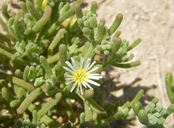
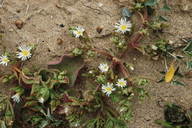
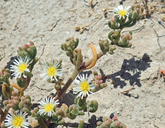
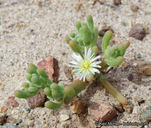
NATURALIZED Stem: prostrate to ascending, branched from base, 15--20 cm. Leaf: blade 1--2 cm, linear. Inflorescence: 1-flowered; pedicel short. Flower: hypanthium obconic; sepals 5, equal; petals aging white to yellow. Fruit: fine-papillate. Seed: +- white to light brown, smooth. Chromosomes: 2n=36. Ecology: Uncommon. Coastal bluffs, margins of saline wetlands; Elevation: < 100 m. Bioregional Distribution: SnFrB, SCo, ChI; Distribution Outside California: to Arizona, Mexico; also Australia; native to southern Africa. Flowering Time: Apr--Nov Jepson eFlora Author: Nancy J. Vivrette Index of California Plant Names (ICPN; linked via the Jepson Online Interchange) Previous taxon: Mesembryanthemum crystallinum Next taxon: Sesuvium
Botanical illustration including Mesembryanthemum nodiflorum
Citation for this treatment: Nancy J. Vivrette 2012, Mesembryanthemum nodiflorum, in Jepson Flora Project (eds.) Jepson eFlora, https://ucjeps.berkeley.edu/eflora/eflora_display.php?tid=33363, accessed on April 25, 2024.
Citation for the whole project: Jepson Flora Project (eds.) 2024, Jepson eFlora, https://ucjeps.berkeley.edu/eflora/, accessed on April 25, 2024.
MAP CONTROLS 1. You can change the display of the base map layer control box in the upper right-hand corner.
2. County and Jepson Region polygons can be turned off and on using the check boxes.
(Note: any qualifiers in the taxon distribution description, such as 'northern', 'southern', 'adjacent' etc., are not reflected in the map above, and in some cases indication of a taxon in a subdivision is based on a single collection or author-verified occurence).
Data provided by the participants of the
Consortium of California Herbaria.
MAP LEGEND View all CCH records All markers link to CCH specimen records. The original determination is shown in the popup window.
Blue markers indicate specimens that map to one of the expected Jepson geographic subdivisions (see left map). Purple markers indicate specimens collected from a garden, greenhouse, or other non-wild location.
Yellow markers indicate records that may provide evidence for eFlora range revision or may have georeferencing or identification issues.
READ ABOUT YELLOW FLAGS
CCH collections by month
Duplicates counted once; synonyms included.
Species do not include records of infraspecific taxa, if there are more than 1 infraspecific taxon in CA.
Blue line denotes eFlora flowering time (fruiting time in some monocot genera).