Common Name: SUNFLOWER FAMILY Habit: Annual to tree. Leaf: basal and/or cauline, alternate, opposite, rarely whorled, simple to 2+ × compound. Inflorescence: 1° inflorescence a head, resembling a flower, of several types (see below), 1--many in generally +- cyme-like cluster; each head generally with +- calyx-like involucre of 1--many series of phyllaries (involucre bracts); receptacle of head flat to conic or columnar, paleate (bearing paleae = receptacle bracts) or epaleate; flowers 1--many per head. Flower: bisexual, unisexual, or sterile, +- small, of several types (see below); calyx 0 or modified into +- persistent pappus of bristles, scales, and/or awns; corolla radial or bilateral (0), lobes generally (0)3--5; stamens 4--5, filaments generally free, generally fused to corolla at tube/throat junction, anthers generally fused into cylinder around style, anther base generally rounded or cordate (deeply sagittate or with tail-like appendages), tip (= flattened appendage) generally projecting beyond pollen sac; pistil 1, 2-carpeled, ovary inferior, 1-chambered, 1-seeded, placenta basal, style 1, tip generally +- 2-branched (except in some staminate disk flowers), branch tips truncate or generally bearing +- brush-like appendages; stigmas 2, generally on adaxial faces of style branches. Fruit: achene (also called a cypsela) (drupe in Chrysanthemoides), cylindric to ovoid, sometimes compressed, generally deciduous with pappus attached. Genera In Family: +- 1500 genera, 23000 species: worldwide, many habitats. Note: Flower and head types differ in form and sexual condition. A disk flower has a generally radial corolla, with a cylindric tube, expanded throat, and generally 5 lobes. Disk flowers are generally bisexual and fertile but occasionally staminate with reduced ovaries. Discoid heads comprise only disk flowers. A radiant head is a variant of a discoid head, with peripheral disk flower corollas expanded, often bilateral. A ray flower corolla is bilateral, generally with a slender tube and flattened petal-like ray (single lip composed of generally 3 lobes). Ray flowers are generally pistillate or sterile (occasionally lacking styles). Radiate heads have peripheral ray flowers and central disk flowers. Disciform heads superficially resemble discoid heads, with pistillate or sterile flowers that lack rays, together with or separate from disk flowers. A ligulate flower is bisexual, with a bilateral, generally ephemeral corolla and 5-lobed ligule. Liguliflorous heads comprise only ligulate flowers. See glossary p. 31 for illustrations of family characteristics. Echinops sphaerocephalus L., Gaillardia aristata Pursh, Gaillardia pulchella Foug., Hymenothrix loomisii S.F. Blake, Tagetes erecta L., Thelesperma megapotamicum (Spreng.) Kuntze are waifs. Melampodium perfoliatum Kunth, historic urban waif. Ageratum conyzoides L., Guizotia abyssinica (L. f.) Cass., Santolina chamaecyparisus L., orth. var. are rare or uncommon escapes from cultivation. Dyssodia papposa, Ismelia carinata (Schousb.) Sch. Bip. [Chrysanthemum carinatum Schousb.], Mantisalca salmantica (L.) Briq. & Cavill. are historical or extirpated waifs in California. Inula helenium L. not documented in California. Taxa of Aster in TJM (1993) treated here in Almutaster, Doellingeria, Eurybia, Ionactis, Oreostemma, Sericocarpus, Symphyotrichum; Chamomilla in Matricaria; Bahia in Hymenothrix; Cnicus in Centaurea; Conyza in Erigeron and Laennecia; Dugaldia in Hymenoxys; Erechtites in Senecio; Hymenoclea in Ambrosia; Lembertia in Monolopia; Osteospermum ecklonis in Dimorphotheca; Picris echioides in Helminthotheca; Prionopsis in Grindelia; Raillardiopsis in Anisocarpus and Carlquistia; Schkuhria multiflora in Picradeniopsis; Trimorpha in Erigeron; Venidium in Arctotis; Viguiera in Aldama and Bahiopsis; Whitneya in Arnica. Amauriopsis in TJM2 (2012) treated here in Hymenothrix; Arida in Leucosyris; Bahia in Picradeniopsis; Eucephalus in Doellingeria. Unabridged Note: Largest family of vascular plants in California and of eudicots globally. eFlora Treatment Author: David J. Keil, except as noted Scientific Editor: David J. Keil, Bruce G. Baldwin.
Common Name: ASTER Habit: Perennial herb [subshrub], cespitose, thickly taprooted, sometimes with rhizome and woody caudex. Stem: erect or ascending. Leaf: simple, cauline, proximally crowded, spreading or ascending, alternate, sessile; blades linear to narrowly lanceolate or oblanceolate, entire, 1-veined. Inflorescence: heads radiate, 1 [2--3 in loose cyme-like cluster]; involucre cylindric or bell-shaped; phyllaries 20--60, +- equal or graduated in 2--6 series, lance-linear to oblong, 1-veined, midrib green, thickened, margins scarious or membranous; receptacle flat, pitted, epaleate. Ray Flower: pistillate, fertile. Disk Flower: bisexual [or staminate]; corolla yellow, tube < narrowly cylindric throat, lobes 5, triangular; style branch tips lanceolate. Fruit: fusiform, +- compressed, densely strigose, nonglandular (in California) or not; pappus of 2 series of bristles, outer < inner. Etymology: (Greek: violet ray) eFlora Treatment Author: David J. Keil Reference: Nesom & Leary 1992 Brittonia 44: 247--252; Nesom 2006 FNANM 20:82--84
Ionactis alpina (Nutt.) Greene
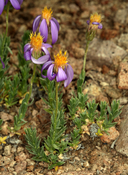
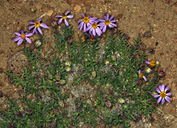
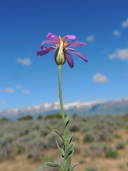
NATIVE Habit: Perennial herb; caudex fibrous-rooted. Stem: 4--12 cm, +- hairy. Leaf: 0.3--1.2 cm, narrowly oblanceolate to elliptic, firm, +- abruptly pointed, densely short-hairy. Inflorescence: head 1; phyllaries lance-linear to oblong, acute to acuminate, green to +- purple, inner pale-margined below. Ray Flower: generally 8--16; corolla 7--12 mm, violet to purple. Disk Flower: corolla 5.5--7.5 mm. Fruit: 5--6 mm; pappus outer bristles +- 1 mm, << inner. Chromosomes: 2n=18,36. Ecology: Dry, rocky places, often with sagebrush; Elevation: 1300--3000 m. Bioregional Distribution: Wrn, n SNE, W&I; Distribution Outside California: to eastern Oregon, Wyoming, Nevada. Flowering Time: May--Jul Synonyms: Aster scopulorum A. Gray Jepson eFlora Author: David J. Keil Reference: Nesom & Leary 1992 Brittonia 44: 247--252; Nesom 2006 FNANM 20:82--84 Index of California Plant Names (ICPN; linked via the Jepson Online Interchange) Previous taxon: Ionactis Next taxon: Isocoma
Citation for this treatment: David J. Keil 2012, Ionactis alpina, in Jepson Flora Project (eds.) Jepson eFlora, https://ucjeps.berkeley.edu/eflora/eflora_display.php?tid=29007, accessed on April 24, 2024.
Citation for the whole project: Jepson Flora Project (eds.) 2024, Jepson eFlora, https://ucjeps.berkeley.edu/eflora/, accessed on April 24, 2024.
Geographic subdivisions for Ionactis alpina:
Wrn, n SNE, W&I
MAP CONTROLS 1. You can change the display of the base map layer control box in the upper right-hand corner.
2. County and Jepson Region polygons can be turned off and on using the check boxes.
(Note: any qualifiers in the taxon distribution description, such as 'northern', 'southern', 'adjacent' etc., are not reflected in the map above, and in some cases indication of a taxon in a subdivision is based on a single collection or author-verified occurence).
Data provided by the participants of the
Consortium of California Herbaria.
MAP LEGEND View all CCH records All markers link to CCH specimen records. The original determination is shown in the popup window.
Blue markers indicate specimens that map to one of the expected Jepson geographic subdivisions (see left map). Purple markers indicate specimens collected from a garden, greenhouse, or other non-wild location.
Yellow markers indicate records that may provide evidence for eFlora range revision or may have georeferencing or identification issues.
READ ABOUT YELLOW FLAGS
CCH collections by month
Duplicates counted once; synonyms included.
Species do not include records of infraspecific taxa, if there are more than 1 infraspecific taxon in CA.
Blue line denotes eFlora flowering time (fruiting time in some monocot genera).