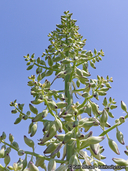
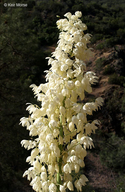
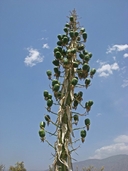
Common Name: CENTURY PLANT FAMILY Habit: Perennial herb, shrub, tree, fibrous succulent or not, from bulbs or rhizomes. Stem: above ground or not, branched or not. Leaf: simple, deciduous or not, basal or in terminal rosettes, generally sessile, linear, lanceolate, oblanceolate or ovate, fibrous or not, thin and flexible or thick and rigid or succulent; margin entire, fine-serrate, dentate, or with filaments, tips rigid or flexible, with a spine or not. Flower: bisexual; perianth parts 6, in 2 petal-like whorls, free or +- fused; stamens 6, +- fused to perianth, filaments often wide, succulent; ovary superior or inferior, chambers 3, style 1 (thick, poorly defined), stigma head-like or 3-lobed. Fruit: capsule, indehiscent, loculicidal, or septicidal. Seed: few to many, +- flat or ovoid, generally black. Genera In Family: 24 genera, 637 species: worldwide. eFlora Treatment Author: Dale W. McNeal, except as noted Scientific Editor: Dale W. McNeal, Thomas J. Rosatti, Bruce G. Baldwin.
Citation for this treatment: William J. Hess 2012, Hesperoyucca whipplei, in Jepson Flora Project (eds.) Jepson eFlora, https://ucjeps.berkeley.edu/eflora/eflora_display.php?tid=28057, accessed on April 24, 2024.
Citation for the whole project: Jepson Flora Project (eds.) 2024, Jepson eFlora, https://ucjeps.berkeley.edu/eflora/, accessed on April 24, 2024.
Geographic subdivisions for Hesperoyucca whipplei:
s SN (esp e slope), SCoR, SW, SNE (Deep Springs Valley), sw edge DMoj
MAP CONTROLS 1. You can change the display of the base map layer control box in the upper right-hand corner.
2. County and Jepson Region polygons can be turned off and on using the check boxes.
(Note: any qualifiers in the taxon distribution description, such as 'northern', 'southern', 'adjacent' etc., are not reflected in the map above, and in some cases indication of a taxon in a subdivision is based on a single collection or author-verified occurence).
Data provided by the participants of the
Consortium of California Herbaria.
MAP LEGEND View all CCH records All markers link to CCH specimen records. The original determination is shown in the popup window.
Blue markers indicate specimens that map to one of the expected Jepson geographic subdivisions (see left map). Purple markers indicate specimens collected from a garden, greenhouse, or other non-wild location.
Yellow markers indicate records that may provide evidence for eFlora range revision or may have georeferencing or identification issues.
READ ABOUT YELLOW FLAGS
CCH collections by month
Duplicates counted once; synonyms included.
Species do not include records of infraspecific taxa, if there are more than 1 infraspecific taxon in CA.
Blue line denotes eFlora flowering time (fruiting time in some monocot genera).