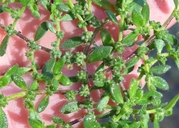
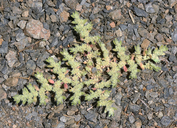
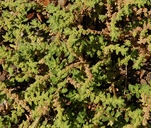
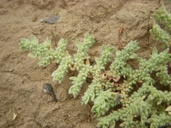
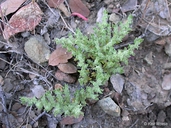
Common Name: PINK FAMILY Habit: Annual to perennial herb; rarely dioecious (Silene), taprooted or rhizome generally slender. Leaf: simple, generally opposite (subwhorled), entire, pairs at nodes often +- connected at bases; stipules generally 0; petiole generally 0. Inflorescence: generally cyme, generally open; flowers 1--many; involucre generally 0 (present in most Dianthus, Petrorhagia). Flower: generally bisexual, radial; hypanthium often present but obscure; sepals (4)5, +- free or fused into a tube, margins generally scarious, more so on inner 2 or not, tube generally not scarious, awns generally 0; petals (4)5 or 0, generally tapered to base (or with claw long, limb expanded), entire to 2--several-lobed, limb generally without scale-like appendages adaxially, generally without ear-like lobes at base; stamens generally 10, generally fertile, generally free, generally from ovary base; nectaries 0 or 5; ovary superior, generally 1-chambered, placentas basal or free-central, styles 2--5 with 0 branches or 1 with 2--3 branches. Fruit: capsule or utricle (rarely +- dehiscent), generally sessile. Seed: appendage generally 0 (present in Moehringia). Genera In Family: +- 100 genera, 3000 species: widespread, especially arctic, alpine, temperate northern hemisphere; some cultivated (Agrostemma, Arenaria, Atocion, Cerastium, Dianthus, Gypsophila, Lychnis, Sagina, Saponaria, Silene). Note: Apetalous Caryophyllaceae can also be keyed in Rabeler & Hartman 2005 FNANM 5:5--8. Taxa of Minuartia in TJM2 treated here in Cherleria and Sabulina; Pseudostellaria in Hartmaniella and Torreyostellaria; Vaccaria in Gypsophila; Velezia in Dianthus. eFlora Treatment Author: Ronald L. Hartman (deceased) & Richard K. Rabeler, except as noted Scientific Editor: Bruce G. Baldwin & Thomas J. Rosatti.
Citation for this treatment: Ronald L. Hartman (deceased) & Richard K. Rabeler 2012, Herniaria hirsuta, in Jepson Flora Project (eds.) Jepson eFlora, https://ucjeps.berkeley.edu/eflora/eflora_display.php?tid=28011, accessed on April 24, 2024.
Citation for the whole project: Jepson Flora Project (eds.) 2024, Jepson eFlora, https://ucjeps.berkeley.edu/eflora/, accessed on April 24, 2024.
MAP CONTROLS 1. You can change the display of the base map layer control box in the upper right-hand corner.
2. County and Jepson Region polygons can be turned off and on using the check boxes.
(Note: any qualifiers in the taxon distribution description, such as 'northern', 'southern', 'adjacent' etc., are not reflected in the map above, and in some cases indication of a taxon in a subdivision is based on a single collection or author-verified occurence).
Data provided by the participants of the
Consortium of California Herbaria.
MAP LEGEND View all CCH records All markers link to CCH specimen records. The original determination is shown in the popup window.
Blue markers indicate specimens that map to one of the expected Jepson geographic subdivisions (see left map). Purple markers indicate specimens collected from a garden, greenhouse, or other non-wild location.
Yellow markers indicate records that may provide evidence for eFlora range revision or may have georeferencing or identification issues.
READ ABOUT YELLOW FLAGS
CCH collections by month
Duplicates counted once; synonyms included.
Species do not include records of infraspecific taxa, if there are more than 1 infraspecific taxon in CA.
Blue line denotes eFlora flowering time (fruiting time in some monocot genera).