Common Name: MALLOW FAMILY Habit: Annual to tree; generally with stellate hairs, often with bristles or peltate scales; juice generally mucilage-like; bark fibrous. Leaf: generally cauline, alternate, petioled, simple [palmate-compound], generally palmate-lobed and/or veined, generally toothed, evergreen or not; stipules persistent or not. Inflorescence: head, spike, raceme, or panicle, in panicle or not (a compound panicle), or flowers >= 1 in leaf axils, or flowers generally 1 opposite a leaf or on a spur; bracts leaf-like or not; bractlets 0 or on flowering stalks, often closely subtending calyx, generally in involucel. Flower: generally bisexual, radial; sepals 5, generally fused at base, abutting in bud, larger in fruit or not, nectaries as tufts of glandular hairs at base; petals (0)5, free from each other but generally fused at base to, falling with filament tube, clawed or not; stamens 5--many, filaments fused for most of length into tube around style, staminodes 5, alternate stamens, or generally 0; pistil 1, ovary superior, stalked or generally not, chambers generally >= 5, styles or style branches, stigmas generally 1 or 1--2 × chamber number. Fruit: loculicidal capsule, [berry], or 5--many, disk- or wedge-shaped segments (= mericarps). Genera In Family: 266 genera, 4025 species: worldwide, especially warm regions; some cultivated (e.g., Abelmoschus okra; Alcea hollyhock; Gossypium cotton; Hibiscus hibiscus). Note: Recently treated to include Bombacaceae, Sterculiaceae, Tiliaceae. Mature fruit needed for identification; "outer edges" are surfaces between sides and back (abaxial surface) of segment. "Flower stalk" used instead of "pedicel," "peduncle," especially where both needed (i.e., when flowers both 1 in leaf axils and otherwise). eFlora Treatment Author: Steven R. Hill, except as noted Scientific Editor: Steven R. Hill, Thomas J. Rosatti.
Common Name: COTTON Habit: Annual to perennial herb, [subshrub to tree], +- gland-dotted. Stem: erect, stellate-hairy to glabrous. Leaf: petioled; blades ovate, palmate-lobed or -parted, entire; generally not much reduced above; stipules prominent or not. Inflorescence: flowers 1 in leaf axils or few clustered on axillary short-shoots; flowering stalks generally < flowers; bractlets 3, conspicuous, green, leaf-like, cordate, generally irregularly toothed or fringed, enclosing flower in bud, persisting in fruit. Flower: calyx fused, tip truncate or 5-toothed; petals cream, yellow, or rose, often with dark spot at base, showy; filament tube 5-toothed at top, anthers scattered entire length; style 1, generally >= filament tube, stigma lobes 3--5, decurrent, generally short or obscure. Fruit: capsule, loculicidal, ovoid, 3--5-chambered, glabrous, generally prominently gland-dotted. Seed: generally > 5 mm, obovoid, angled, generally densely long-hairy [(subglabrous)], hairs generally white [tan]. Etymology: (Greek: gossypion, cotton; or Arabic: goz or gothn, a soft substance) Note:Gossypium armourianum Kearney (bractlets strap-shaped vs widely cordate-ovate in Gossypium hirsutum), reportedly naturalized in California, in fact only persisting (albeit for at least 70 years) after plantings, and showing "little likelihood of spreading or becoming invasive" (Paul Fryxell, pers. comm.). eFlora Treatment Author: Paul A. Fryxell Reference: Fryxell 1979 Natural History Cotton Tribe. TAMU Press; Fryxell 1988 Syst Bot Monogr 25:159--178
Gossypium hirsutum L.
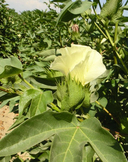
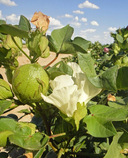
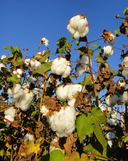
WAIF Habit: Annual to perennial herb, [shrub], generally widely branching, +- stellate-hairy. Stem: erect, 0.5--1(2) m. Leaf: blade 4--10 cm, cordate, lobes 3--5, shallow, lobes widely ovate, acute to acuminate; stipules 0.5--2 cm, generally curved. Inflorescence: flowering stalks 2--4 cm; bractlets 2--4.5 cm, each above a nectary. Flower: generally <= leaves; calyx 5--6 mm; petals 2--5 cm, cream or pale yellow, basal dark spot present or not; stamen tube +- 1.5 cm, +- = style. Fruit: 2--4 cm, widely ovoid to +- spheric, 3--5-celled, glabrous. Seed: several per chamber, 8--10 mm, +- hidden by long hairs. Chromosomes: 2n=52. Ecology: Uncommon. Disturbed places, roadsides, agricultural land; Elevation: < 100 m. Bioregional Distribution: ScV, DSon (sporadic); Distribution Outside California: southern United States; originally tropical America, especially Mexico. Flowering Time: Apr--Oct Note: Cultivated worldwide, occasional escape, evidently not naturalized in California. Jepson eFlora Author: Paul A. Fryxell Reference: Fryxell 1979 Natural History Cotton Tribe. TAMU Press; Fryxell 1988 Syst Bot Monogr 25:159--178 Index of California Plant Names (ICPN; linked via the Jepson Online Interchange) Previous taxon: Gossypium Next taxon: Herissantia
Citation for this treatment: Paul A. Fryxell 2012, Gossypium hirsutum, in Jepson Flora Project (eds.) Jepson eFlora, https://ucjeps.berkeley.edu/eflora/eflora_display.php?tid=27214, accessed on April 24, 2024.
Citation for the whole project: Jepson Flora Project (eds.) 2024, Jepson eFlora, https://ucjeps.berkeley.edu/eflora/, accessed on April 24, 2024.
MAP CONTROLS 1. You can change the display of the base map layer control box in the upper right-hand corner.
2. County and Jepson Region polygons can be turned off and on using the check boxes.
(Note: any qualifiers in the taxon distribution description, such as 'northern', 'southern', 'adjacent' etc., are not reflected in the map above, and in some cases indication of a taxon in a subdivision is based on a single collection or author-verified occurence).
Data provided by the participants of the
Consortium of California Herbaria.
MAP LEGEND View all CCH records All markers link to CCH specimen records. The original determination is shown in the popup window.
Blue markers indicate specimens that map to one of the expected Jepson geographic subdivisions (see left map). Purple markers indicate specimens collected from a garden, greenhouse, or other non-wild location.
Yellow markers indicate records that may provide evidence for eFlora range revision or may have georeferencing or identification issues.
READ ABOUT YELLOW FLAGS
CCH collections by month
Duplicates counted once; synonyms included.
Species do not include records of infraspecific taxa, if there are more than 1 infraspecific taxon in CA.
Blue line denotes eFlora flowering time (fruiting time in some monocot genera).