Common Name: SPURGE FAMILY Habit: Annual to shrub, tree [vine, cactus-like succulent]; monoecious or dioecious; sap clear or milky. Stem: generally branched [fleshy or spiny]. Leaf: generally simple, alternate to whorled, generally stipuled, sessile or petioled; blade entire, toothed, or lobed. Inflorescence: flowers solitary or in terminal or axillary cymes, racemes, spikes, or panicles, or (in Euphorbia) 1° inflorescence a compact, flower-like cyathium with much-reduced flowers enclosed within an involucre of fused bracts, cyathia terminal or axillary, 1 or in cyme-like arrays. Flower: unisexual, +- radial; sepals 0 or 2--6, free or fused; petals generally 0(5); stamens 1--many, free or filaments fused; ovary superior, chambers (1)3(4), styles free or fused, undivided, forked, or variously lobed. Fruit: generally capsule that splits into mericarps that then dehisce, releasing seeds. Seed: 1 per chamber; knob-like appendage sometimes present at attachment scar. Genera In Family: 217 genera, 6000+ species: +- worldwide especially tropics; some cultivated (Aleurites, tung oil; Euphorbia species; Hevea, rubber; Ricinus). Toxicity: Many species +- highly TOXIC, due primarily to latex, especially if eaten or in contact with skin, eyes. Note:Eremocarpus moved to Croton, Tetracoccus moved to Picrodendraceae for TJM2; Chamaesyce moved to Euphorbia here (key to genera revised by Thomas J. Rosatti). eFlora Treatment Author: Mark H. Mayfield & Grady L. Webster, except as noted Scientific Editor: Bruce G. Baldwin.
Common Name: SPURGE Habit: Annual to shrub [tree; fleshy, +- cactus-like], glabrous or hairy; sap milky; generally monoecious. Stem: prostrate to erect, generally < 1 m; branches arrayed around main stem(s) in 3-dimensions or 2-ranked, resulting in 2-faced stems with adaxial leaf faces all displayed to top side and abaxial leaf faces to bottom side. Leaf: proximal cauline, alternate or opposite, +- sessile to petioled; distal-most cauline in some species whorled, subtending umbel-like cluster of inflorescence branches, leafy bracts distal to whorled leaves generally opposite (whorled); stipules 0, gland-like, thread-like, or scale-like, free or fused, entire to divided; blade entire or toothed (pinnately lobed), base symmetric or asymmetric. Inflorescence: 1° inflorescence a cyathium, resembling a flower; cyathia 1--many, stalked or sessile, terminal (axillary), in generally leafy-bracted cyme-like arrays; cyathium a compact unit comprising an involucre of 5 fused bracts enclosing 1--many reduced staminate flowers and 1(0) pistillate flower; involucre generally 1--5 mm, bract tips alternate with 1--5 nectary glands (derived from modified stipules of involucre bracts), these transversely crescent-shaped or oblong to +- round, flat to cup-like, entire, toothed, or with 2 horn-like lobes, with or without distal, white to pink or red, flat, petal-like appendages; bractlets within involucre membranous or thread-like, often fringed. Staminate Flower: (1--4)5--many, generally in 5 clusters around pistillate flower (this difficult to observe); calyx 0; each staminate flower a single stamen jointed to tip of a thread-like pedicel; pedicel persistent, stamen deciduous after pollen released. Pistillate Flower: (0)1, central, stalked; calyx 0; ovary chambers 3, styles 3, free or fused at base, undivided or +- deeply forked. Fruit: stalk generally elongating, generally curved, pushing developing fruit from involucre; capsule +- spheric to ovoid or oblong, in ×-section +- round to 3-lobed or -angled. Seed: +- round or +- 3- or 4-angled (flattened) in ×-section, smooth or sculptured; knob-like appendage at attachment scar present or 0. Etymology: Euphorbus, physician to the King of Mauritania, 1st century Note: Forms monophyletic group with Chamaesyce, included here. Euphorbia serrata L. considered extirpated from California; 2003 report that Euphorbia exigua L. is possibly naturalizing as yet unconfirmed; Euphorbia marginata Pursh occasionally persisting from gardens, but recent records lacking. Euphorbia graminea Jacq. an urban weed. For fruit, seeds, "in ×-section" indicated only if not lobed or angled. eFlora Treatment Author: David J. Keil, Thomas J. Rosatti, Mark H. Mayfield & Daryl Koutnik Reference: Horn et al. 2012 Molec Phylogen Evol 63:305--326 Unabridged Reference: Wheeler 1936 Bull S Calif Acad Sci 35:127--147
Euphorbia spathulata Lam.
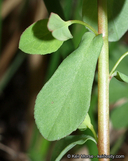
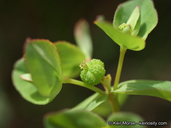
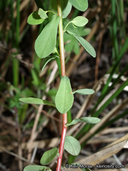
NATIVE Habit: Annual, glabrous. Stem: 0.5--4.5 dm. Leaf: proximal cauline alternate, sessile or +- petioled; stipules 0; blade 1--3 cm, obovate to spoon-shaped, finely toothed, base symmetric, tapered, tip obtuse to notched; distal-most cauline in a whorl of 3(4). Inflorescence: 1° inflorescence branches in umbel-like cluster of 3(4) from axils of whorled leaves and also often from axils of distal alternate leaves; cyathia in leafy-bracted cyme-like clusters; bracts opposite, sessile, triangular-ovate, minutely toothed; involucre < 1.5 mm, bell-shaped; glands 4(5), < 1 mm, transversely oblong or elliptic; petal-like appendage 0. Staminate Flower: 5--10. Pistillate Flower: styles forked +- 1/2. Fruit: 2--3 mm, spheric, lobed, tubercled especially near tip and on lobes. Seed: 1.5--2 mm, ovoid, slightly flattened front-to-back, both sides convex, surface net-like; knob present. Ecology: Open, generally disturbed places; Elevation: < 1300 m. Bioregional Distribution: CA-FP; Distribution Outside California: to Washington, eastern North America, South America. Flowering Time: Mar--Jun Jepson eFlora Author: David J. Keil, Thomas J. Rosatti, Mark H. Mayfield & Daryl Koutnik Reference: Horn et al. 2012 Molec Phylogen Evol 63:305--326 Index of California Plant Names (ICPN; linked via the Jepson Online Interchange) Previous taxon: Euphorbia setiloba Next taxon: Euphorbia terracina
Botanical illustration including Euphorbia spathulata
Citation for this treatment: David J. Keil, Thomas J. Rosatti, Mark H. Mayfield & Daryl Koutnik 2013, Euphorbia spathulata, in Jepson Flora Project (eds.) Jepson eFlora, Revision 1, https://ucjeps.berkeley.edu/eflora/eflora_display.php?tid=25609, accessed on April 24, 2024.
Citation for the whole project: Jepson Flora Project (eds.) 2024, Jepson eFlora, https://ucjeps.berkeley.edu/eflora/, accessed on April 24, 2024.
MAP CONTROLS 1. You can change the display of the base map layer control box in the upper right-hand corner.
2. County and Jepson Region polygons can be turned off and on using the check boxes.
(Note: any qualifiers in the taxon distribution description, such as 'northern', 'southern', 'adjacent' etc., are not reflected in the map above, and in some cases indication of a taxon in a subdivision is based on a single collection or author-verified occurence).
Data provided by the participants of the
Consortium of California Herbaria.
MAP LEGEND View all CCH records All markers link to CCH specimen records. The original determination is shown in the popup window.
Blue markers indicate specimens that map to one of the expected Jepson geographic subdivisions (see left map). Purple markers indicate specimens collected from a garden, greenhouse, or other non-wild location.
Yellow markers indicate records that may provide evidence for eFlora range revision or may have georeferencing or identification issues.
READ ABOUT YELLOW FLAGS
CCH collections by month
Duplicates counted once; synonyms included.
Species do not include records of infraspecific taxa, if there are more than 1 infraspecific taxon in CA.
Blue line denotes eFlora flowering time (fruiting time in some monocot genera).