Common Name: WATERLEAF FAMILY Habit: Annual, perennial herb, generally hairy, generally taprooted. Stem: prostrate to erect. Leaf: simple to pinnately compound, basal or cauline, alternate or opposite; stipules 0. Inflorescence: cyme, generally raceme-like and coiled, or flowers 1. Flower: bisexual, generally radial; calyx lobes generally 5, generally fused at base, generally persistent, enlarging in fruit; corolla rotate to cylindric, generally deciduous, lobes generally 5, appendages in pairs on tube between filaments or 0; stamens generally 5, epipetalous, filament base sometimes appendaged, appendages scale-like; ovary generally superior, chambers 1 or 2, placentas 2, parietal, enlarged into chamber, sometimes meeting so ovary appears 2--5-chambered, style 1, style branches 2, stigmas generally head-like. Fruit: capsule, generally loculicidal; valves generally 2. Genera In Family: 12 genera, 240--260 species: especially western US; some cultivated (Emmenanthe, Nemophila, Phacelia). Note: Included in Boraginaceae in TJM2 and some other treatments (Angiosperm Phylogeny Group IV 2016 Bot J Linn Soc 181:1--20) but treated as separate family (excluding Namaceae) by Boraginales Working Group (Luebert et al. 2016). eFlora Treatment Author: Genevieve K. Walden, Robert W. Patterson & Richard R. Halse, except as specified Scientific Editor: Bruce G. Baldwin
Habit: Annual, glandular, sticky, odorous. Stem: erect, much-branched. Leaf: 1--3-pinnate-lobed; proximal cauline opposite, petioled, distal alternate, smaller, sessile, clasping; petioles generally narrow-winged, ciliate. Inflorescence: terminal, sometimes also axillary, cymes simple or +- paniculate, few- to many-flowered, sometimes flowers 1 in leaf axils; pedicels 0 or short, elongate in fruit, +- ascending to erect in flower, erect to nodding in fruit, short- to long-hairy, minute- to short-glandular. Flower: calyx lobes equal in size, alike in shape, oblong to obovate or ovate; corolla bell-shaped, white, yellow, pink, or purple, dark-marked or veined; corolla scales reduced or 0; nectary glands reduced as V-shaped transverse fold between each pair of filaments below throat or 0; stamens included, equal, equally attached, filaments not widened at base, not appendaged, not winged; ovary chamber appearing 4 or 5, ovules on both sides of placenta, style 1, included, shallowly 2-lobed. Fruit: ovoid to spheric, terete or +- compressed, short- to long-hairy, minute- to short-glandular, generally exceeded by calyx. Seed: outer readily shed and inner persistent in capsule, 5--15(24), brown or black, all alike in shape or not, ellipsoid or ovoid to oblong or curved-oblong, +- compressed to cylindric, surface minutely or coarsely net-like pitted or corrugated; attached fleshy structure 0. Etymology: Greek: well hidden, from seeds eFlora Treatment Author: Genevieve K. Walden, Robert W. Patterson & Richard R. Halse Unabridged Reference: Constance 1938 Lloydia 1:143--152; Ferguson 1999 Syst Bot 23:253--268; Walden 2015 Systematics of Emmenanthe, Eucrypta, and Phacelia sect. Ramosissimae (Hydrophyllaceae; Boraginales) Ph.D. Dissertation, Univ CA Berkeley
Eucrypta micrantha (Torr.) A. Heller
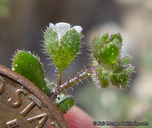
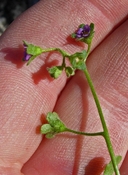
NATIVE Habit: Plants (2)5--25(30) cm. Stem: weak, < 3 dm, generally stalked-glandular. Leaf: proximal 1--5 cm, < 2 cm wide, petiole short, widened to clasping base, blade oblong or ovate, deep-1-pinnate-lobed, lobes 7--9, oblong or oblanceolate, straight or sickle-shaped, entire or few-toothed, distal leaves greatly reduced, lobed, toothed or entire. Inflorescence: 4--12-flowered cymes; pedicels generally erect in flower, erect or spreading to +- curved in fruit, short- to long-hairy, short-glandular. Flower: calyx lobes erect, 1.5--3 mm, 1--3 mm wide in flower, 2--5 mm, 2--4 mm wide in fruit, enclosing fruit, oblong or obovate, dark-glandular; corolla 2--4 mm, +- exceeding or = calyx, white or blue-purple, tube yellow, dark-marked or veined, limb 3--5 mm diam; corolla scales 0; nectary glands reduced as V-shaped transverse fold between each pair of filaments below throat; stamens 1.5--3 mm; style 1--2 mm. Fruit: 2--3 wide. Seed: 7--15(24), 0.8--1 mm, black or dark-brown, all alike in shape, oblong or ovoid, cylindric, becoming curved-oblong at maturity, appearing worm-like, coarsely net-like pitted and corrugated, transversely corrugated at maturity. Chromosomes: n=6,12. Ecology: Canyons, hillsides, rocky crevices, washes, slopes; Elevation: 60--2500 m. Bioregional Distribution: w PR, SnJt, SNE, D; Distribution Outside California: to Utah, Texas, western Mexico. Flowering Time: Mar--Jun Note: Not the closest relative of E. chrysanthemifolia based on molecular findings (Walden 2015), which warrant a taxonomic change; work in progress. Synonyms: Phacelia micrantha Torr; Macrocalyx micranthus (Torr.) Coville; Nyctelea micrantha (Torr.) Wooton & Standl.; Ellisia micrantha (Torr.) Brand; Phacelia pinetorum M.E. Jones; Eucrypta pinetorum (M.E. Jones) Rydb.; Nyctelea pinetorum (M.E. Jones) Tidestr. Jepson eFlora Author: Genevieve K. Walden, Robert W. Patterson & Richard R. Halse Index of California Plant Names (ICPN; linked via the Jepson Online Interchange) Previous taxon: Eucrypta chrysanthemifolia var. chrysanthemifolia Next taxon: Hesperochiron
Botanical illustration including Eucrypta micrantha
Citation for this treatment: Genevieve K. Walden, Robert W. Patterson & Richard R. Halse 2021, Eucrypta micrantha, in Jepson Flora Project (eds.) Jepson eFlora, Revision 9, https://ucjeps.berkeley.edu/eflora/eflora_display.php?tid=25305, accessed on April 25, 2024.
Citation for the whole project: Jepson Flora Project (eds.) 2024, Jepson eFlora, https://ucjeps.berkeley.edu/eflora/, accessed on April 25, 2024.
MAP CONTROLS 1. You can change the display of the base map layer control box in the upper right-hand corner.
2. County and Jepson Region polygons can be turned off and on using the check boxes.
(Note: any qualifiers in the taxon distribution description, such as 'northern', 'southern', 'adjacent' etc., are not reflected in the map above, and in some cases indication of a taxon in a subdivision is based on a single collection or author-verified occurence).
Data provided by the participants of the
Consortium of California Herbaria.
MAP LEGEND View all CCH records All markers link to CCH specimen records. The original determination is shown in the popup window.
Blue markers indicate specimens that map to one of the expected Jepson geographic subdivisions (see left map). Purple markers indicate specimens collected from a garden, greenhouse, or other non-wild location.
Yellow markers indicate records that may provide evidence for eFlora range revision or may have georeferencing or identification issues.
READ ABOUT YELLOW FLAGS
CCH collections by month
Duplicates counted once; synonyms included.
Species do not include records of infraspecific taxa, if there are more than 1 infraspecific taxon in CA.
Blue line denotes eFlora flowering time (fruiting time in some monocot genera).