Common Name: POPPY FAMILY Habit: Annual to small tree; sap colorless, yellow, orange, red, or white. Leaf: basal, cauline, or both, simple and entire, toothed, or lobed, or 1--3-pinnate-dissected or compound; cauline generally alternate; stipules 0. Inflorescence: terminal, 1-flowered or cyme, raceme, or panicle; bracts generally present. Flower: bisexual, radial, bilateral, or biradial; sepals 2--3, shed after flower; petals generally 2 × sepals in number; stamens generally many; ovary 1, superior, chamber 1, style 0 or 1, stigmas or lobes 2--many, ovules few to many. Fruit: capsule, dehiscent by valves or pores, +- nut, or breaking transversely into 1-seeded, indehiscent units. Seed: fleshy appendage generally 0. Genera In Family: 25--30 genera, 200 species: northern temperate, northern tropics; some cultivated (Papaver, Eschscholzia, Hunnemannia), source of opiates. Note:Stylomecon moved to Papaver. Corydalis, Dicentra, Fumaria in Fumariaceae in FNANM, elsewhere. Glaucium flavum Crantz is a waif. According to FNANM (3:300--301), Hunnemannia fumariifolia Sweet (+- like Eschscholzia except sepals free) an occasional waif in California, but documentation evidently lacking. Fleshy appendage of seed sometimes for dispersal by ants. eFlora Treatment Author: Gary L. Hannan & Curtis Clark, except as noted Scientific Editor: Thomas J. Rosatti.
Habit: Annual, perennial herb; sap colorless or orange. Leaf: basal or basal and cauline, 1--4-ternate-dissected, segments narrow to wide. Inflorescence: cyme, 1--many-flowered. Flower: receptacle funnel-shaped, tip cupped around ovary base, outer receptacle rim occasionally spreading; sepals 2, fused, shed as unit at flower; petals generally 4 (except doubled flowers), free, obovate or wedge-shaped, generally yellow to orange (white or pink), shed after flower leaving crown-like membrane (inner receptacle rim); stamens 8--many, free; carpels 2, style 0, stigma lobes 4, spreading, linear. Fruit: oblong, dehiscent from base. Seed: many, 1--2 mm, round to ovate, net-ridged, prominent-discontinuous-ridged, or minutely pitted, tan, brown, or black. Etymology: (J.F.G. von Eschscholtz, Russian surgeon, botanist, 1793--1831) eFlora Treatment Author: Shannon M. Still, Gary Hannan & Curtis Clark
Eschscholzia minutiflora S. Watson
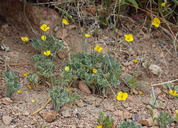
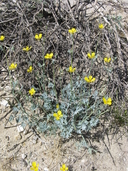
NATIVE Habit: Annual, erect or spreading, 5--35 cm, glabrous, gray- or blue-glaucous. Leaf: segments short, generally obtuse, entire to shallowly notched; distalmost cauline leaves with > 8 segments. Inflorescence: 1--many-flowered, each pedicel subtended by a leaf. Flower: bud nodding, short-pointed with tip generally < 1/4 bud, glabrous, occasionally glaucous; receptacle obconic; petals 3--26 mm, yellow, base occasionally orange-spotted. Fruit: 2.4--8 cm. Seed: 1--1.4 mm wide, generally oblong to elliptic, net-ridged, brown to black. Chromosomes: 2n=12,24,36. Flowering Time: Jan--May Note: The three subspecies recognized here co-occur and warrant elevation to species rank. Jepson eFlora Author: Shannon M. Still, Gary Hannan & Curtis Clark Index of California Plant Names (ICPN; linked via the Jepson Online Interchange) Previous taxon: Eschscholzia mexicana Next taxon: Eschscholzia minutiflora subsp. covillei
Citation for this treatment: Shannon M. Still, Gary Hannan & Curtis Clark 2023, Eschscholzia minutiflora, in Jepson Flora Project (eds.) Jepson eFlora, Revision 12, https://ucjeps.berkeley.edu/eflora/eflora_display.php?tid=25212, accessed on April 23, 2024.
Citation for the whole project: Jepson Flora Project (eds.) 2024, Jepson eFlora, https://ucjeps.berkeley.edu/eflora/, accessed on April 23, 2024.
MAP CONTROLS 1. You can change the display of the base map layer control box in the upper right-hand corner.
2. County and Jepson Region polygons can be turned off and on using the check boxes.
(Note: any qualifiers in the taxon distribution description, such as 'northern', 'southern', 'adjacent' etc., are not reflected in the map above, and in some cases indication of a taxon in a subdivision is based on a single collection or author-verified occurence).
Data provided by the participants of the
Consortium of California Herbaria.
MAP LEGEND View all CCH records All markers link to CCH specimen records. The original determination is shown in the popup window.
Blue markers indicate specimens that map to one of the expected Jepson geographic subdivisions (see left map). Purple markers indicate specimens collected from a garden, greenhouse, or other non-wild location.
Yellow markers indicate records that may provide evidence for eFlora range revision or may have georeferencing or identification issues.
READ ABOUT YELLOW FLAGS
CCH collections by month
Duplicates counted once; synonyms included.
Species do not include records of infraspecific taxa, if there are more than 1 infraspecific taxon in CA.
Blue line denotes eFlora flowering time (fruiting time in some monocot genera).