Common Name: MUSTARD FAMILY Habit: Annual to shrub; sap pungent, watery. Leaf: generally simple, alternate; generally both basal, cauline; stipules 0. Inflorescence: generally raceme, generally not bracted. Flower: bisexual, generally radial; sepals 4, generally free; petals (0)4, forming a cross, generally white or yellow to purple; stamens generally 6 (2 or 4), 4 long, 2 short (3 pairs of unequal length); ovary 1, superior, generally 2-chambered with septum connecting 2 parietal placentas; style 1, stigma entire or 2-lobed. Fruit: capsule, generally 2-valved, "silique" (length >= 3 × width) or "silicle" (length < 3 × width), dehiscent by 2 valves or indehiscent, cylindric or flat parallel or perpendicular to septum, segmented or not. Seed: 1--many, in 1 or 2 rows per chamber, winged or wingless; embryo strongly curved. Genera In Family: +- 330 genera, 3780 species: worldwide, especially temperate. Note: Highest diversity in Mediterranean area, mountains of southwestern Asia, adjacent central Asia, western North America; some Brassica species are oil or vegetable crops; Arabidopsis thaliana used in experimental molecular biology; many species are ornamentals, weeds. Aurinia saxatilis (L.) Desvaux in cultivation only. Aubrieta occasional waif in central NCoR, Carrichtera annua (L.) DC. in SCo, Iberis sempervirens L., Iberis umbellata L. in PR, Teesdalia coronopifolia (Bergeret) Thell., Teesdalia nudicaulis (L.) W.T. Aiton in southern NCoRO, CCo. Cardaria, Coronopus moved to Lepidium; Caulostramina to Hesperidanthus; Guillenia to Caulanthus; Heterodraba to Athysanus; California taxa of Lesquerella to Physaria; Malcolmia africana to Strigosella. eFlora Treatment Author: Ihsan A. Al-Shehbaz, except as noted Scientific Editor: Douglas H. Goldman, Bruce G. Baldwin.
Common Name: WALLFLOWER Habit: Annual to subshrub [shrub]; hairs sessile, appressed, 2--5(8)-rayed. Leaf: basal rosetted, petioled, entire, dentate, or pinnately lobed; cauline sessile or petioled, bases not lobed. Inflorescence: elongated. Flower: sepals oblong to linear, erect, base of lateral pair sac-like or not; petals clawed, yellow or orange (white, purple, or brown). Fruit: silique, dehiscent, linear, cylindric, 4-sided, or flat parallel or perpendicular to septum, unsegmented; stigma entire or 2-lobed. Seed: 15--100, in 1 or 2 rows, plump or flattened, oblong, winged or not. Etymology: (Greek: to help or save, from alleged medicinal properties of some species) Note: Fls, fruit, basal leaves needed for identification. All native California taxa related to Erysimum capitatum; hybridization blurs limits of some species. eFlora Treatment Author: Ihsan A. Al-Shehbaz Reference: Rossbach 1958 Madroño 14:261--267 Unabridged Reference: Rollins 1993 Cruciferae of continental N.Am. Stanford Univ Press.
Erysimum capitatum (Douglas ex Hook.) Greene
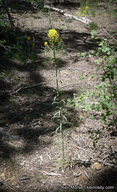
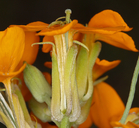
NATIVE Habit: Biennial or short-lived perennial herb. Stem: (0.5)1.2--10(12) dm. Leaf: 0.3--1.5(3) cm wide, linear to spoon-shaped or oblanceolate, flat, entire or dentate, hairs 2--4(7)-rayed; distal cauline sessile or short-petioled, entire or dentate. Flower: sepals 7--14 mm; petals 12--25(30) mm, (5)6--10(13) mm wide, orange to yellow (lavender to +- purple), claw 8--16 mm. Fruit: 3.5--11(15) cm, 1.3--3.3 mm wide, 4-angled or flat parallel to septum, not constricted between seeds; valves outside with 2--5-rayed hairs, inside glabrous, midvein distinct; style 0.2--2.5(3) mm; pedicels spreading to ascending, 4--17(25) mm. Seed: (40)54--82, 1.5--4 mm, oblong, tip winged or 0. Chromosomes: 2n=36. Note: Highly variable, most widespread sp. in California, of diverse habitats. Occasionally divided into several infraspecific taxa based on overlapping leaf characters. Jepson eFlora Author: Ihsan A. Al-Shehbaz Reference: Rossbach 1958 Madroño 14:261--267 Index of California Plant Names (ICPN; linked via the Jepson Online Interchange) Previous taxon: Erysimum ammophilum Next taxon: Erysimum capitatum var. capitatum
Citation for this treatment: Ihsan A. Al-Shehbaz 2012, Erysimum capitatum, in Jepson Flora Project (eds.) Jepson eFlora, https://ucjeps.berkeley.edu/eflora/eflora_display.php?tid=25113, accessed on April 23, 2024.
Citation for the whole project: Jepson Flora Project (eds.) 2024, Jepson eFlora, https://ucjeps.berkeley.edu/eflora/, accessed on April 23, 2024.
MAP CONTROLS 1. You can change the display of the base map layer control box in the upper right-hand corner.
2. County and Jepson Region polygons can be turned off and on using the check boxes.
(Note: any qualifiers in the taxon distribution description, such as 'northern', 'southern', 'adjacent' etc., are not reflected in the map above, and in some cases indication of a taxon in a subdivision is based on a single collection or author-verified occurence).
Data provided by the participants of the
Consortium of California Herbaria.
MAP LEGEND View all CCH records All markers link to CCH specimen records. The original determination is shown in the popup window.
Blue markers indicate specimens that map to one of the expected Jepson geographic subdivisions (see left map). Purple markers indicate specimens collected from a garden, greenhouse, or other non-wild location.
Yellow markers indicate records that may provide evidence for eFlora range revision or may have georeferencing or identification issues.
READ ABOUT YELLOW FLAGS
CCH collections by month
Duplicates counted once; synonyms included.
Species do not include records of infraspecific taxa, if there are more than 1 infraspecific taxon in CA.
Blue line denotes eFlora flowering time (fruiting time in some monocot genera).