Common Name: EPHEDRA FAMILY Habit: Shrub; generally dioecious; taproot deep. Stem: erect, prostrate, occasionally climbing, jointed, much branched, green in youth; branchlets opposite or whorled, cylindric, longitudinally grooved; pith brown or white. Leaf: simple, 2 (each pair at right angles to adjacent pairs) or 3 per node, scale-like, +- fused at base into membranous sheath, generally ephemeral; resin canals 0. Cone: axillary (terminal), sessile or not, 1--many per node, ovoid or ellipsoid. Pollen Cone: bracts 2--3 per node, proximal sterile, distal subtending 2 basally fused bractlets subtending a stalk with 2--10(15) sessile to stalked, anther-like parts with 2 apical pores. Seed Cone: stalk 1--11(50) mm, generally straight, naked or with reduced basal bracts; distal bracts in (2)4--10 pairs or whorls, free or fused, brown or green, scarious or fleshy, subtending 2 fused leathery bractlets enclosing 1 ovule. Seed: 1--3(4) per cone (in ×-section, +- round if 1, +- semicircular if 2, +- triangular if 3, etc.), +- spheric to ellipsoid or lance-ovoid, beaked or not. Genera In Family: 1 genus, +- 50 species: arid, semi-arid (to tropical) regions of northern Africa, Asia, Europe, North America, South America. eFlora Treatment Author: Stefanie M. Ickert-Bond Scientific Editor: Thomas J. Rosatti.
Common Name: EPHEDRA, MORMON TEA Stem: spreading to generally erect, 0.3--2(4.5) m; uppermost bud generally conic, generally not thorn-like. Etymology: (Greek: sitting upon, from jointed stems and/or ancient name for Equisetum, also with jointed stems)
Ephedra funerea Coville & C.V. Morton
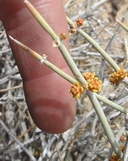
NATIVE Stem: < 1.5 m; twig gray-green, aging gray; uppermost bud narrowed but not thorn-like; pith brown. Leaf: generally 3 per node, < 5 mm; base persistent, not recurved, not swollen. Pollen Cone: 1--3 per node, 5--8 mm; bracts 3 per node. Seed Cone: 1--3 per node, 9--13 mm, elliptic, stalk 0 or < 1 mm, straight, basal bracts reduced; distal bracts 3 per node, obovate, membranous, +- green, +- thickened, margin wide, yellow-translucent, stalk-like base wide. Seed: 1(3), 6--9 mm, barely 3 × as long as wide, beaked, smooth to scabrous with minute, spreading papillae. Chromosomes: 2n=56+B. Ecology: Dry rocky slopes in creosote-bush scrub; Elevation: 360--1700 m. Bioregional Distribution: DMoj; Distribution Outside California: western Nevada, western Arizona. Note: Cones present Mar--Apr. Synonyms: Ephedra californica S. Watson var. funerea (Coville & C.V. Morton) L.D. Benson Jepson eFlora Author: Stefanie M. Ickert-Bond Index of California Plant Names (ICPN; linked via the Jepson Online Interchange) Previous taxon: Ephedra foeminea Next taxon: Ephedra nevadensis
Citation for this treatment: Stefanie M. Ickert-Bond 2012, Ephedra funerea, in Jepson Flora Project (eds.) Jepson eFlora, https://ucjeps.berkeley.edu/eflora/eflora_display.php?tid=24276, accessed on April 25, 2024.
Citation for the whole project: Jepson Flora Project (eds.) 2024, Jepson eFlora, https://ucjeps.berkeley.edu/eflora/, accessed on April 25, 2024.
MAP CONTROLS 1. You can change the display of the base map layer control box in the upper right-hand corner.
2. County and Jepson Region polygons can be turned off and on using the check boxes.
(Note: any qualifiers in the taxon distribution description, such as 'northern', 'southern', 'adjacent' etc., are not reflected in the map above, and in some cases indication of a taxon in a subdivision is based on a single collection or author-verified occurence).
Data provided by the participants of the
Consortium of California Herbaria.
MAP LEGEND View all CCH records All markers link to CCH specimen records. The original determination is shown in the popup window.
Blue markers indicate specimens that map to one of the expected Jepson geographic subdivisions (see left map). Purple markers indicate specimens collected from a garden, greenhouse, or other non-wild location.
Yellow markers indicate records that may provide evidence for eFlora range revision or may have georeferencing or identification issues.
READ ABOUT YELLOW FLAGS
CCH collections by month
Duplicates counted once; synonyms included.
Species do not include records of infraspecific taxa, if there are more than 1 infraspecific taxon in CA.
Blue line denotes eFlora flowering time (fruiting time in some monocot genera).