Common Name: STONECROP FAMILY Habit: Annual to shrub [+- tree-like or climbing], fleshy. Leaf: generally simple, alternate or opposite (whorled), in dense to open, basal (or terminal) rosettes, or basal and cauline (not in rosettes), reduced on distal stem or not, often +- red. Inflorescence: generally a cyme, panicle-like, generally bracted. Flower: generally bisexual; sepals generally 3--5, generally +- free; petals generally 3--5, +- free or fused; stamens >> to = sepals, epipetalous or not; pistils generally 3--5(8), simple, fused at base or not, ovary 1-chambered, placenta 1, parietal, ovules 1--many, style 1 per pistil. Fruit: follicles, generally 3--5. Seed: 1--many, small. Genera In Family: +- 33 genera, +- 1400 species: +- worldwide, especially dry temperate; many cultivated for ornament. Note: Water-stressed plants often +- red. Consistent terminology regarding leaves, bracts difficult; in Aeonium and Dudleya, structures in rosettes are leaves, those on peduncles are bracts, and those subtending flowers are flower bracts; thus in taxa where the inflorescence is terminal, rosette leaves may "become" bracts as stem rapidly elongates to form an inflorescence. In Sedum structures below the inflorescence are interpreted as stems and leaves, not peduncles and bracts. Seed numbers given per follicle. SCIED: Scientific Editor: Bruce G. Baldwin, Thomas J. Rosatti. eFlora Treatment Author: Steve Boyd, except as noted Scientific Editor: Bruce G. Baldwin, Thomas J. Rosatti.
Common Name: DUDLEYA, LIVEFOREVER Habit: Perennial herb, fleshy, glabrous, bisexual. Stem: generally caudex- or corm-like, branched or not, +- covered with dried leaves. Leaf: in rosettes, evergreen or +- deciduous in summer (withering, falling or not), waxy or not, base wounding purple-red (yellow) or generally not. Inflorescence: cyme; flower bracts +- subtending pedicels, < bracts; bracts alternate. Flower: sepals 5, fused below; petals 5, fused at base, erect to spreading above; stamens 10, epipetalous; carpels 5, +- fused below. Fruit: follicles 5, erect to spreading, many-seeded. Seed: < 1 mm, narrowly ovoid, brown, striate. Etymology: (W.R. Dudley, 1st head of Botany Department, Stanford University, 1849--1911) Note: Fruit just before opening generally most reliable for orientation; insect damage may cause branching in taxa characterized as non-branching. Unabridged Note: Whether or not leaves of Dudleya cymosa subsp. costifolia, Dudleya saxosa subsp. saxosa, Dudleya variegata wound purple-red, red, yellow, or some other color at base when removed is evidently unknown. eFlora Treatment Author: Stephen Ward McCabe Reference: Thiede 2003 in Eggli (ed.) Illus Handbook Succulent Pls 6 (Crassulaceae):85--103. Springer
Dudleya lanceolata (Nutt.) Britton & Rose
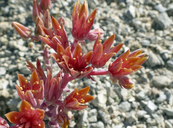
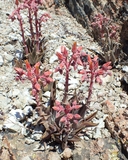
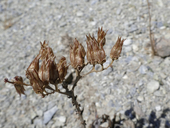
NATIVE Habit: Rosettes 1--3 (8), 3--35 cm wide. Stem: generally < 4 cm, 1--3 cm wide, occasionally elongate. Leaf: evergreen but few green in droughts, 5--30 cm, 1--4 cm wide, 1.5--6 mm thick, lanceolate to lance-oblong, glaucous or not, base wounding purple-red, 1--3 cm wide, tip acute. Inflorescence: peduncle 15--95 cm, 3--12 mm wide; lower internodes > 5 mm; 1° branches (2)3, branched 0--1 ×; terminal branches 2--25 cm, 2--20-flowered; pedicels spreading, 2--12 mm, becoming erect, red or green, not generally pink. Flower: sepals 3--6 mm, deltate-ovate; petals 10--16 mm, 3.5--5 mm wide, fused 1--2 mm, elliptic to oblanceolate, acute, yellow to generally red. Chromosomes: 2n=68,136,+-170. Ecology: Soil or slopes with broken rocks; Elevation: 30--1250 m. Bioregional Distribution: Teh, c CCo (s Santa Cruz Co.), SnFrB, SCoR, SCo, TR, PR, DMtns, DMoj (w edge); Distribution Outside California: northern Baja California. Flowering Time: Apr--Jul Note: Hybrids with Dudleya cymosa, Dudleya palmeri, Dudleya pulverulenta, Dudleya saxosa suspected. Synonyms: Dudleya cymosa (Lem.) Britton & Rose subsp. minor (Rose) Moran; Dudleya elongata Rose; Echeveria lanceolata Nutt. var. composta Jeps.; Echeveria lanceolata Nutt. var. incerta Jeps. Jepson eFlora Author: Stephen Ward McCabe Reference: Thiede 2003 in Eggli (ed.) Illus Handbook Succulent Pls 6 (Crassulaceae):85--103. Springer Index of California Plant Names (ICPN; linked via the Jepson Online Interchange) Previous taxon: Dudleya greenei Next taxon: Dudleya multicaulis
Botanical illustration including Dudleya lanceolata
Citation for this treatment: Stephen Ward McCabe 2012, Dudleya lanceolata, in Jepson Flora Project (eds.) Jepson eFlora, https://ucjeps.berkeley.edu/eflora/eflora_display.php?tid=23661, accessed on April 24, 2024.
Citation for the whole project: Jepson Flora Project (eds.) 2024, Jepson eFlora, https://ucjeps.berkeley.edu/eflora/, accessed on April 24, 2024.
Geographic subdivisions for Dudleya lanceolata:
Teh, c CCo (s Santa Cruz Co.), SnFrB, SCoR, SCo, TR, PR, DMtns, DMoj (w edge)
MAP CONTROLS 1. You can change the display of the base map layer control box in the upper right-hand corner.
2. County and Jepson Region polygons can be turned off and on using the check boxes.
(Note: any qualifiers in the taxon distribution description, such as 'northern', 'southern', 'adjacent' etc., are not reflected in the map above, and in some cases indication of a taxon in a subdivision is based on a single collection or author-verified occurence).
Data provided by the participants of the
Consortium of California Herbaria.
MAP LEGEND View all CCH records All markers link to CCH specimen records. The original determination is shown in the popup window.
Blue markers indicate specimens that map to one of the expected Jepson geographic subdivisions (see left map). Purple markers indicate specimens collected from a garden, greenhouse, or other non-wild location.
Yellow markers indicate records that may provide evidence for eFlora range revision or may have georeferencing or identification issues.
READ ABOUT YELLOW FLAGS
CCH collections by month
Duplicates counted once; synonyms included.
Species do not include records of infraspecific taxa, if there are more than 1 infraspecific taxon in CA.
Blue line denotes eFlora flowering time (fruiting time in some monocot genera).