Common Name: ORCHID FAMILY Habit: Perennial herb, terrestrial [growing on other pls], non-green (nutrition from association of roots with fungi) or green, generally from rhizomes or tubers with few to many fleshy to slender roots; cauline leaves +- reduced to sheathing stem bracts or not. Leaf: 1--many, basal to cauline, linear to +- round, alternate to opposite (if only 1 pair), generally sessile. Inflorescence: flowers 1--many, spike or raceme, bracted. Flower: bisexual, bilateral, in bud generally rotating 180° by twisting ovary (position of parts indicated after twisting); sepals generally 3, generally free, generally petal-like, uppermost generally erect, lateral with chin- or spur-like projection (mentum) or not; petals 3, 1 (lip) different, spurred or not; stamens generally 1 (3 in Cypripedium, 2 functional, 1 a staminode), fused with style, stigma into column, pollen generally lumped, generally removed as unit by insect; ovary inferior, 1-chambered, placentas 3, parietal, stigma 3 lobed, generally under column tip. Fruit: capsule. Seed: many, minute. Genera In Family: +- 800 genera, +- 25000 species: especially tropics (worldwide except Antarctica). Many cultivated for ornament, especially Cattleya, Cymbidium, Epidendrum, Oncidium, Paphiopedilum; Vanilla planifolia Andrews fruits used to flavor food. Note:Platanthera may be paraphyletic without inclusion of Piperia (Bateman et al. 2009 Ann Bot 104:431--445); study needed. eFlora Treatment Author: Ronald A. Coleman, Dieter H. Wilken & William F. Jennings, except as noted Scientific Editor: Ronald A. Coleman, Thomas J. Rosatti.
Common Name: CORALROOT Habit: Plant +- scapose, brown, tan, +- pink, +- red, +- purple, (+- green); rhizome branches many, short, scaly, together coral-like. Leaf: at flower 0. Inflorescence: raceme; flower bract << flower, often scale-like. Flower: sepals +- alike, oblong to (ob)lanceolate, generally curved over column and lip, generally 3-veined, lower generally fused at base, mentum present or not; lateral petals spreading or curved toward lip, lip not spurred, entire to 3-lobed, spreading to reflexed; column generally convex adaxially, concave abaxially, curved over lip. Fruit: pendent. Etymology: (Greek: coral root) eFlora Treatment Author: Ronald A. Coleman, Dieter H. Wilken & William F. Jennings
Corallorhiza maculata (Raf.) Raf.
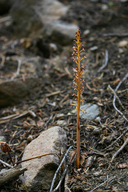
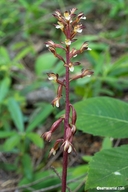
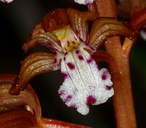
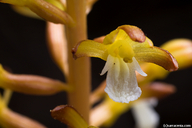
NATIVE Habit: Plant 17--55 cm. Stem: red to yellow-brown to yellow. Flower: sepals 5.5--10 mm, lower spreading, color generally same as stems, mentum < 2.5 mm; lateral petals generally like sepals, yellow-brown or deep pink to red, dark-spotted or not, lip 5--7 mm, with 2 rounded lobes laterally, white, unspotted or generally red- to purple-spotted, tip crenate or toothed; column 3--5 mm, +- yellow, purple-spotted. Fruit: 15--20 mm. Chromosomes: 2n=42. Note: Where together, Corallorhiza maculata var. occidentalis typically flowers 2--4 weeks earlier than Corallorhiza maculata var. maculata. Jepson eFlora Author: Ronald A. Coleman, Dieter H. Wilken & William F. Jennings Index of California Plant Names (ICPN; linked via the Jepson Online Interchange) Previous taxon: Corallorhiza Next taxon: Corallorhiza maculata var. maculata
Botanical illustration including Corallorhiza maculata
Citation for this treatment: Ronald A. Coleman, Dieter H. Wilken & William F. Jennings 2012, Corallorhiza maculata, in Jepson Flora Project (eds.) Jepson eFlora, https://ucjeps.berkeley.edu/eflora/eflora_display.php?tid=20259, accessed on April 17, 2024.
Citation for the whole project: Jepson Flora Project (eds.) 2024, Jepson eFlora, https://ucjeps.berkeley.edu/eflora/, accessed on April 17, 2024.
MAP CONTROLS 1. You can change the display of the base map layer control box in the upper right-hand corner.
2. County and Jepson Region polygons can be turned off and on using the check boxes.
(Note: any qualifiers in the taxon distribution description, such as 'northern', 'southern', 'adjacent' etc., are not reflected in the map above, and in some cases indication of a taxon in a subdivision is based on a single collection or author-verified occurence).
Data provided by the participants of the
Consortium of California Herbaria.
MAP LEGEND View all CCH records All markers link to CCH specimen records. The original determination is shown in the popup window.
Blue markers indicate specimens that map to one of the expected Jepson geographic subdivisions (see left map). Purple markers indicate specimens collected from a garden, greenhouse, or other non-wild location.
Yellow markers indicate records that may provide evidence for eFlora range revision or may have georeferencing or identification issues.
READ ABOUT YELLOW FLAGS
CCH collections by month
Duplicates counted once; synonyms included.
Species do not include records of infraspecific taxa, if there are more than 1 infraspecific taxon in CA.
Blue line denotes eFlora flowering time (fruiting time in some monocot genera).