Common Name: PHLOX FAMILY Habit: Annual, perennial herb, shrub, vine. Leaf: simple or compound, cauline (or most basal), alternate or opposite; stipules 0. Inflorescence: cymes, heads, clusters, or flower 1; bracts in involucres or not. Flower: sepals generally 5, fused at base, translucent membrane generally connecting lobes, torn by fruit; corolla generally 5-lobed, radial or bilateral, salverform to bell-shaped, throat often well defined; stamens generally 5, epipetalous, attached at >= 1 level, filaments of >= 1 length, pollen white, yellow, blue, or red; ovary superior, chambers generally 3, style 1, stigmas generally 3. Fruit: capsule. Seed: 1--many, when wetted swelling or not, gelatinous or not. Genera In Family: 26 genera, 314 species: America, northern Europe, northern Asia; some cultivated (Cantua, Cobaea (cup-and-saucer vine), Collomia, Gilia, Ipomopsis, Linanthus, Phlox). Note:Leptodactylon moved to Linanthus. eFlora Treatment Author: Robert W. Patterson, family description, key to genera, except as noted Scientific Editor: Robert W. Patterson, Thomas J. Rosatti.
Common Name: TRUMPET FLOWER Stem: hairy or glandular. Leaf: alternate, simple, entire to generally pinnate-lobed, linear to ovate [fan-shaped]; basal short-petioled; cauline sessile. Inflorescence: heads or clusters, terminal, or flowers 1--3 in axils. Flower: calyx lobes connected by narrow membrane forming a pitcher-like projection at sinus, enlarging, not rupturing in fruit; corolla salverform to funnel-shaped. Fruit: ovate to elliptic, explosively dehiscent, valves reflexed on dehiscence. Seed: 1(2--3) per chamber, oblong, generally gelatinous when wet, brown. Chromosomes: 2n=16. Etymology: (Greek: glue, from wet seed surface) Note: Annual species self-pollinated; perennial herb species generally cross-pollinated. eFlora Treatment Author: Leigh A. Johnson & Dieter H. Wilken Unabridged Reference: Wilken et al. 1982 Biochem Syst Ecol 10:239--243
Collomia diversifolia Greene
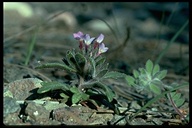
NATIVE Habit: Annual. Stem: erect, branches generally several, subequal, spreading to ascending; internodes long-translucent-glandular-hairy. Leaf: basal, lower cauline 3-toothed; upper cauline entire, glandular-puberulent. Inflorescence: clusters, terminal and axillary; flowers 7--15. Flower: calyx 10--12 mm, lobes acuminate; corolla 9--12 mm, tube purple, throat yellow, lobes violet-pink; filaments attached at > 1 level, < 1 mm, pollen white. Seed: 2--3 per chamber. Ecology: Rocky to gravelly serpentine areas; Elevation: 60--900 m. Bioregional Distribution: NCoRH, NCoRI, ne SnFrB (Contra Costa Co.). Flowering Time: Apr--Jul Jepson eFlora Author: Leigh A. Johnson & Dieter H. Wilken Index of California Plant Names (ICPN; linked via the Jepson Online Interchange) Listed on CNPS Rare Plant Inventory Previous taxon: Collomia Next taxon: Collomia grandiflora
Botanical illustration including Collomia diversifolia
Citation for this treatment: Leigh A. Johnson & Dieter H. Wilken 2012, Collomia diversifolia, in Jepson Flora Project (eds.) Jepson eFlora, https://ucjeps.berkeley.edu/eflora/eflora_display.php?tid=20020, accessed on April 18, 2024.
Citation for the whole project: Jepson Flora Project (eds.) 2024, Jepson eFlora, https://ucjeps.berkeley.edu/eflora/, accessed on April 18, 2024.
Geographic subdivisions for Collomia diversifolia:
NCoRH, NCoRI, ne SnFrB (Contra Costa Co.).
MAP CONTROLS 1. You can change the display of the base map layer control box in the upper right-hand corner.
2. County and Jepson Region polygons can be turned off and on using the check boxes.
(Note: any qualifiers in the taxon distribution description, such as 'northern', 'southern', 'adjacent' etc., are not reflected in the map above, and in some cases indication of a taxon in a subdivision is based on a single collection or author-verified occurence).
Data provided by the participants of the
Consortium of California Herbaria.
MAP LEGEND View all CCH records All markers link to CCH specimen records. The original determination is shown in the popup window.
Blue markers indicate specimens that map to one of the expected Jepson geographic subdivisions (see left map). Purple markers indicate specimens collected from a garden, greenhouse, or other non-wild location.
Yellow markers indicate records that may provide evidence for eFlora range revision or may have georeferencing or identification issues.
READ ABOUT YELLOW FLAGS
CCH collections by month
Duplicates counted once; synonyms included.
Species do not include records of infraspecific taxa, if there are more than 1 infraspecific taxon in CA.
Blue line denotes eFlora flowering time (fruiting time in some monocot genera).