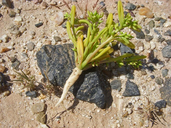
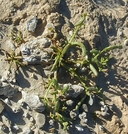
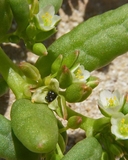
Common Name: MINER'S LETTUCE FAMILY Habit: Annual to perennial herb; generally fleshy. Stem: 1--many, generally glabrous. Leaf: simple, alternate or opposite. Inflorescence: axillary or terminal; cyme, raceme, panicle, umbel, or flower 1. Flower: bisexual, radial; sepals generally 2(9), free; petals (1)2--19, free or +- fused; stamens 1--many, epipetalous or not, anthers pink, rose, or yellow; ovary superior, chamber 1, ovules 1--many, placenta basal or free-central; styles (0)1--8, generally fused at base, branched. Fruit: capsule, circumscissile or 2--3-valved. Seed: 1--many, shiny or +- pebbly or sculptured, black or gray, generally with oil-filled appendage as food for ants. Genera In Family: +- 22 genera, +- 230 species: generally temperate America, Asia, Australia, Europe, Kerguelen Is, New Zealand, southern Africa, poorly represented in Europe; some cultivated (Lewisia, Calandrinia). Note: All CA genera previously included in Portulacaceae; details of flowers, seeds require 20× magnification. Unabridged Note: May include Hectorellaceae. eFlora Treatment Author: John M. Miller, except as noted Scientific Editor: Thomas J. Rosatti.
Habit: Annual [perennial herb], +- fleshy, from taproot or fibrous roots, generally glabrous. Stem: generally several, generally spreading to ascending. Leaf: cauline [basal and cauline], simple, linear to spoon-shaped, fleshy; basal rosetted. Inflorescence: scapose, raceme, panicle, or umbel, bracts leaf-like or not; bracts generally < sepals, scarious; flowers generally on 1 side of axis, deciduous or not in fruit. Flower: sepals 2, ovate, green, scarious-margined or not, persistent in fruit; petals 5, > sepals; stamens 5--10, anthers yellow; style 1, stigmas 3. Fruit: 3-valved, ovoid. Seed: 6--many, shiny or dull, black or gray [dark brownish red]. Etymology: (Greek: rockrose-flower) eFlora Treatment Author: John M. Miller & C. Matt Guilliams Reference: Hershkovitz 2006 Gayana Bot 63:13--74 Unabridged Reference: Hershkovitz 1990 Phytologia 68:267--270; Hershkovitz 1991a Ann Missouri Bot Gard 78:1009--1021; Hershkovitz 1991b Phytologia 70:209--225; Hershkovitz 1992 Syst Bot 17:220--238; Hershkovitz & Zimmer 2000 Molec Phylogen Evol 15:419--439; Hinton 1975 Brittonia 27:197--208; Kelley et al. 2003 FNANM 4:460--464.
Cistanthe ambigua (S. Watson) Carolin ex Hershk.
NATIVE Stem: spreading to erect. Leaf: 1.5--6 cm, linear to +- spoon-shaped, +- cylindric. Inflorescence: panicle of umbel-like clusters, compact; bracts scarious; pedicel 1--3 mm, straight in fruit. Flower: sepals 2--5 mm, glabrous, margins white-scarious; petals 3--5, 2--5 mm; stamens 5--7(10). Fruit: < calyx. Seed: 6--15, 1--2 mm wide, +- elliptic to ovate, shiny, glabrous, black. Ecology: Desert scrub, sandy to silty soil, often alkaline; Elevation: < 1000 m. Bioregional Distribution: D; Distribution Outside California: southwestern Arizona, northwestern Mexico. Flowering Time: Feb--May Synonyms: Calandrinia ambigua (S. Watson) Howell Unabridged Note: Belongs in neither Calandrinia nor Cistanthe, and might better be treated as a separate, monotypic genus, according to Hershovitz (pers. comm.). Jepson eFlora Author: John M. Miller & C. Matt Guilliams Reference: Hershkovitz 2006 Gayana Bot 63:13--74 Index of California Plant Names (ICPN; linked via the Jepson Online Interchange) Previous taxon: Cistanthe Next taxon: Cistanthe maritima
Botanical illustration including Cistanthe ambigua
Citation for this treatment: John M. Miller & C. Matt Guilliams 2012, Cistanthe ambigua, in Jepson Flora Project (eds.) Jepson eFlora, https://ucjeps.berkeley.edu/eflora/eflora_display.php?tid=19501, accessed on April 25, 2024.
Citation for the whole project: Jepson Flora Project (eds.) 2024, Jepson eFlora, https://ucjeps.berkeley.edu/eflora/, accessed on April 25, 2024.
MAP CONTROLS 1. You can change the display of the base map layer control box in the upper right-hand corner.
2. County and Jepson Region polygons can be turned off and on using the check boxes.
(Note: any qualifiers in the taxon distribution description, such as 'northern', 'southern', 'adjacent' etc., are not reflected in the map above, and in some cases indication of a taxon in a subdivision is based on a single collection or author-verified occurence).
Data provided by the participants of the
Consortium of California Herbaria.
MAP LEGEND View all CCH records All markers link to CCH specimen records. The original determination is shown in the popup window.
Blue markers indicate specimens that map to one of the expected Jepson geographic subdivisions (see left map). Purple markers indicate specimens collected from a garden, greenhouse, or other non-wild location.
Yellow markers indicate records that may provide evidence for eFlora range revision or may have georeferencing or identification issues.
READ ABOUT YELLOW FLAGS
CCH collections by month
Duplicates counted once; synonyms included.
Species do not include records of infraspecific taxa, if there are more than 1 infraspecific taxon in CA.
Blue line denotes eFlora flowering time (fruiting time in some monocot genera).