Common Name: DOGBANE FAMILY Habit: Annual, perennial herb, shrub, tree, often vine; sap generally milky. Leaf: simple, alternate, opposite, subwhorled to whorled, entire; stipules 0 or small, finger-like. Inflorescence: axillary or terminal, cyme, generally umbel- or raceme-like, or flowers 1--2. Flower: bisexual, radial; perianth parts, especially petals, overlapped, twisted to right or left, at least in bud; sepals generally 5, fused at base, often reflexed, persistent; petals generally 5, fused in basal +- 1/2; stamens generally 5, attached to corolla tube or throat, alternate lobes, free or fused to form filament column and anther head, filament column then generally with 5 free or fused, +- elaborate appendages abaxially, pollen +- free or removed in pairs of pollinia; nectaries 0 or near ovaries, then 2 or 5[10], or in stigmatic chambers; ovaries 2, superior or +- so, free [fused]; style tips, stigmas generally fused into massive pistil head. Fruit: 1--2 follicles, (capsule), [berry, drupe]. Seed: many, often with tuft of hairs at 1 or both ends. Genera In Family: 200--450 genera, 3000--5000 species: all continents, especially tropics, subtropical South America, southern Africa; many ornamental (including Asclepias, Hoya, Nerium, Plumeria, Stapelia); cardiac glycosides, produced by some members formerly treated in Asclepiadaceae, used as arrow poisons, in medicine to control heart function, and by various insects for defense. Note: Asclepiadaceae ("asclepiads"), although monophyletic, included in Apocynaceae because otherwise the latter is paraphyletic. Complexity of floral structure, variation in asclepiads arguably greatest among all angiosperms. Pattern of carpel fusion (carpels free in ovule-bearing region, fused above), present +- throughout Apocynaceae (in broad sense), nearly unknown in other angiosperms. Base chromosome number generally 11; abundance of latex, generally small size of chromosomes evidently have impeded cytological investigations. eFlora Treatment Author: Thomas J. Rosatti, except as noted Scientific Editor: Bruce G. Baldwin.
Common Name: MILKWEED Habit: Annual, perennial herb, shrub. Stem: prostrate to erect. Leaf: generally opposite (alternate, whorled), each pair at right angles to those below, above, generally persistent; blade narrow-linear to ovate or cordate. Inflorescence: terminal or at generally upper nodes, umbel-like cyme. Flower: ring of tissue at base of corolla 0; filament column appendages (hoods) free, elevated above corolla base or not, each often with an elongate projection (horn) attached to inside, margins converging and meeting or nearly meeting adaxially but not fused; anthers fused into anther head around and fused to pistil head, pollen in pollinia; pistil head flat or conic on top; nectaries in stigmatic chambers. Fruit: erect (but generally on pendent pedicel) or pendent, lance-ovoid to ovoid, smooth or with tubercles. Etymology: (Greek physician Aesculapius) Note: Fresh flowers generally better for determining relative positions of parts; hoods may have near anther head 2 +- sickle shaped lobes each that may +- resemble horns. A. linaria not outside cultivation in California, so deleted here; previous inclusion in TJM2 (2012) based on faulty locality data. eFlora Treatment Author: Thomas J. Rosatti & Carol A. Hoffman Unabridged Reference: Liede-Schumann & Meve 2006 http://www.uni-bayreuth.de/departments/planta2/research/databases/delta_as/www/asclep.htm; Woodson 1954 Ann Missouri Bot Gard 41:1--211
Asclepias vestita Hook. & Arn.
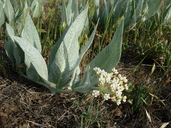
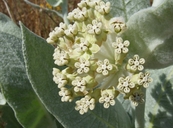
NATIVE Habit: Perennial herb, generally dense-hairy, +- glabrous in age or not. Stem: ascending. Leaf: opposite; petiole generally short; blade elliptic, lanceolate, or ovate. Inflorescence: terminal and at upper nodes; peduncle +- 0. Flower: corolla reflexed, cream to purple; hoods +- elevated above corolla base, at +- same level as anther head, yellow-white, occasionally with vertical brown stripe; horns exserted, at +- same level as hoods. Fruit: erect on +- reflexed pedicels. Seed: +- 10 mm (largest in California). Ecology: Dry plains, brushy flats, hillsides, desert canyons; Elevation: 50--1350 m. Bioregional Distribution: GV, CW, TR, DMoj. Flowering Time: Apr--Jul Synonyms: Asclepias vestita subsp. parishii (Jeps.) Woodson; Asclepias vestita subsp. vestita; Asclepias vestita var. parishii Jeps.; Asclepias vestita var. vestita Unabridged Note: For our pls, Asclepias vestita var. vestita (corolla cream; dry plains, low hills; GV, CW) and Asclepias vestita var. parishii Jeps. (corolla purple; brushy flats, hillsides, desert canyons; CW, TR, DMoj) have been recognized elsewhere, but there is considerable intergradation morphologically, which even Woodson (p. 149), in elevating the varieties to subspecies, allowed could be environmental rather than genetic, so that infraspecific taxa in this sp. are not recognized here. Jepson eFlora Author: Thomas J. Rosatti & Carol A. Hoffman Index of California Plant Names (ICPN; linked via the Jepson Online Interchange) Previous taxon: Asclepias subulata Next taxon: Catharanthus
Citation for this treatment: Thomas J. Rosatti & Carol A. Hoffman 2013, Asclepias vestita, in Jepson Flora Project (eds.) Jepson eFlora, Revision 1, https://ucjeps.berkeley.edu/eflora/eflora_display.php?tid=14441, accessed on April 24, 2024.
Citation for the whole project: Jepson Flora Project (eds.) 2024, Jepson eFlora, https://ucjeps.berkeley.edu/eflora/, accessed on April 24, 2024.
MAP CONTROLS 1. You can change the display of the base map layer control box in the upper right-hand corner.
2. County and Jepson Region polygons can be turned off and on using the check boxes.
(Note: any qualifiers in the taxon distribution description, such as 'northern', 'southern', 'adjacent' etc., are not reflected in the map above, and in some cases indication of a taxon in a subdivision is based on a single collection or author-verified occurence).
Data provided by the participants of the
Consortium of California Herbaria.
MAP LEGEND View all CCH records All markers link to CCH specimen records. The original determination is shown in the popup window.
Blue markers indicate specimens that map to one of the expected Jepson geographic subdivisions (see left map). Purple markers indicate specimens collected from a garden, greenhouse, or other non-wild location.
Yellow markers indicate records that may provide evidence for eFlora range revision or may have georeferencing or identification issues.
READ ABOUT YELLOW FLAGS
CCH collections by month
Duplicates counted once; synonyms included.
Species do not include records of infraspecific taxa, if there are more than 1 infraspecific taxon in CA.
Blue line denotes eFlora flowering time (fruiting time in some monocot genera).