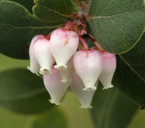
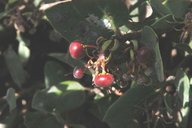
Common Name: HEATH FAMILY Habit: Perennial herb, shrub, tree. Stem: bark often peeling distinctively. Leaf: simple or 0, generally cauline, alternate, opposite (whorled), evergreen or deciduous, often leathery, petioled or not; stipules 0. Inflorescence: raceme, panicle, cyme, or flowers 1, terminal or axillary, generally bracted; pedicel often with 2 bractlets. Flower: generally bisexual, generally radial, bell-shaped, cylindric, or urn-shaped; sepals generally (0)4--5, generally free; petals generally (0)4--5, free or fused; stamens (2--5)8--10, free, filaments rarely appendaged, anthers dehiscing by pores or slits, awns 0 or 2(4), seemingly abaxial, reduced or elongate, generally curved; nectary generally present at ovary base, generally disk-like; ovary superior or inferior, chambers generally 1--5, placentas axile or parietal, ovules 1--many per chamber, style 1, stigma head- to funnel-like or lobed. Fruit: capsule, drupe, berry. Seed: generally many, winged or not. Genera In Family: +- 100 genera, 3000 species: generally worldwide except deserts; some cultivated, especially Arbutus, Arctostaphylos, Rhododendron, Vaccinium. Note: Monophyletic only if Empetraceae included, as treated here. Ledum included in Rhododendron. Non-green plants obtain nutrition from green plants through fungal intermediates. eFlora Treatment Author: Gary D. Wallace, except as noted Scientific Editor: Gary D. Wallace, Thomas J. Rosatti, Bruce G. Baldwin.
Common Name: MANZANITA Habit: Shrub to small tree, prostrate to erect. Stem: old stems generally +- red, smooth, bark generally thin, peeling, or generally +- gray or red-gray, shredding and rough; burls at base, woody, sprouting after fire, or generally 0; twig hairs 0 or generally +- like those on inflorescence axes, bracts. Leaf: alternate, evergreen; blade flat to convex, base lobed to wedge-shaped, clasping stem or not, margins generally flat, surfaces with stomata generally both abaxially, adaxially, alike in color, hairiness, less often only or fewer abaxially, generally differing in color, hairiness. Inflorescence: +- raceme (generally 0--1-branched) or panicle (generally 2--10-branched), terminal, nascent inflorescence present following stem growth, generally late spring through winter, remaining dormant 4--6 months prior to flower (except in Arctostaphylos pringlei subsp. drupacea); branches 0 or raceme-like; flower bracts leaf-like, generally flat, or scale-like, often folded, keeled, tips rounded to acute to awl-shaped. Flower: radial; sepals 5(4), free, persistent; corolla conic to urn-shaped, lobes in number = sepals, short, rounded, curved back, white to pink; stamens 2 × number of sepals, included, filaments swollen, generally hairy at base, anthers dark red, awns elongate; ovary superior, on disk, 2--10-chambered, ovule 1 per chamber. Fruit: drupe, generally +- depressed-spheric to spheric; flesh generally thick, +- mealy, occasionally 0; stones 2--10, free, fused, or some fused. Etymology: (Greek: bear berries) Note: Rosatti (1986 Syst Bot 12:61--77) showed that in Arctostaphylos uva-ursi little to none of the variation in hairs (including length, glandularity) is genetically based; Crowe & Parker (2023 Ecol Evol 13(3): e9801) detail variation in stone fusion. eFlora Treatment Author: V. Thomas Parker, Michael C. Vasey & Jon E. Keeley Reference: Keeley 1997 Madroño 44:109--111; Parker et al. 2007 Madroño 54:148--155
Arctostaphylos morroensis Wiesl. & B. Schreib.
NATIVE Habit: Erect, 1--4 m. Stem: old stems gray, bark shredding; twig (and nascent inflorescence axis) short- and long-white-nonglandular-hairy. Leaf: overlapped; petiole 2--5 mm; blade 1.5--3 cm, 1--2 cm wide, oblong-ovate to -elliptic, dark green, shiny, abaxially gray-tomentose, adaxially glabrous, base +- truncate to +- cordate, tip abruptly soft-pointed, margin entire, cupped; stomata abaxial. Inflorescence: panicle, 2--5-branched; nascent inflorescence pendent, bell-shaped, axis 0.5--0.8 cm, > 1 mm wide; bracts 5--8 mm, leaf-like, lance-linear, acuminate, puberulent; pedicel 4--6 mm, glabrous or nonglandular-hairy. Flower: ovary densely (fruit sparsely) white-nonglandular-hairy. Fruit: 7--10 mm wide, depressed-spheric; stones variably fused or free. Chromosomes: 2n=26. Ecology: Stabilized sand dunes, sandstones, chaparral; Elevation: < 200 m. Bioregional Distribution: s CCo (s Morro Bay, San Luis Obispo Co.). Flowering Time: Jan--Mar Jepson eFlora Author: V. Thomas Parker, Michael C. Vasey & Jon E. Keeley Reference: Keeley 1997 Madroño 44:109--111; Parker et al. 2007 Madroño 54:148--155 Index of California Plant Names (ICPN; linked via the Jepson Online Interchange) Listed on CNPS Rare Plant Inventory Previous taxon: Arctostaphylos montereyensis Next taxon: Arctostaphylos myrtifolia
Botanical illustration including Arctostaphylos morroensis
Citation for this treatment: V. Thomas Parker, Michael C. Vasey & Jon E. Keeley 2023, Arctostaphylos morroensis, in Jepson Flora Project (eds.) Jepson eFlora, Revision 12, https://ucjeps.berkeley.edu/eflora/eflora_display.php?tid=13951, accessed on April 25, 2024.
Citation for the whole project: Jepson Flora Project (eds.) 2024, Jepson eFlora, https://ucjeps.berkeley.edu/eflora/, accessed on April 25, 2024.
MAP CONTROLS 1. You can change the display of the base map layer control box in the upper right-hand corner.
2. County and Jepson Region polygons can be turned off and on using the check boxes.
(Note: any qualifiers in the taxon distribution description, such as 'northern', 'southern', 'adjacent' etc., are not reflected in the map above, and in some cases indication of a taxon in a subdivision is based on a single collection or author-verified occurence).
Data provided by the participants of the
Consortium of California Herbaria.
MAP LEGEND View all CCH records All markers link to CCH specimen records. The original determination is shown in the popup window.
Blue markers indicate specimens that map to one of the expected Jepson geographic subdivisions (see left map). Purple markers indicate specimens collected from a garden, greenhouse, or other non-wild location.
Yellow markers indicate records that may provide evidence for eFlora range revision or may have georeferencing or identification issues.
READ ABOUT YELLOW FLAGS
CCH collections by month
Duplicates counted once; synonyms included.
Species do not include records of infraspecific taxa, if there are more than 1 infraspecific taxon in CA.
Blue line denotes eFlora flowering time (fruiting time in some monocot genera).