Common Name: PRIMROSE FAMILY Habit: Annual, perennial herb, or subshrub, glabrous to glandular-hairy. Leaf: simple, +- basal, petioled or not; stipules 0. Inflorescence: scapose umbel, subtended by involucre. Flower: bisexual, radial; parts in 4s or 5s (6s); calyx deeply lobed, often persistent; corolla lobes erect or spreading to reflexed; stamens epipetalous, opposite corolla lobes; ovary superior, 1-chambered, placenta free-central, style 1, stigma head- or dot-like. Fruit: capsule, 2--7-valved or circumscissile. Seed: small, few to many. Genera In Family: +- 8 genera, 600 species: northern hemisphere; several ornamental (Primula). Note: Based on molecular evidence, non-rosette terrestrial members of Primulaceae as treated in TJM (1993) moved to Myrsinaceae, and Samolus to Theophrastaceae; based on the same evidence, Primulaceae has been treated alternatively to include all of Myrsinaceae and Theophrastaceae. Taxa of Dodecatheon in TJM2 treated here in Primula. Unabridged Note: Recent molecular work has led to new understanding of relationships in Ericales. As treated here, non-rosette, terrestrial members of Primulaceae s.l. have been removed from that family and inserted in Myrsinaceae. Myrsinaceae, then, is characterized by synapomorphies of dark dots or streaks on stems, leaves, or flowers, short corolla tubes, seeds immersed in the placenta, and -- for woody members -- wood lacking rays or with only multiseriate rays. Primulaceae, Myrsinaceae, Theophrastaceae, and Maesaceae (a recent segregate of tropical trees), now constitute a closely related, monophyletic clade. A more recently proposed, alternative taxonomy treats all members of that large clade within an expanded Primulaceae. eFlora Treatment Author: Anita F. Cholewa, except as noted Scientific Editor: Bruce G. Baldwin, David J. Keil, Thomas J. Rosatti.
Habit: Annual, perennial herb, generally < 12 cm. Inflorescence: umbel subtended by involucre. Flower: parts in 5s; calyx tube scarious, lobes acute; corolla salverform, tube narrowed at top, lobe tips obcordate or notched; filaments +- 0 or short, anthers free, oblong, included; ovary superior, spheric, style short. Fruit: 5-valved, spheric. Etymology: (Greek: uncertain sea-pl) eFlora Treatment Author: Anita F. Cholewa Reference: Schneeweiss et al. 2004 Syst Biol 53:856--876 Unabridged Reference: Robbins 1944 Amer Midl Naturalist 32:137--163; Schneeweiss et al. 2004 Syst Biol 53(6):856--876
Androsace septentrionalis L.
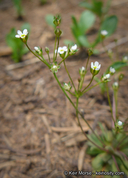
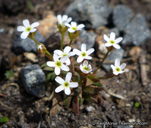
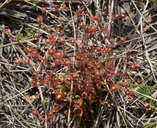
NATIVE Habit: Annual, weak perennial herb, 1--6 cm, hairy. Leaf: 5--20 mm, lance-linear, tapered to petiole, entire to finely dentate. Inflorescence: peduncles (1)several; involucre bracts 1.7--3 mm, generally < 0.5 mm wide, lance-linear to lanceolate; pedicel 0.5--5 cm. Flower: calyx (2.5)3--4 mm, glabrous or puberulent at base, tube > lobes, scarious between ridges, lobes widely lanceolate to triangular, generally +- red, tips acute to obtuse; corolla >= calyx, white. Ecology: Dry, rocky sites; Elevation: 2700--3600 m. Bioregional Distribution: c&s SNH, SnBr, SNE; Distribution Outside California: to British Columbia, Rocky Mountains. Flowering Time: Jul--Aug Synonyms: Androsace septentrionalis subsp. puberulenta (Rydb.) G.T. Robbins; Androsace septentrionalis subsp. subumbellata (A. Nelson) G.T. Robbins Jepson eFlora Author: Anita F. Cholewa Reference: Schneeweiss et al. 2004 Syst Biol 53:856--876 Index of California Plant Names (ICPN; linked via the Jepson Online Interchange) Previous taxon: Androsace occidentalis Next taxon: Primula
Botanical illustration including Androsace septentrionalis
Citation for this treatment: Anita F. Cholewa 2012, Androsace septentrionalis, in Jepson Flora Project (eds.) Jepson eFlora, https://ucjeps.berkeley.edu/eflora/eflora_display.php?tid=13325, accessed on April 24, 2024.
Citation for the whole project: Jepson Flora Project (eds.) 2024, Jepson eFlora, https://ucjeps.berkeley.edu/eflora/, accessed on April 24, 2024.
MAP CONTROLS 1. You can change the display of the base map layer control box in the upper right-hand corner.
2. County and Jepson Region polygons can be turned off and on using the check boxes.
(Note: any qualifiers in the taxon distribution description, such as 'northern', 'southern', 'adjacent' etc., are not reflected in the map above, and in some cases indication of a taxon in a subdivision is based on a single collection or author-verified occurence).
Data provided by the participants of the
Consortium of California Herbaria.
MAP LEGEND View all CCH records All markers link to CCH specimen records. The original determination is shown in the popup window.
Blue markers indicate specimens that map to one of the expected Jepson geographic subdivisions (see left map). Purple markers indicate specimens collected from a garden, greenhouse, or other non-wild location.
Yellow markers indicate records that may provide evidence for eFlora range revision or may have georeferencing or identification issues.
READ ABOUT YELLOW FLAGS
CCH collections by month
Duplicates counted once; synonyms included.
Species do not include records of infraspecific taxa, if there are more than 1 infraspecific taxon in CA.
Blue line denotes eFlora flowering time (fruiting time in some monocot genera).