Common Name: GRASS FAMILY Habit: Annual to woody perennial herb; roots generally fibrous. Stem: generally round, hollow; nodes swollen, solid. Leaf: alternate, 2-ranked, generally linear, parallel-veined; sheath generally open; ligule membranous or hairy, at blade base. Inflorescence: various (of generally many spikelets). Spikelet: glumes generally 2; florets (lemma, palea, flower) 1--many; lemma generally membranous, sometimes glume-like; palea generally +- transparent, +- enclosed by lemma. Flower: generally bisexual, minute; perianth vestigial; stamens generally 3; stigmas generally 2, generally plumose. Fruit: grain, sometimes achene- or utricle-like. Genera In Family: 650--900 genera; +- 10550 species: worldwide; greatest economic importance of any family (wheat, rice, maize, millet, sorghum, sugar cane, forage crops, ornamental, weeds; thatching, weaving, building materials). Note: Generally wind-pollinated. Achnatherum, Ampelodesmos, Hesperostipa, Nassella, Piptatherum, Piptochaetium, Ptilagrostis moved to Stipa; Elytrigia, Leymus, Pascopyrum, Pseudoroegneria, Taeniatherum to Elymus; Hierochloe to Anthoxanthum; Lolium, Vulpia to Festuca; Lycurus to Muhlenbergia; Monanthochloe to Distichlis; Pleuraphis to Hilaria; Rhynchelytrum to Melinis. The following taxa (in genera not included here), recorded in California from historical collections or reported in literature, are extirpated, lacking vouchers, or not considered naturalized: Acrachne racemosa (Roth) Ohwi, Allolepis texana (Vasey) Soderstr. & H.F. Decker, Amphibromus nervosus (Hook. f.) Baill., Axonopus affinis Chase, Axonopus fissifolius (Raddi) Kuhlm., Coix lacryma-jobi L., Cutandia memphitica (Spreng.) K. Richt., Dinebra retroflexa (Vahl) Panz., Eremochloa ciliaris (L.) Merr., Eustachys distichophylla (Lag.) Nees, Gaudinia fragilis (L.) P. Beauv., Miscanthus sinensis Andersson, Neyraudia arundinacea (L.) Henrard, Phyllostachys aurea Rivière & C. Rivière, Phyllostachys bambusoides Siebold & Zuccarini, Rottboellia cochinchinensis (Lour.) Clayton, Schedonnardus paniculatus (Nutt.) Branner & Coville, Schizachyrium cirratum (Hack.) Wooton & Standl., Schizachyrium scoparium (Michx.) Nash, Themeda quadrivalvis (L.) Kuntze, Thysanolaena latifolia (Hornem.) Honda, Tribolium obliterum (Hemsl.) Renvoize, Zea mays L., Zizania palustris L. var. interior (Fassett) Dore, Zoysia japonica Steud. Paspalum pubiflorum E. Fourn., Paspalum quadrifarium Lam., are now reported for southern California (J Bot Res Inst Texas 4:761--770). See Glossary p. 30 for illustrations of general family characteristics. eFlora Treatment Author: James P. Smith, Jr., except as noted Scientific Editor: James P. Smith, Jr., J. Travis Columbus, Dieter H. Wilken.
Common Name: BENT GRASS Habit: Annual or perennial herb, generally tufted, occasionally from rhizomes or stolons. Stem: generally erect. Leaf: sheath generally smooth, glabrous; ligule membranous; blade flat to rolled. Inflorescence: panicle-like, densely cylindric to openly ovate. Spikelet: glumes generally subequal, back generally glabrous, vein generally finely scabrous, 1-veined, generally acute; floret 1, < glumes, generally breaking above glumes; callus glabrous to densely hairy; lemma generally 5-veined, veins not converging, occasionally extended as short teeth, awned from back or not; palea generally 0 or << lemma, translucent; anthers generally 3. Etymology: (Greek: pasture) Note: Some cultivated in pastures, lawns. Agropogon lutosus (Poir.) P. Fourn. is a sterile hybrid between Agrostis stolonifera and Polypogon monspeliensis. Agrostis viridis is treated as Polypogon viridis. Agrostis nebulosa Boiss. & Reut. is reported for California (FNANM 24: 661), but no specimens have been located. Generic delimitation adopted here reflects editorial preference. Agrostis lacuna-vernalis newly described, added as native. eFlora Treatment Author: Paul M. Peterson & Michael J. Harvey Reference: Peterson et al. 2011 J Bot Res Inst Texas 5:421--426 Unabridged Reference: Carlbom 1967 Ph.D. Dissertation Oregon State Univ; Harvey 2007 FNANM 24:633--662; 693--697
Agrostis microphylla Steud.
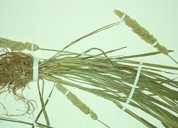
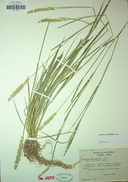
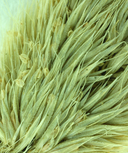
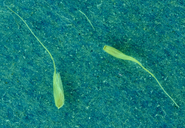
NATIVE Habit: Annual 8--45 cm. Leaf: ligule 1.5--4 mm; proximal blades 3--15 cm, 0.7--2.5 mm wide, fine-scabrous, flat, becoming inrolled. Inflorescence: 2--12 cm, +- cylindric, dense; 1° branches ascending to +- appressed, proximal 0.3--1.5 cm. Spikelet: glumes 2.5--5 mm, tips narrowly acuminate to awn-like; callus hairs < 0.5 mm; lemma 1.5--2 mm, awned from middle, awn 3.5--8 mm, slightly bent; palea 0; anther +- 0.5 mm. Ecology: Thin, rocky soils, cliffs, vernal pools, occasionally on serpentine; Elevation: < 200 m. Bioregional Distribution: NCo, s NCoR, GV, CCo, SCoRO, SCo; Distribution Outside California: to British Columbia, Baja California. Flowering Time: May--Jul Synonyms: Agrostis aristiglumis Swallen; Agrostis microphylla var. intermedia Beetle Jepson eFlora Author: Paul M. Peterson & Michael J. Harvey Reference: Peterson et al. 2011 J Bot Res Inst Texas 5:421--426 Index of California Plant Names (ICPN; linked via the Jepson Online Interchange) Previous taxon: Agrostis lacuna-vernalis Next taxon: Agrostis oregonensis
Botanical illustration including Agrostis microphylla
Citation for this treatment: Paul M. Peterson & Michael J. Harvey 2014, Agrostis microphylla, in Jepson Flora Project (eds.) Jepson eFlora, Revision 2, https://ucjeps.berkeley.edu/eflora/eflora_display.php?tid=12307, accessed on April 25, 2024.
Citation for the whole project: Jepson Flora Project (eds.) 2024, Jepson eFlora, https://ucjeps.berkeley.edu/eflora/, accessed on April 25, 2024.
Geographic subdivisions for Agrostis microphylla:
NCo, s NCoR, GV, CCo, SCoRO, SCo
MAP CONTROLS 1. You can change the display of the base map layer control box in the upper right-hand corner.
2. County and Jepson Region polygons can be turned off and on using the check boxes.
(Note: any qualifiers in the taxon distribution description, such as 'northern', 'southern', 'adjacent' etc., are not reflected in the map above, and in some cases indication of a taxon in a subdivision is based on a single collection or author-verified occurence).
Data provided by the participants of the
Consortium of California Herbaria.
MAP LEGEND View all CCH records All markers link to CCH specimen records. The original determination is shown in the popup window.
Blue markers indicate specimens that map to one of the expected Jepson geographic subdivisions (see left map). Purple markers indicate specimens collected from a garden, greenhouse, or other non-wild location.
Yellow markers indicate records that may provide evidence for eFlora range revision or may have georeferencing or identification issues.
READ ABOUT YELLOW FLAGS
CCH collections by month
Duplicates counted once; synonyms included.
Species do not include records of infraspecific taxa, if there are more than 1 infraspecific taxon in CA.
Blue line denotes eFlora flowering time (fruiting time in some monocot genera).